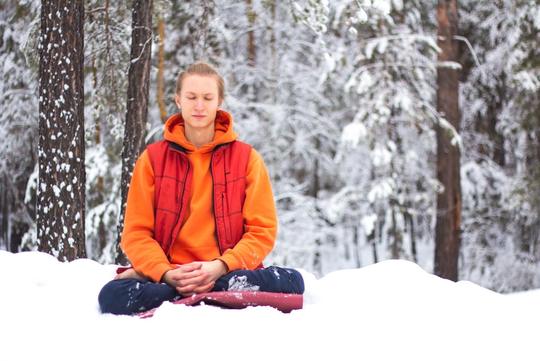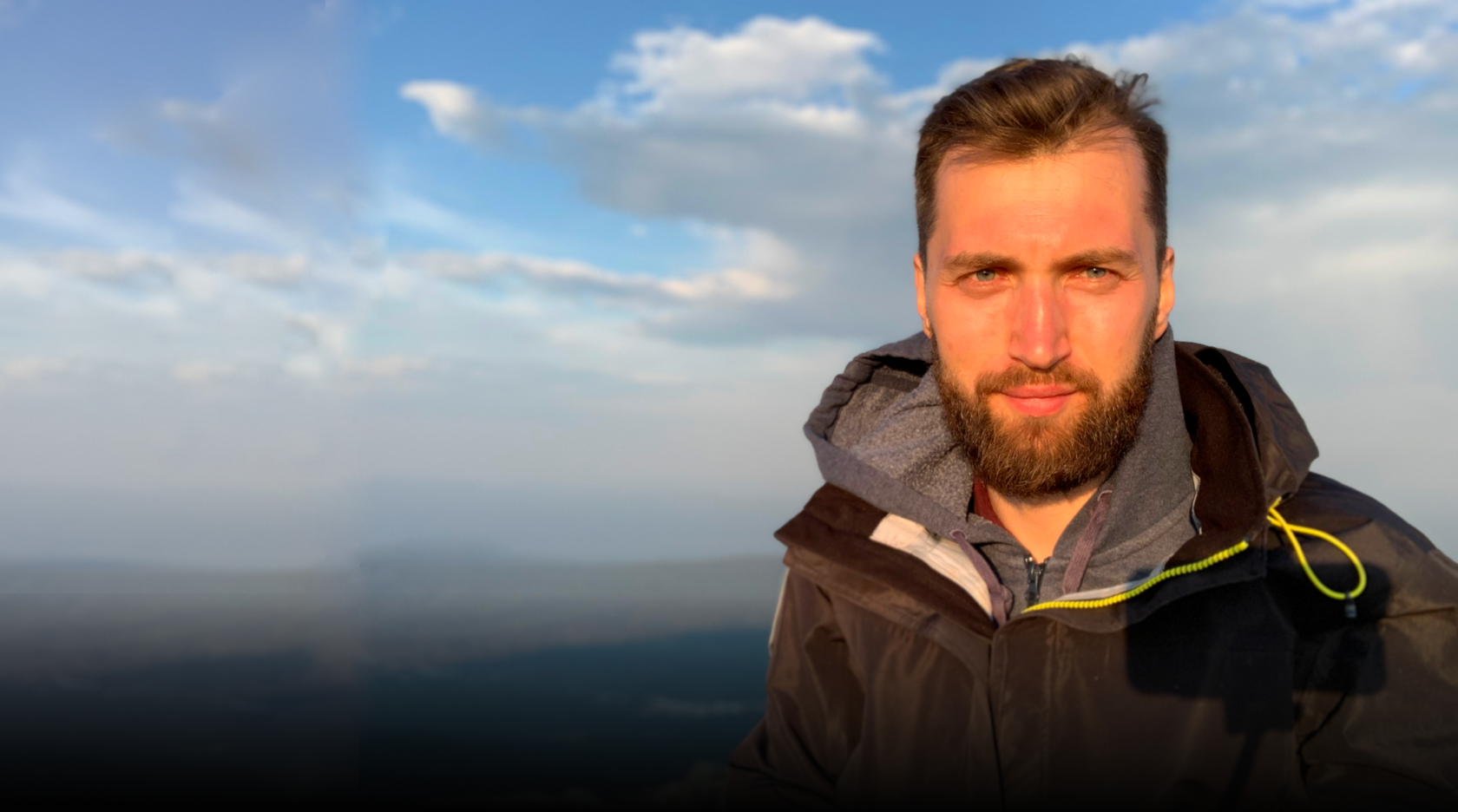
A conversation with the Urokimeditatsii representative in the Bakhchisaray district of Crimea: how a lawyer came to meditation, why group meditations matter, the move to Crimea, the "Seeds" eco-camp and vegetarian meals for people in need.
"I realized that when I'm old and my children ask me, 'Dad, what did you achieve, what did you create, how did you help people?' — I'll have nothing to answer. That key thought gave me a kind of push, and a need for a spiritual search appeared."
Today we are talking with Denis Petrov, the representative of the Urokimeditatsii (Meditation Lessons) project in the Bakhchisaray district of Crimea.
We'll discuss why it's worth going to group meditations and why, out of all the Indian teachers, he chose the Russian Dada Sadananda. Denis will share why he quit a stable job and moved to Crimea to build an eco-camp from scratch.
- Advice for new representatives
- How to get into the mood for practice
- Whether to trust the Universe
- What brings true happiness
- How yoga and meditation change your life
— Tell us, why did you decide to start meditating?
— I'm a lawyer by training, and I worked in that field for 15 years. I had my own firm, where every day, even on weekends, I solved other people's problems. One day there was a turning point: I realized that work was taking all my attention. I had no hobby, I wasn't growing, I often neglected my family.
— All my interest was in things that didn't bring me happiness. A new car or some buzz at work — great, a little endorphin gets released, but on the whole nothing changed.
— What did you do?
— My wife and I decided to go to India. It was a great opportunity to get some distance from work and to find enlightened people 🙂
— I slowly began to immerse myself in yoga — I'd talk with someone, go to a concert, sing some A sound or set of sounds that, repeated with its meaning in mind, carries the mind toward the Infinite., do the "Surya Namaskar," or "Sun Salutation," sequence with my wife. In other words, I found a kind of little scene in India.
— How did you find out about Urokimeditatsii?
— By chance. I was walking past my wife's laptop and saw some guy in orange. She told me about Dada Sadananda, a monk from Barnaul, and suggested I watch his course "The Biopsychology of Yoga." At that moment it struck me: here we are in India, at the epicenter of enlightened people, and she's recommending a Russian from Siberia to me.
— And you didn't watch it, did you?
— Right, denial and incomprehension rose up in me. I thought: what could he know about yoga, and what could he teach? For me back then, meditation and Barnaul were incompatible ideas.
— I began practicing a guided meditation from an Indian teacher, but when I returned to Russia, I realized I was missing philosophy. I began to dig in and look for information in different sources, but nowhere did I find a complete picture. One day in my YouTube feed I saw the Urokimeditatsii channel, decided to give it a second chance, and watched a few videos. The ideas Dada was discussing resonated with me.
— I learned the basic technique and began meditating twice a day.
— What attracted you most of all?
— That Dada's project is non-commercial. At that time my wife was taking a yoga course that cost 150,000 for two weeks. And I thought: if the organizers have achieved something in meditation, why are they making money on it instead of giving the knowledge away for free, or at least for a donation of your choice? It turns out that if you have no money, you don't get to grow.
In Urokimeditatsii I saw a completely different system — deep, extensive knowledge, and yet Dada doesn't push anything on you and doesn't promise any enlightenment.
— Our subscribers complain that it's hard for them to practice twice a day. How did you manage to keep to that routine?
— I set myself a challenge. If there's a goal, interest will come. I didn't experience any special effects in meditation, but I calmed my mind and my nervous system.
— During the day I was filled with thoughts about clients, employees, everyday matters. When I came home, I realized that mentally I had stayed at the office and was still solving problems.
— What helped you at such moments? How did you get yourself into the mood for practice?
— Singing a name of the Supreme together, often with a simple dance; in Ananda Marga the words are Bábá Nám Kevalam., or singing a mantra. I've always loved to sing. I'm from a small town in the Urals, and as a teenager I often got together with friends and sang songs to the guitar.
— Kiirtan resonated with me. It took my mind off the bustle and calmed me.
— For half a year I meditated with the basic technique, then I began attending group meditations and took special courses to become the project's representative in Perm.
— Why did you become a representative?
— My goal is to change the world. But how can I do that, when I'm small and the world is so huge? I decided to change people so that they would transform the world. And the more of them choose the path of yoga, the stronger the changes will be.
But I couldn't just say, "Go change, meditate, and you'll feel great." To inspire others, I first have to change myself. To practice, to be inspired by the idea, and at the same time to change others.
— First of all, I'm not a representative but a beneficiary. I prepare for a group meditation and level up myself — I watch and read Dada's lectures, notice the small details and refresh the philosophical ideas in my memory. When I go over the basic technique again, I find something new.
— So it's a double benefit: I help people change and grow, and I learn and level up myself. And that inspires me.
— Tell us, why are group meditations and local branches needed?
— I've noticed that people more often come to group meditations not to practice but to be in inspiring company and to talk with spiritually minded people. They want to get what they can't get at home — support from like-minded people and answers to their questions.
— Even if you don't feel a spiritual flow, come just to talk.
— You were the head of a company and the leader of a growing branch. How did the idea of moving to Crimea come about?
— I didn't want to do law anymore, because for me it had stopped being a righteous business 🙂. A good lawyer lies or holds things back to please clients, and at some point I felt an inner resistance to it.
— My wife and I liked living in nature and spending time with creative, interesting people who are growing. That's how the idea of opening a retreat base came about, but Perm is cold, so we chose Crimea. With its energy and its nature, it reminded us of India.
— Did you move "with a light heart"?
— No, with anxiety because of the uncertainty. I had always kept everything under control. I had a business and a stable income, and if anything happened, I could sort it all out.
When you have to start over, only the Supreme Consciousness knows how it will turn out. And it's at such moments that your trust in It is tested.
— While preparing for this interview, I learned that you not only opened the Urokimeditatsii branch in the Bakhchisaray district but also help other branches in Crimea.
— As soon as my wife and I moved to the Belbek Valley, we decided to hold group meditations. For me it's already an inseparable part of life.
— But first we went to Simferopol to see how things were going for the folks there. At that time 2–3 people were coming to them. And I started helping them — I ran their social media, made regular posts and not just weekly announcements of group meditations, held a yoga day.
— The next branch was Sevastopol; I gave them a bit of a boost.
— I took on Yalta and at the same time held group meditations in the Belbek Valley.
— Impressive. Share some advice with new representatives: how do you achieve results like that?
— Develop yourself. When I was just starting, I tried to spread information about group meditations as widely as possible, but got no response. But when I had leveled up and had energy I could share, people began coming on their own.
— That doesn't mean you should abandon social media or not use other tools to attract people, but the main thing is to invest in yourself so that you stay interesting.
— At the beginning of this year your team designed a project and is preparing to build the eco-camp "Semena" ("Seeds") in the Belbek Valley. You mentioned that you like sharing knowledge for free. Do you plan to continue that in the eco-camp?
— Yes. Yoga and meditation changed me, and I clearly realized that I want not to take but to give. To create a place where everyone can touch a "different" life.
— We plan to hold a large number of free events — group meditations, retreats, festivals, A yoga posture held steadily and comfortably; it balances the glands and quiets body and mind for meditation. classes. All the teaching practices will be by donation of your choice.
— The aim of the project is for spiritual seekers to get to know the practices of Urokimeditatsii and, when they return home, to continue in the local branches or on their own.
We want to plant a seed that may not sprout right away, but will certainly sprout.
To show that you can eat tasty and healthy food without harmful products. To show yogis and vegetarians as interesting people, not boring ones who only "eat grass" and meditate.
To reveal that spiritual life is not only practices and a set of rules, but also workshops that help you grow, sentient films and music.
— Do you interact with practitioners of other yoga traditions?
— In the Belbek Valley there are Buddhists, Vaishnavas, lovers of Hatha, Vinyasa and Ashtanga yoga, and we talk with one another at the group meditations. We discuss our points of view on philosophical and everyday questions — real conversations, not lectures from me. We interact and respect one another's interests.
— You organize group meditations in your town, you help the neighboring branches, and in May you became a curator of online groups that go through the courses of the educational platform "Universe of Self-Development" together. How do you manage it all without burning out?
— Planning helps me. Every day of mine is scheduled several months in advance. I used to be skewed toward work; now I approach my daily routine more consciously and set aside special time for spiritual practices and rest. But burnout is still inevitable. I get tired, give myself time, recover and start again. And this cycle repeats from time to time.
— I also know that you organized vegetarian meals for the homeless in Perm. Tell us, how did that idea come to you?
— I've always had a need to serve and help people.
— When I became a representative, I began to think about how to organize a service project. I started volunteering, feeding the homeless at a church. And once a man in need came up to me and asked what we were handing out. That day it was fish soup, and he refused, saying, "I don't eat anything that was alive." And something clicked inside me: a person who perhaps hadn't eaten anything yet was trying not to harm others.
— Is that why you decided to become a vegetarian?
— No, and not even at Dada Sadananda's suggestion (although he has a video on the topic), but for health reasons. I was listening to an audiobook about farms and learned that animals are given hormones and antibiotics so that they don't get sick. I had chronic problems with my immune system; I connected these two facts and switched to seafood, and when I went deeper into yogic philosophy, I gave up eggs, onions and garlic.
— Did you have any conflicts with your loved ones over vegetarianism?
— Nothing serious. When I started eating this way, I lost 20 kilograms, and it showed in how I looked. My mom noticed, worried, and asked me to start eating meat again, but without lecturing. She is always accepting of my decisions and trusts me.
— My wife, though, was at a bit of a loss — what to cook and from what. For a couple of weeks she cooked separately for herself, but soon she got tired of it and became a vegetarian too.
— Let's go back to feeding people in need. How did the branch take your idea?
— Nobody supported me 🙂 I had to do it myself: I went to the market, bought kitchen utensils and offered it to the group again. A participant with an empty apartment responded, and a young woman who helps as a kitchen volunteer at the Urokimeditatsii retreats. We chose a district of Perm and began handing out vegetarian food.
— Mostly I put in my own money. Of course, there were some fundraisers and donations, but there was never enough money. I began looking for opportunities and found out about the "Green Island" Charitable Foundation.
Their mission caught me: "To fill the world with love through caring for those close to us, to give everyone the opportunity to make a contribution to the development of society according to their means, and to make charity accessible and attractive."
— I contacted them, and we opened their branch in Perm. They helped financially, and it was up to us to organize the meals or other social projects. Most importantly, they shared experience that I lacked.
— When I moved to Crimea, I had two tasks: to organize group meditations and to open a branch of "Green Island."
— What charity events have you already organized?
— We live in an area of private houses, and there's no one to feed here. So it's targeted help: we collected clean clothes and helped an elderly woman pay for an operation.
— And finally. What would you like to wish the subscribers of the Urokimeditatsii project?
— Don't be afraid to look inside yourself and to follow your true desires. Meditation will help your inner seed to sprout. It doesn't have to be a radical change of your whole life.
— To find some creative spark, or inspiration, or something that will change your state of mind and the atmosphere in your family.
Meditate to know yourself and awaken your true "I."