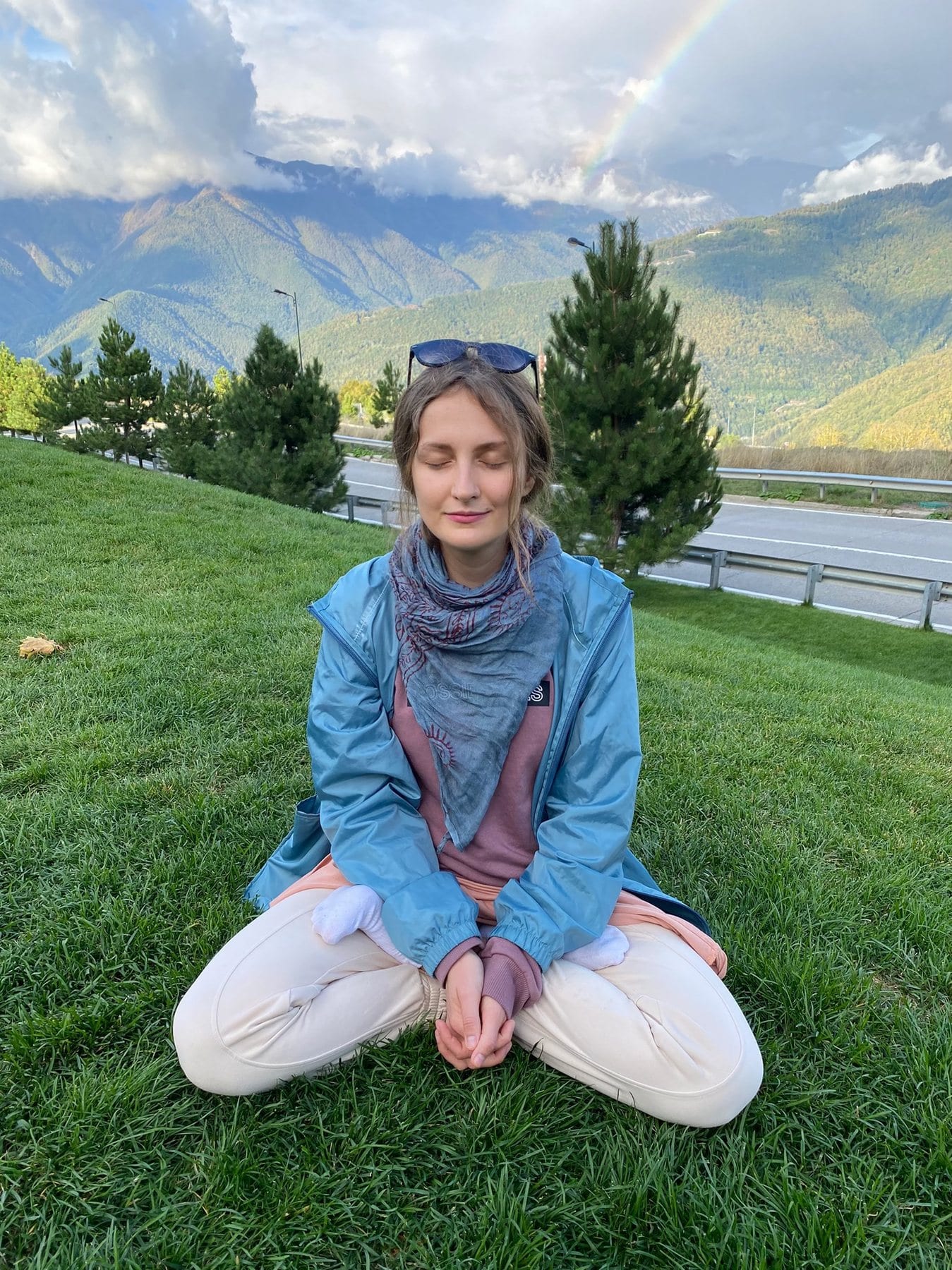
How to choose a meditation technique, how a complete classical meditation on the highest idea differs from 'meditations for money', and five tips to help a beginner make practice regular.
Meditation helps us become more effective in life, in business, in creative work, and in our personal, friendly and professional relationships. But is that the only reason to meditate? And how exactly should it be done? Is the practice something esoteric, intuitive, hazy? Or is it built on its own rules and laws?
If you are new to this, you probably have a lot of questions. In this article you will learn which meditation technique to choose, how to learn it on your own at home, how to back up your intention to practice with self-discipline, and much more.
What is meditation and why do we need it?
I really must start learning English. Tomorrow. Yes, definitely tomorrow. Go running in the mornings. Also starting tomorrow. Remember proper nutrition, breathing, a daily routine… And in general, change my lifestyle right away, make a checklist of the good habits that will be part of my new life! But then tomorrow comes, and after it the day after tomorrow… A week goes by, a month, and I still haven't started anything. A little lawyer wakes up inside, always ready to defend laziness and small weaknesses: "You simply don't have the time," "You're low on energy right now, English can wait, it's not going anywhere," "You're doing great even without running, and you deserve a TV series tonight."
And yet how much I want to be in a more productive state! Not to scatter myself over a million things at once and not to waste myself on trifles, but to build my life so that I feel fulfilled. If such thoughts are familiar to you, consider starting to meditate. It helps you turn into a more focused and successful version of yourself, and also become happier, more sensitive, more attentive to your own state and to the people around you.
It sounds a bit too promising, as if we were talking about a magic pill. Can that really be so?
Many successful people meditate regularly, and it helps them reach their goals. "When I meditate, answers come to me before I have even asked the question," the scientist Albert Einstein once said. And the Hollywood actor Keanu Reeves once admitted that meditation had made his life calmer and that now no problems frighten him. Richard Gere, Steven Seagal, Sting: these and other famous people often speak about the benefits of meditation. So do top managers in Silicon Valley.
In Russia, too, there are quite a few people who practice regularly: the head of Sber, Herman Gref; the founder of the online hotel booking service Ostrovok, Sergei Faguet; the musician and founder of the large Russian fitness school Sekta, Olga Markes; the TV host Irena Ponaroshku; the founder of the Doc+ service, Ruslan Zaydulin; and many others.
Developing emotional intelligence, creativity, empathy and intuition in order to move forward is, at today's pace of life, no longer just a wish but a necessity. On top of all that, meditation lowers stress levels and renews and restructures the mind.
We asked 1,000 people: what does meditation give you?
- 73% of people who started meditating respond more calmly to the circumstances of life,
- 27% stopped feeling lonely,
- 60% get more satisfaction and joy,
- 40% began to feel more confident,
- 56% cope with stress faster,
- 44% improved their mental concentration,
- 43% raised their energy levels,
- 36% found like-minded people,
- 21% became more productive at work.
But what is this practice, really? In the language of the dictionary, the term "meditation" (from the Latin meditatio) means reflecting on an idea or an object. Contrary to popular belief, meditation does not mean "thinking about nothing." Let's look at how it works.
The classical meditation technique: what is it and what are its advantages?
Sometimes we don't know where to look. There are so many different techniques… Which one should I choose? How can I tell which practice will suit me best? There are classical forms of meditation, yoga, relaxation, concentration on the breath and so on. And some practices are made up by someone practically on the fly. Meditation for money, for a house of your own, for a good husband, for a faithful wife, for a more attractive image of yourself… We have all heard something like that. Is it worth doing such practices?
There are several criteria for meditation.
The first is that it should be directed toward lofty ideas. Through practice we develop spiritually, we grow. Our state becomes calmer, our mind clearer, our breathing deeper, and we ourselves happier. We want to do something for others. But there are also meditations aimed solely at attracting money, increasing sexual appeal and the like. It is as if we tried to use the key that opens a great door leading to something important to open a small door into a storeroom. Meditations on mundane goals make the mind more enslaved to the objects of the external world. With such desires we are hardly going to become inwardly free, pure and self-sufficient. Practicing such techniques will lead us to additional suffering, not to spiritual evolution.
The second criterion. Among the abundance of meditation techniques, you need to choose the one that is the most complete. For example, if we concentrate on the breath, that cannot be called meditation. In essence it is withdrawal from the external world and relaxation, reaching a superficially relaxed state of mind. If we compare the practice to motor racing, say, it is important to choose a reliable, well-built car that will get us to the finish and not fall apart along the way. That is, we need a meditation that will lead a person to the highest stage of development.
We become a more realized and complete version of ourselves when every aspect of the personality is developed. Yes, a person may have a strong intellect, but if there is no wisdom or kindness, that is very one-sided development. You can be effective in life only by developing in every direction. That is why you should choose a complete path, not half-measures.
Meditation on a subtle idea, on the highest meaning of one's existence, helps open in the heart an inexhaustible source of benevolent energy that imperceptibly transforms life. We do not need separate meditations for prosperity, love, a car and everything else we think will make us satisfied and happy. The whole trick is that we meditate on one idea and receive everything we need for joy and happiness.
When you practice such meditation, the personality develops and new facets of the mind open up. We feel a change in our self-image and state: we begin to perceive the world more vividly and to feel something new; we become more refined, sensitive, cultured, kind and calm. As a result, our personality becomes more and more whole.
Five tips for those who practice meditation
And now some useful information for those who are just getting acquainted with the technique of meditation.
Not everyone is able to stay motivated to practice regularly. Many people learn about meditation, many start to practice, but doing it every day will not be easy for everyone. Why does this happen? And how can you make your motivation steady?
Five tips for beginners.
The first tip: regularity
It is more important than intensity. Meditation, when done twice a day, brings us into a special state of mind. Nothing may happen during the practice itself, but the effect will be felt later. If we have meditated in the morning, the whole day will be colored by that practice. We intuitively make better decisions. We have more positive emotions. We interact better with people, so there are fewer conflicts in life, our breathing is calm, and less energy is spent on negativity and fuss.
The evening meditation is important too. It is good to do it right after work. It is like washing your hands when you come home from outside: the effect is about the same. Meditation in the right technique in the evening clears the mind of the echoes of the day's hectic activity, sets you in a calm and peaceful mood, soothes you and prepares you for a full rest, so that you wake up in the morning charged and full of strength.
So if we give a little time to practice in the morning and evening, but regularly and steadily, we will develop. You simply need to make it a rule to meditate twice a day, with no compromises with yourself. We have started and dropped many things, but this time it really is worth trying to keep the promise you made to yourself. And to make it easier to settle into a good habit, you can tell yourself: I will practice for a set period. For example, two weeks. It often happens that after that it simply seems a pity to give it up.
So regularity is the most important thing. But there is something else.
The second tip: don't try to take on too much
Measure your abilities. Suppose we have been inspired by the technique we have chosen and decided to go full speed from the start. At once, decisively and irrevocably: long meditations, so as to get results sooner. But one needs to get used to the practice. You cannot walk into a gym and immediately lift the heaviest barbell. You cannot run a marathon without training; you will lose your breath. It is the same here: the muscles of the will have to be built up. To begin with, you can meditate for five minutes. A long meditation can provoke an inner resistance of the mind that you will have to overcome, while a short one is within everyone's reach. After a while you will feel that five minutes is not enough, that you want to prolong this state. Then a little more, and a little more… And so, gradually, you will find your optimal time. For an advanced practitioner, the minimum meditation time is 20 minutes. Regularly practicing for 30–40 minutes is already a powerful meditative flow, like even and deep breathing.
The third tip: you need to train your body
You can make an agreement with yourself: if you haven't meditated, you don't eat. Let food serve as positive reinforcement. I have meditated, then I go and have breakfast. An excellent agreement with your own mind! Food then becomes a reward; it becomes more desirable and eating it more enjoyable. Perception after practice is brighter, and we savor every bite. Yogis joke that eating without meditation is money thrown to the wind.
The fourth tip: settle on a meditation technique
It is better to practice a complete, full form. Urokimeditatsii (Meditation Lessons) has a free basic course that explains in detail what to do and how. Or you can watch the introductory video explaining the meditation technique. It is the right technique that matters most.
And the fifth tip: find like-minded people
Like-minded people who practice the same method of meditation as you. Once a week you can meet for collective practice. That will be excellent support. Besides, collective meditation is a source of additional spiritual energy: it creates a special atmosphere, brings you into a blissful state and gives you the strength to keep your intention. Your mind receives great support, and a new way of life takes shape.
These five tips will help you become established on the path of the meditation technique you have chosen and succeed in your practice.