A conversation with Anfisa Mavrina, head of the international department of Urokimeditatsii and a nutritionist: meeting Dada Sadananda, retreats and deep meditation, working with children, 16 years as a vegetarian, and why vegetarians should get regular blood tests.
We talked with Anfisa Mavrina, head of the international department of Urokimeditatsii (Meditation Lessons), a nutritionist and a speaker at marathons on vegetarian nutrition.
Anfisa told us whether she has found the meaning of life, why she became a vegetarian and what health problems this led to. She explained why feeling well does not mean the body is healthy, and recalled a few funny episodes involving Dada Sadananda.
We also discussed how to reach deep states in meditation, at what age one can begin to practice, and whether vegetarians need to have regular blood tests.
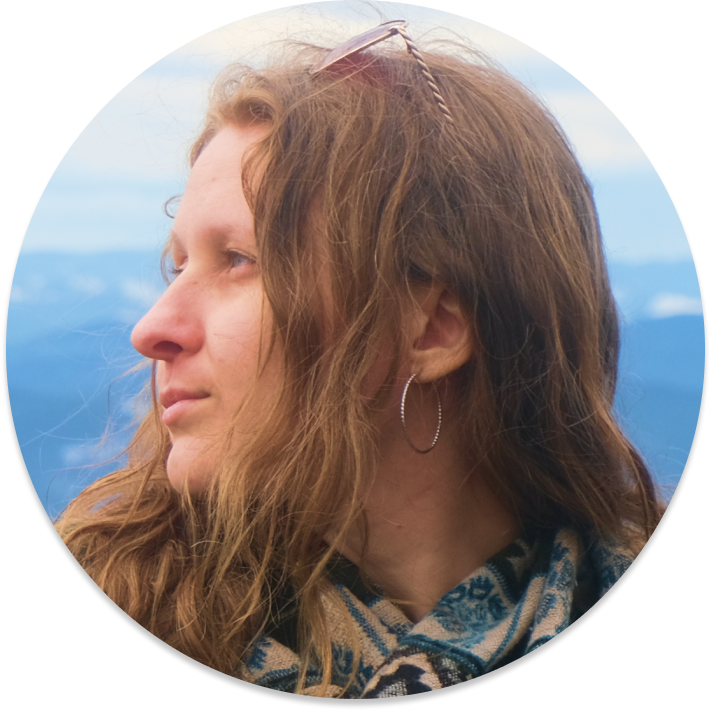
— You have known Dada Sadananda personally for 16 years now. Tell us how you met him.
I wasn't looking for any spirituality. I was just going to yoga classes, saw a notice that a monk was coming to town, and thought it would be fun to have a look at him. That was all my motivation.
— What impression did your first meeting leave on you?
It's not the prettiest story 🙂 because I came to the lecture hungover. I was 18, and I was looking for some meaning in life, including with the help of alcohol. I even missed the first day, because I had been partying with friends the night before.
I came late to the second lecture. I walk into the hall and they are singing "“Only the name of the Supreme Consciousness”, or “there is only Supreme Consciousness”: the mantra sung in kiirtan, open to anyone.," and what I hear is "Baba nam pei voda" ("Baba, drink some water") — apparently I was very thirsty after the night before. The first thought I had was: "Another sect has gathered, and their A sound or set of sounds that, repeated with its meaning in mind, carries the mind toward the Infinite. is weird too." I thought that I like singing, so I decided to sing a little and then go home.
— What made you stay?
Dada's charisma and his words. I always had a longing for something real, for some great meaning in life, for something that would truly resonate inside. And when he said that the meaning of life is love, which shows itself in different forms, his words moved me so much that I stayed to hear what would come next.
— What is Dada like in real life, and is he different from how he is on screen?
In his inspiring side and his wisdom, no, but in personal relationships he is simpler, more relaxed, jokes more, and can say things directly and sharply. On screen he is more reserved.
I remember when we were building the yoga center in Barnaul, I went off to give lectures in the neighboring towns, and when I came back, Dada and all the others were talking in the nasal voice of the dubbed movies of the '90s. You are unlikely to hear anything like that from Dada when he is leading a retreat or sharing knowledge on YouTube.
— How did you end up building the yoga center in Barnaul?
I came there for a retreat from Novosibirsk, where I was living then. It turned everything in me upside down: my meditation improved, my interests and my circle of friends changed.
From then on I began to come to Barnaul more often and help on the construction site — I cleared the grounds of rubbish, brought building materials with friends and cooked food. Each time I wanted to stay longer and give all my free time and resources to building this center.
I felt I was in my place, doing something useful and important with people who were close to me in spirit.
At that time in Novosibirsk I was working as a human-resources manager, and I understood more and more that people were treated as a consumable: the person themselves doesn't matter, what matters is that they deliver the required result, and if they can't cope, we'll find someone else. That approach disappointed me, and I wanted to get out of that system as soon as possible.
— Let's talk about retreats, where people go for deeper practices of self-knowledge. How does that work in your case?
At any retreat I understand and remember why I began to meditate. In ordinary life I have a great many different things to do, and my attention gets scattered.
At retreats I concentrate on practice and on coming to know my inner depth. I felt this especially on a recent trip to India, because I hadn't taken part in retreats for a long time. I really wanted to meditate, to sit and go deep, and my mind and soul were very calm. A state like that is very hard to reach in ordinary life, with all the bustle, work and home around you, so retreats bring me back to practice, to experience and to depth of perception — plus I'm among like-minded people.
— Do you think one has to go to India to reach such deep states?
I think not, but in India or in other spiritual centers where people have meditated for decades, you go deep more quickly, because there is a special energy there. It also depends on your condition and preparation. For example, before the trip I made a point of doing my A yoga posture held steadily and comfortably; it balances the glands and quiets body and mind for meditation. well and read extra spiritual literature.
— At the start of the interview you said you were looking for something very big and real. At what age did your search begin?
Since childhood I felt this world a little differently. For example, I might go into the forest and talk to the flowers, and feel sorry for them because someone comes and tramples them.
When I was a teenager, nature moved me to tears. I'd step out of the house and see the snow falling in big flakes, forming a snowy cap on the birch tree in my yard. I'd look at it, and something inside would ache from the beauty of this wonderful experience. Now I understand that I was feeling something subtle and divine, but back then I simply thought I was strange and perceived nature differently.
— Have you found the meaning of your life?
I'm still searching 🙂 I always felt that there must be something truly important, not just getting an education, having children and holding a normal job. And important not only for me but for others as well. I wanted progress and happiness for all humanity.
— Is that why you decided to become the leader of the international department of Urokimeditatsii?
I never planned to be at all. I always wanted to work with children, so after university I did professional retraining as a "child psychologist" and a "teacher of supplementary education."
When I was living at the retreat center, I had the idea of creating a course for children and parents that would include the moral principles of Five principles for how we treat the world: not harming, truthfulness, not stealing, keeping the mind on the Supreme, not living beyond need. and Five principles for shaping oneself: cleanliness, contentment, service despite hardship, uplifting study, keeping the Supreme as life’s goal., and I suggested to Dada Sadananda that we launch a channel, "Urokimeditatsii. Children." He liked it and suggested discussing it with the people who were then helping him run the Urokimeditatsii project. That's when I learned that the project's structure had changed and the team was looking for a head of the international department. Since in the past I had dealt a lot with foreign yoga teachers and organized retreats and master classes with them, they offered me the role.
— What does the international department of Urokimeditatsii do, and what are your own duties as its head?
We help Dada Sadananda develop the project in Europe. In recent years we have opened branches in France, Spain, Germany, Romania and the Czech Republic.
We also run social media in English and organize retreats in different countries and in foreign languages. We also translated Dada Sadananda's basic meditation course. My task is to make sure all these areas run steadily.
— Let's come back to children. At what age do you think one can start meditating?
I think from age 5, because at that age children begin to discover their boundaries and become more independent. You can show them relaxation exercises and little by little explain the moral principles of yama and niyama, so that in the future they build healthy relationships with others and with themselves. For example, satya and shaoca will teach them honest and open communication, tapah will teach them discipline, and santośa will teach them to be grateful for what they have.
— Why did working with children interest you?
In my childhood there weren't enough sensible adults to lean on, adults who wouldn't break you but would help you understand yourself. I personally know literally a couple of people who understood and loved children. And since I always felt the need for such people, when I grew up I realized that I myself could become such an adult for children.
I saw how parents affect children with their negative attitudes, and I very much wanted to become the adult who would be a support for them. Because of my own negative experience I sensed and understood subtly what was going on in children's hearts, and it was easy for me to connect with them, teach them and help them.
— I learned from your sister that you keep changing where you live and work — she even called you a "nomad." Why do you move so often, and is it connected with helping children?
Probably not. I just never liked my hometown of Novokuznetsk and wanted professional and cultural growth, so as soon as I defended my thesis, I dashed off to Novosibirsk. Then I lived in Barnaul, Kyzyl, Yekaterinburg, Gorno-Altaysk and Tver, and now I live with my husband in the outskirts of Sochi.
I always wanted to find my home, but the more I traveled, the more clearly I understood that it has to do not with something external, but with my inner state. I simply let it go and stopped looking for a particular place to live.
In the new year I plan to go back to Yekaterinburg, since I'm actively growing in nutrition science and trying to understand how the human body works; I also want to be closer to civilization and medicine, to have good doctors and diagnostics nearby.
— You have been a vegetarian for 16 years. Tell us how you made the switch.
Completely thoughtlessly 😄 I cut out everything I could and didn't think at all about whether I was eating properly or getting enough vitamins. I just told my mom which foods I no longer ate, and her eyes went round, and she had only one question: "Then what am I supposed to feed you?" At that time I was still living with her, so all the questions about my food fell on her.
— Why didn't you and your mom look for more information about vegetarianism?
Today the internet is full of articles and research — take it, study it and adapt it to yourself — but back then vegetarianism was not yet very widespread in the world. People hadn't run into problems and didn't think about how to switch to this way of eating properly. And my vegetarian friends didn't ask themselves whether their health was all right either.
— What motivated you to become a vegetarian?
I had been meditating for a month and going to yoga, and one day I simply woke up and decided I didn't want it anymore. Six months before that I had kept a Christian fast and already realized then that I could eat differently. I really liked that experience, but the people around me didn't support it, and I couldn't stay on that diet for long, though I very much wanted to. I felt lightness, my flexibility and concentration improved.
A subtler perception of reality also appeared; it's hard to explain logically, I simply began to see the world differently.
— When did you feel that vegetarianism was having a negative effect on your health?
After 5 years the first signs appeared, but I didn't connect them with vegetarianism and kept stubbornly ignoring them for probably another 5 years. Only a couple of years ago did I pay attention to my diet and get tested to check whether everything was all right with me.
When I started studying nutrition science, I realized that I had certain problems even before vegetarianism — I was short of iodine, iron and some other important elements. My diet was unbalanced as it was, and on top of that I piled vegetarianism. Only after 10 years did I feel and understand the consequences of that decision, and now I regret that I didn't keep track of my levels at the beginning.
— So if I feel well and look healthy, that doesn't yet mean everything is fine?
Absolutely right. We spend every day with ourselves, and it's very hard for us to notice new symptoms and see at what point we started having less energy or lost concentration. Even when some problems that seem minor to us show up in the body — a headache or low blood pressure — we take it as normal.
I really like the phrase: "Deficiencies announce themselves not by presence but by absence, and they do it very quietly."
Years may pass before we feel what we lack. I myself ignored the symptoms for a very long time and didn't think they were connected with food; I was sure that work, the weather outside or hormones were to blame, but never iron deficiency.
— Why get tested, and what can you learn from a set of numbers?
We shouldn't rely only on the figures in the test results; what matters is to understand whether they confirm our symptoms or not. When we don't monitor the state of the body, it's easy to miss deficiencies.
For example, I had them even before vegetarianism, but the body worked differently then and had an enormous capacity to recover. When the deficiencies grew, I began to get tired more often, couldn't fall asleep or wake up, and felt dizzy all the time — but, I repeat, I didn't connect this with food.
— You updated the course "Sensible Vegetarianism," and judging by participants' feedback it has become noticeably richer. Tell us how you became a speaker and why you decided to rework it.
I've been studying nutrition science for 4 years now, but I didn't say much about it to the Urokimeditatsii team, because I wasn't confident and didn't see that I could really be useful. They sometimes consulted me about food, and apparently they liked my approach and knowledge so much that they offered me the chance to relaunch the course. I invited the chef of the Barnaul yoga center, Yulia Tsvelik, to strengthen my theoretical part with her advice and recipes. We had only a month, but we made it, and the result was a great product.
— What happened in your life four years ago that made you decide to start studying nutrition science?
I was found to have gallstones, and that is always a time bomb. The doctors offered to let me live with the disease or remove the organ; there were no other options in conventional medicine. That didn't suit me, and I tried dissolving the stones with pills, then practiced Ayurveda, the traditional Indian system of medicine, but nothing helped me.
Then I decided to study medicine on my own: I watched lectures by gastroenterologists on YouTube, came across nutrition science by chance and realized that a great deal depends on food. I followed the advice, and my condition improved, my gallbladder became cleaner, and the stones were completely gone.
— So you studied nutrition science on your own, from YouTube lectures, and you have no formal training in it?
No — I liked the subject of nutrition so much that I went to study and graduated from the "Academy of Nutrition Science and Diet Therapy" as a nutritionist. And every day I try to take short courses with leading specialists in digestion, gynecology, endocrinology and stress management, and I listen to lectures from the "Uniprof Academy for Doctors' Training," because medicine is developing very fast. In addition I study biochemistry and medical literature, to understand how the body and all its internal processes work.
— At the beginning of 2025 the Urokimeditatsii team presented the "UM.Eda" platform. It is a completely new and unique product for vegetarians who want to vary their diet and stay healthy. Tell us more about the project and your role in it.
I gave advice from the point of view of nutrition science.
We developed the platform specifically for beginning vegetarians, so that they could switch to the new way of eating without trouble, but experienced ones will also find it useful.
On this platform we combined familiar vegetarian recipes into daily meal plans balanced for protein. We chose this macronutrient because it's the one the body feels the lack of first. The project has only just started, and later we plan to balance the meal plans for other macronutrients as well.
— Tell us what makes it unique compared with similar apps.
Our programmers created a very convenient tool. Users can choose how many times a week they want to cook, for how many people and the portion size, and the program automatically puts together a menu, tells you the quantities in grams and makes a shopping list. And if you don't like some ingredient or you have an allergy, any dish can easily be swapped, because we composed the meal plans so that each has a familiar combination of textures and flavors.
— What are the team's plans for developing the project further?
I see that it can grow without limit. For example, we could develop menus for different needs — for iron deficiency, for weight loss or for athletes. We want to add short educational courses and marathons for beginners and for those who are further along, because different questions come up at different stages of vegetarianism.
I repeat, the project has huge potential, so we want to see how subscribers respond to it and use it, to understand in which direction to develop it.
— And finally: what would you like to wish the subscribers of Urokimeditatsii?
To listen to themselves. We are all very different, and each of us needs our own key and approach. I'd like to wish that subscribers don't force themselves into some kind of frame, but treat themselves with love, acceptance and understanding. When we do something out of resistance and without paying attention to ourselves, it never works in the long run.
We should always listen to our inner "I," which knows what will be best for us.
Whether we should switch to vegetarianism at once, or gradually, over several months, give up animal products. Whether we should start meditating for an hour from tomorrow, or rather every day but for 5 minutes. This is very important, because nothing works through force, and everything should come from a feeling of love and an understanding of why, where to, and what it means for me.
Interview by Alexander Khmelevskoy