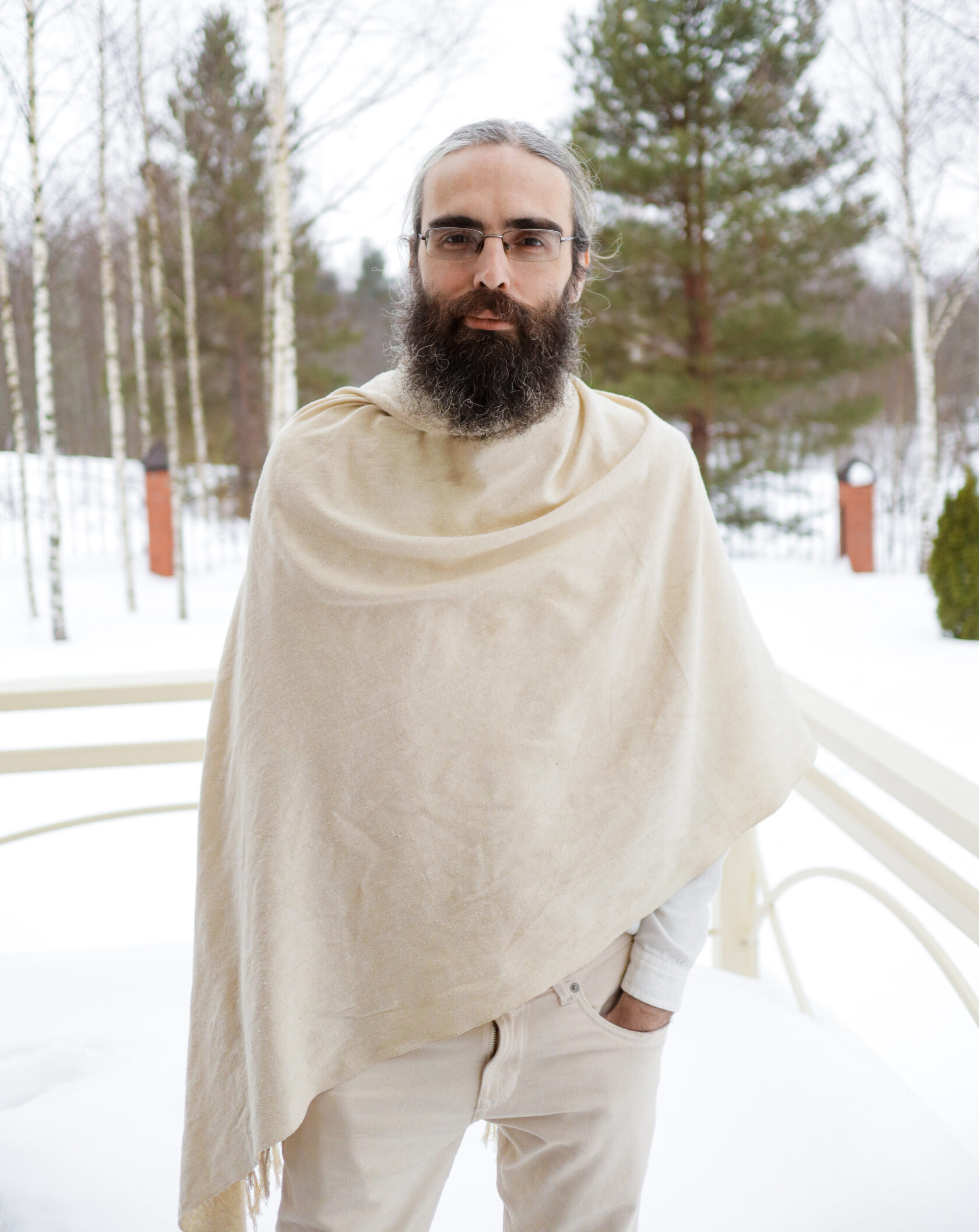
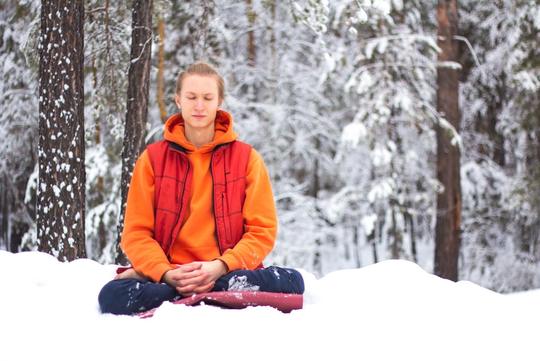
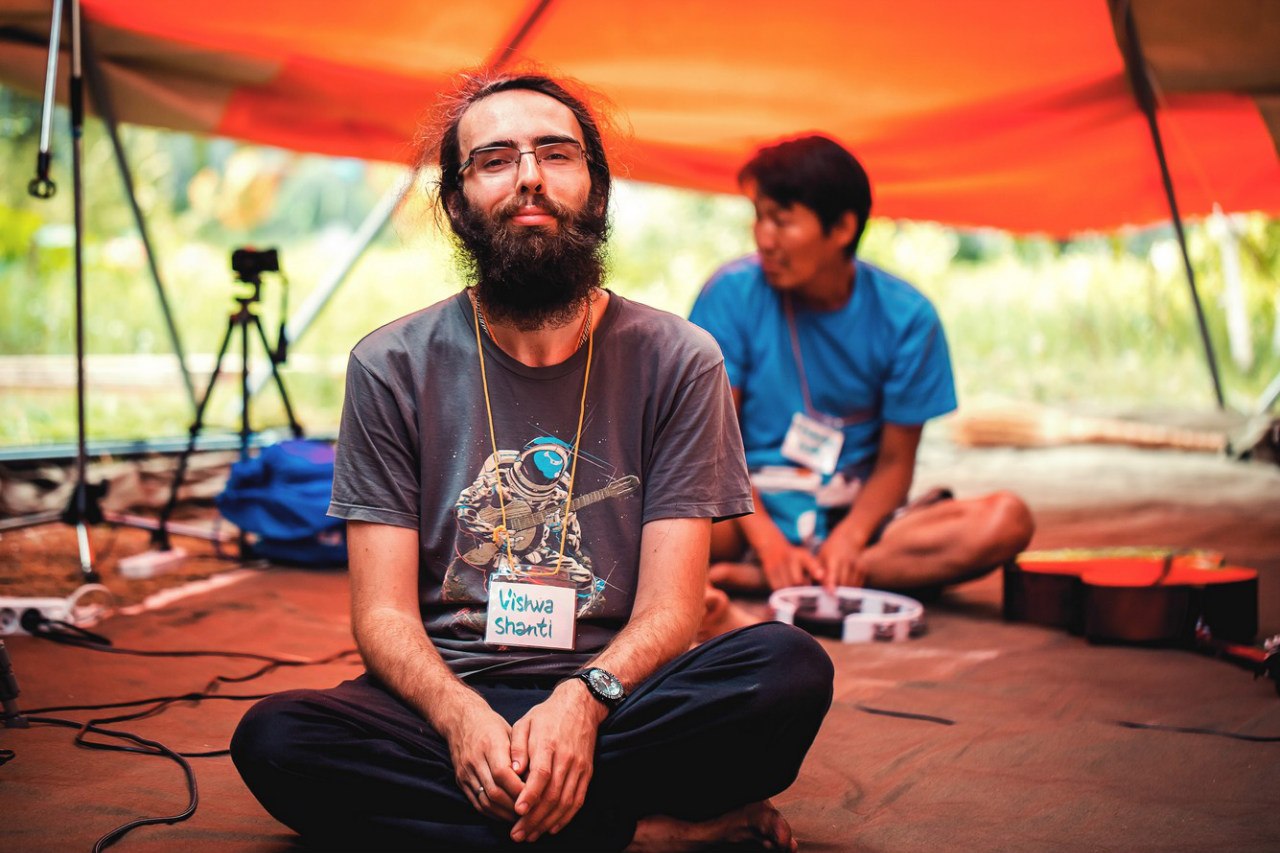
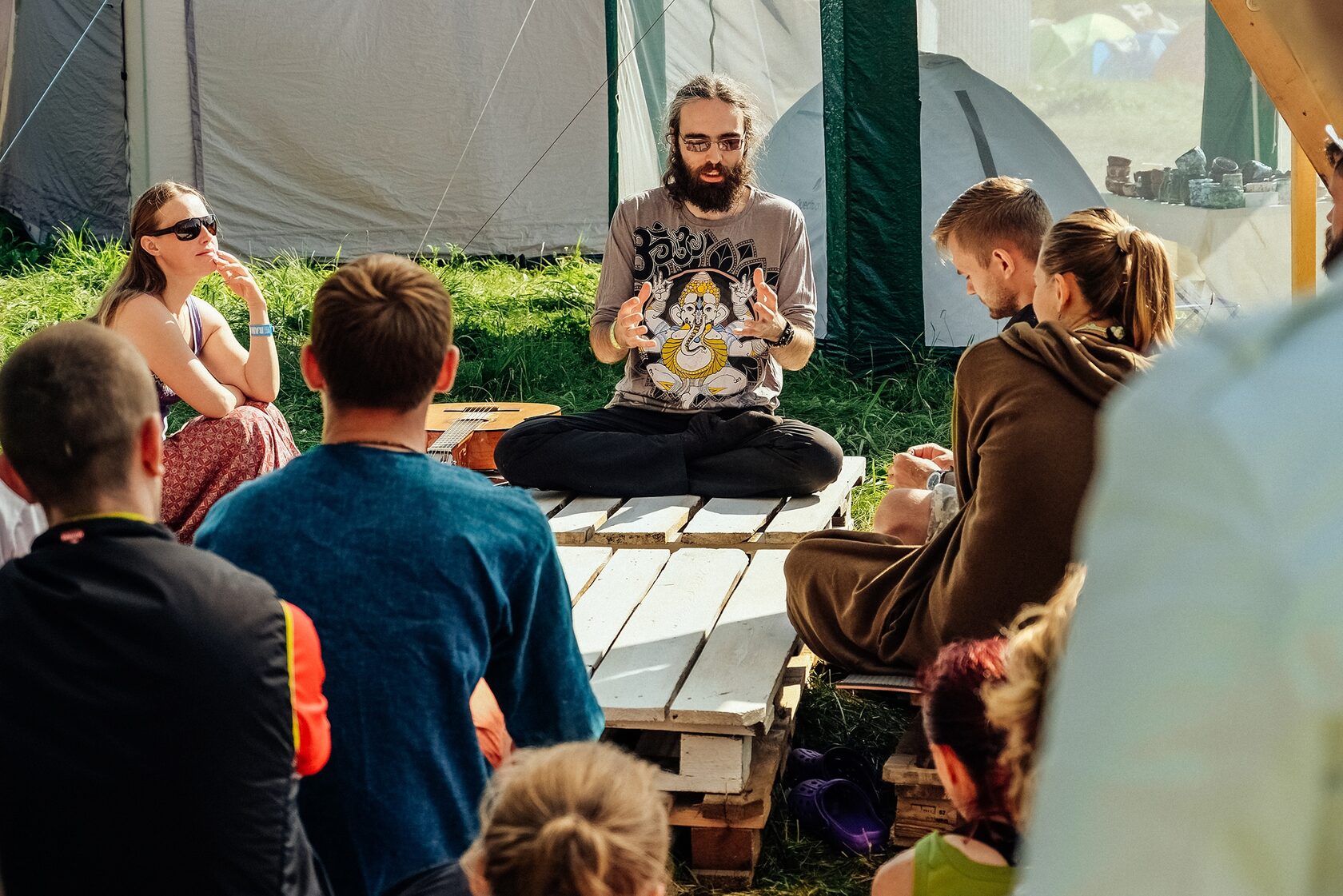
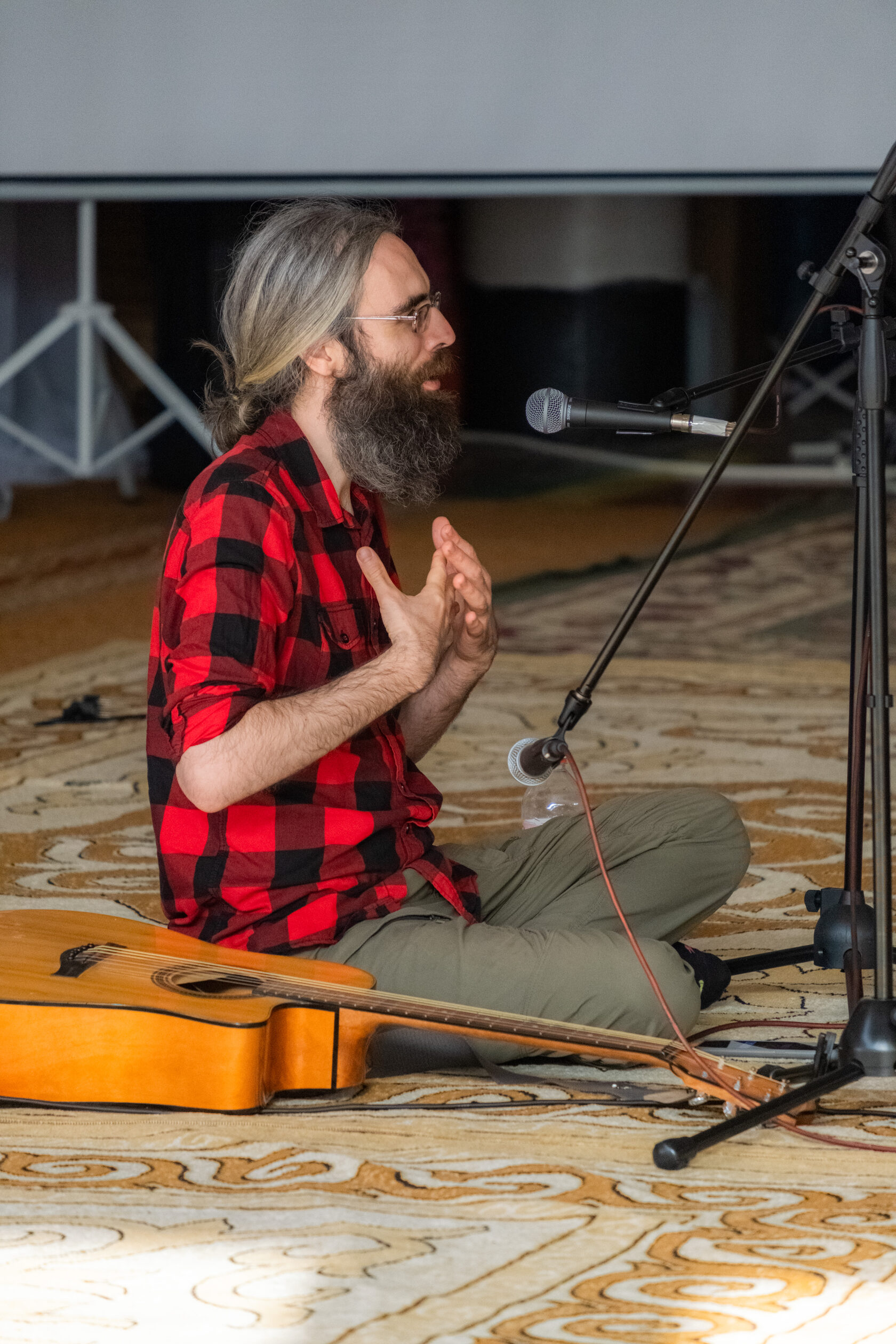
A conversation with Dada Vishvashanti (Vladimir Semenikhin), one of the leaders of the Urokimeditatsii project and the first family Dada in Russia, about the changes in his life and his plans for the future.
In 2011 Dada received a personal meditation lesson from Dada Sadananda; together with him he has been developing the Urokimeditatsii (Meditation Lessons) project since 2014, became its leader in 2019, and at the end of 2023 completed a training in India and received the status of a family teacher of yoga and meditation.
From this interview we will learn how to restore your mental energy in seven days under the open sky on the bank of the Ganges, why Dada watches TV series that are not exactly refined and which songs inspire him; how he plans to combine family, developing the project and supporting his students; whether it is hard to lead a team of meditating people who live in different cities and countries; and what moved him to go from IT specialist first to leader of a yoga project and then to meditation teacher.
— Dada, your status changed recently — you became a teacher of yoga and meditation. What has this added to your life as a family man and leader of the Urokimeditatsii project?
My training has allowed me, like Dada Sadananda, to give a personal lesson and initiation into the tradition of Rájádhirája yoga. That is the key change that has happened.
— You are already the leader of a project that helps people improve their lives and follow the spiritual path. Why become a Dada?
There is a lot of different propaganda about what we need in order to be happy: wear jeans, study to be a lawyer, become a photographer, don't be an accountant, live like this, don't live like that. I see that the Urokimeditatsii project and meditation itself are a chance to step away from outside advice, reach your own core, and find the answer there — what I should do in life and what my unique, unrepeatable purpose is. I am inspired by the idea of giving this tool to as many people as possible.
The second reason is that I want to inspire others by my own example to move along the path of growth and expansion. Most of our subscribers are family people who look at the monk Dada Sadananda and think that since he has no family, it is much easier and calmer for him to walk the spiritual path. They are sure that for family people the status of meditation teacher is an unattainable spiritual height, and with my life I want to prove the opposite.
I understand that now a spotlight is pointed at me and every weakness, flaw and mistake of mine will be examined more closely, but I am ready for this challenge.
Back in 2013 I set myself on this path, asking Dada Sadananda how to become a family meditation teacher — an A teacher of meditation trained to give personal instruction; monks, nuns and family people can be ácáryas..
"You must inspire by your example, do your spiritual practice well, serve the world, carry out socially significant projects, and in time you will earn the right to become a Dada," was his answer.
— Giving personal meditation lessons is a responsibility: students will come and you will have to give them attention, yet you also have a wife and children who need you too. How will you manage not to lose out on either side when there are only 24 hours in a day?
Meditation works, so the only thing I should be losing is my weakness and laziness. I see the way out in a disciplined approach to life, strictly following a daily routine, with clearly set periods of time for family, work and supporting the people in my care. If you switch chaotically, you can't avoid burnout.
— Doesn't such strict discipline take the wings, inspiration and joy out of life?
One of the key factors is to plan rest along with your tasks. For balance, according to yoga, a person needs proper food, cleansing, exertion and rest, because the feeling of joy and of flying disappears when we are very tired and have no energy. I fly when I am with my family, working at Urokimeditatsii, giving a lecture, supporting beginning practitioners — this is my choice; these duties were not forced on me. To unwind I may watch a YouTube video or a TV series, and if I watch it together with my wife, that already counts as quality time with the family (smiles).
— What series do you watch, and how do you unwind?
I watch various series, and not always particularly refined or chaste ones, because I need to understand what people around me are talking about and discussing. It is a chance to get to know other views and broaden my horizons. But I am aware that they can influence my worldview, and I do it very carefully. Recently I watched the series The Big Second; it shows how our relationships not only affect the people close to us but transform the world.
My favorite pastime is looking for spirituality and inspiration in unexpected things. At a harp concert or an organ recital it is easy for us to feel deep emotions, but finding them in elements of mass culture is harder, and for me that is always an interesting challenge and quest. For example, in the songs of the band Grazhdanskaya Oborona I feel a sincere longing for true values, a wish to be free of the shackles of material life, and a fragile harmony with the universe.
— Let's go back to your training in India. You said that to receive the status of Dada, among other things, you have to live for several days under the open sky on the bank of the Ganges without everyday comforts, cook on a fire and not speak to anyone. That looks archaic. Why does a modern person need all this, and how does it affect whether you will be a good teacher or not?
The title of meditation teacher within any tradition speaks of the trust of that tradition's senior representatives, because the whole teaching will be judged by you. Trainings and stress tests like this help them get to know the candidate, test his discipline, see how he bears life's hardships and whether he has any mental illness. My teachers from the tradition of Rájádhirája yoga also wanted to make sure I was of sound mind.
For seven days I lived under the open sky. Two lengths of white cloth for clothing and a blanket to cover myself at night; once a day I cooked on a fire from the food they gave me. It was a fairly meager diet: potatoes or grain, a few vegetables.
Such a training is a challenge and a chance to touch your true "I" through the practice of silence and deep meditation. Within a week I quickly restored my mental energy, since I was silent, didn't read the news, and the world's problems didn't touch me. By the end my enthusiasm and inspiration had reached incredible heights; my brain was filled with boundless energy.
— Now you have two names — Vladimir Semenikhin and Dada Vishvashanti. How are you going to reconcile your two selves, and how should people address you?
I understand perfectly well that people are much more comfortable calling me by my first name and surname. On the other hand, a name is a sacred and deep thing that automatically tunes you to a certain frame of mind and endows you with certain qualities. My close relatives and my mother call me Vovik, and that tunes me to be the little son and live up to that image. In the gamer crowd I had one nickname, in the rocker crowd another, and they awaken in me a sense of belonging to one worldview or another. When people call me Dada Vishvashanti, all the best in me wakes up and I try to live up to that high title. Personally, I am more comfortable being single-pointed, so my intention is to use only the name Dada Vishvashanti as much as possible — it will help me become established in my noble qualities sooner.
— What does your name mean?
"Vishva" is the universe, "shanti" is peace, calm, tranquility, so "Vishvashanti" is the peace of the universe, or universal peace. And "dada" means elder brother.
— Last year the Urokimeditatsii project turned ten. You were there at its founding together with Dada Sadananda, at first simply helping make videos for YouTube, and since 2019 as team leader. Let's talk about how your attitude to the project has changed over these ten years, about your role in it, and about its progress.
Until 2019 the team consisted of six people. In 2015 we began building the out-of-town yoga center Ananda Shivani, and I mostly handled IT tasks, but since we all lived together I took part in brainstorming and discussed ideas — where we were heading, what videos we would shoot. There was no clear division of responsibilities back then. Urokimeditatsii was a family-type organization, where everyone does everything and then everyone burns out together too.
In 2019 organizational development began, and within two years the team grew to 40 people who work steadily and develop the various areas of the Urokimeditatsii project. For me this is great progress: it is one thing when a group of friends moved in together and tried to do something sincerely but clumsily and without experience — and quite another level when I already have experience and wisdom in matters of leadership, management and administration. I learned to delegate, because when you have a team of 40 people it is impossible to remain a family-type organization.
— You mentioned that the Urokimeditatsii team has 40 people. What do all these people do?
Some work in media — they release new videos, write posts, draw illustrations and comics, and create websites for the marathons and intensives.
There is an educational products team. In our project, learning meditation is free on principle, but there are skills and habits that help you do your spiritual practice and combine it with ordinary life: going to bed and getting up early, managing yourself and your time, nonviolent communication, yoga exercises, and others. To master these skills we have created a whole system of learning formats: marathons, intensives, online retreats, webinars. All of them are pay-what-you-wish. The team works and develops the educational programs on the funds collected.
Other people work on the main website and the mobile app. We want everyone to have a meditation helper in their pocket.
A separate team helps Dada Sadananda develop the project in English, since we have already grown to an international level.
— Dada, what motivates you to keep working on Urokimeditatsii after ten years?
My key dream is to make meditation as accessible and understandable as possible, to convey to everyone why it is needed and what benefit it can bring. When a person practices regularly, dormant, truly divine qualities blossom in them that are not always noticeable. Just as a seed sprouts and turns into a huge, beautiful, radiant, many-colored flower, so every person, with the help of meditation, finds their true bright traits and qualities of character.
I am led by the dream that people's best qualities will come out — the striving for creativity, nobility, dignity — that they will live happy lives, that the amount of pain and aggression will decrease, and that society will be transformed.
— Let's go back to the interview you gave five years ago, when you had just become the project's leader. It is very inspiring; in it you set out the program we have heard again today. What helps and sustains you in leadership, since this is exhausting work that leads to burnout?
I see that the fundamental thing that helps me in leadership is doing my meditation well. It sounds paradoxical, but if we teach, we have to set an example by our own behavior. Good practice gives a good connection with your core and your inner joy, and that in turn gives enough energy to be a leader and take on responsibility.
The second key factor is a sincere and attentive attitude of one person to another. Our team is not a machine where every cog can be replaced. I try to see the potential in each person and give them the chance to unfold.
It was a discovery for me that leadership is not goals and results but a sensitive understanding of the team, where everyone is unrepeatable, unique, and has their own dream, traits and wishes. My work consists only in harmoniously joining the direction in which a team member wants to grow with the tasks they handle in the project.
— You said in an interview that the global goal of Urokimeditatsii is to make meditation available to as many people as possible. Can everyone practice meditation, or is it sometimes not their path?
From the point of view of yoga, everyone born in a human body has one common trait — they need infinite happiness, and attaining it requires certain actions. In yoga this is called The inherent nature of a thing; for a human being, the longing for the Infinite and the effort to reach it.. One of its elements is doing a practice through which we will feel this source of happiness within ourselves not only in theory but in fact.
I am convinced that every person needs to find something infinite, regularly concentrate on it and take it into themselves. The practice can take different forms, and I don't claim that our path is the only right one, but I do state that it works and is complete.
Spiritual life is a mountain with many trails leading to the summit.
Each of us has problems caused by an insufficient understanding of ourselves, of the meaning of life, of who we should be and become, and the challenge of the Urokimeditatsii project is to help people understand that their tasks, pains and life tensions can be resolved with the help of meditation.
— Are there contraindications to meditation, for example mental illness?
The contraindications come only from the fact that meditating is quite difficult. We cannot harm ourselves with meditation, but even for a relatively healthy person, withdrawing attention from all outside stimuli and directing it inward is not the simplest of tasks.
If there are mental difficulties, I recommend balancing your diet, moving more, walking in the fresh air, and doing sports. With a weak level of self-control it is hard to do silent meditation, so raise your arms and sing a A sound or set of sounds that, repeated with its meaning in mind, carries the mind toward the Infinite., do Singing a name of the Supreme together, often with a simple dance; in Ananda Marga the words are Bábá Nám Kevalam. — you will feel the effect and relief. And most important: be sure to see a competent specialist, and on no account think that spiritual practice is a substitute for treatment.
— Let's shift the focus to Urokimeditatsii's subscribers. During your time with the project you have led 15 silent retreats. During the pandemic, for 360 days in a row without a break, you organized online group meditations and spent an hour answering participants' difficult questions. For the last two years you have been waking subscribers up with "Sattva Wake-Up" streams. Tell us what programs you are running now and where people can see you online or in person.
I have always been inspired to share knowledge about meditation and the tools that help along this path. I can't take anyone by the hand or meditate for them, but I have the chance to pass on my experience, and my teachers have spoken positively about my work. Their support and approval are important to me, because being a teacher is always a challenge. You share knowledge, answer questions — and with every second pride grows; and if you don't constantly watch and pay attention to your behavior, it will swallow you.
Until now I led a silent retreat about once a year, gave lectures at some Urokimeditatsii retreats, and was a speaker at the marathons, but the status of Dada implies more active work. So I plan to hold more meetings in different cities and more online events.
Recently, on February 23, there was a live broadcast with Dada Sadananda on the topic "How to create an inspiring family? The balance between the material and the spiritual." In it we discussed how I see a spiritual family, which qualities to rely on when choosing a partner, and how to find a balance between family duties and yogic practices. I invite you to watch the recording.
On March 4 the marathon "7 Secrets of Meditation" begins. On every day of the marathon I will be on air live — in real time, not recorded. You will be able to talk with me, ask questions, and clear up anything unclear right away — about technique, mantra, ideation, diet or moral principles.
Then there will be two in-person meetings — on March 16 in Moscow and March 23 in St. Petersburg — on the topic "How to make meditation a regular practice." I invite both those who are just trying meditation and are not yet established in it, and experienced practitioners who are looking for inspiration and want to practice together, hear a lecture and ask questions.
At the end of April there will be a silent retreat in the Tver region — a program of silence, meditation and deep immersion in oneself without distraction by outside stimuli.
I will be glad to see you in person or online at these events, to help you sort out your meditation practice and answer any questions. Good practice to everyone!