Yoga is not only exercises on a mat but a deep philosophy and a way of life. We look at its history, its paths, the eight steps, yama and niyama, ásanas, breathing, diet and home practice.
Millennia pass, and people keep practicing yoga. This ancient knowledge from India does not grow old; on the contrary, it keeps finding new followers. Where does its strength lie? In the exercises on the mat? In a deep philosophy that shapes our relationship with ourselves and the world, or in the way of life of those who practice? There is no short answer.
To understand what yoga is and what it can give a person today, let us look in detail at its foundations and principles.
Why we need yoga
Yoga is universal. It stands outside eras, religions and nationalities; before it, everyone is equal. This is not surprising, since inwardly we are very much alike. Our body, mind and soul function according to the same laws.
The ancient practice is meant to develop our innate capacity to attain happiness and harmony. All of us have this capacity; what remains is to figure out how to use it. Forgetting about the spiritual sphere, we sometimes mistakenly believe that success and money will bring us the greatest joy. Or we care exclusively about our body and appearance. As a result, the balance between the spheres of life is upset. Yoga teaches us to find that balance and keep it.
This comprehensive system works on the levels of body, mind and soul. It unites them into one whole and restores inner equilibrium.
On the level of the body, the practice brings health and longer life, makes up for a lack of physical activity and puts the organism in order. Muscle tone and elasticity rise to their highest level. The internal organs receive a gentle effect. The endocrine system begins to work normally.
Yoga practice restrains the fluctuations of the mind. We stop jumping in our thoughts from one thing to another and learn to concentrate on the present moment. In this state it is much easier to control our feelings, to sense our body and to notice how beautiful life is.
When the body is healthy and the mind is calm, it is easier to hear one's soul. It will always tell you how to act and what choice to make.
On the level of the soul, yoga also offers enormous opportunities for spiritual growth and for understanding the universe. In meditation its essence is revealed.
People who practice yoga notice positive changes in their character, habits and way of life. It becomes easy and natural for them to give up what can cause harm. Artificial substitutes for happiness, such as cigarettes, alcohol and tasty food in excessive amounts, are no longer needed.
The history of yoga
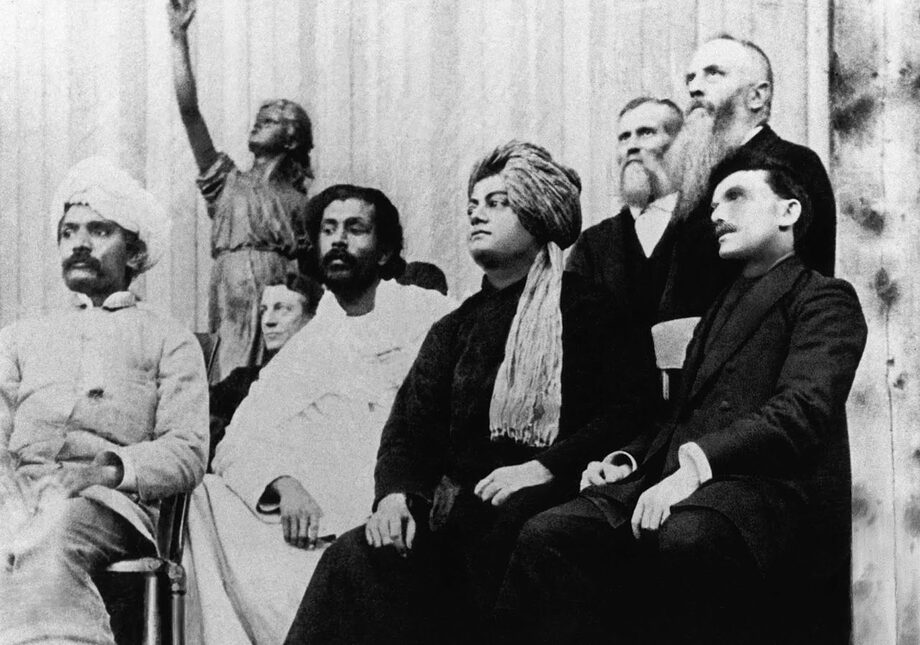
The Parliament of Religions, September 1893. On the platform (left to right): Virchand Gandhi, Anagarika Dharmapala, Swami Vivekananda and G. Bonet Maury
Yoga arose in India in deep antiquity. Knowledge about it, A yoga posture held steadily and comfortably; it balances the glands and quiets body and mind for meditation., the secrets of successful meditation, recommendations on diet and daily routine were passed on personally from teacher to disciple. So it was until, in the second century BCE, the sage Patanjali brought together all the theoretical and practical information in his treatise, the Yoga Sutras. This first step-by-step guide, consisting of 196 sutras, or brief truths, became the basis of classical yoga.
Until the end of the 19th century, yoga was practiced only in India. Then its teachers began to travel to other countries and tell people about their knowledge. Thus in 1893, at the "World's Parliament of Religions" in Chicago, the Indian teacher Swami Vivekananda gave a short speech on Indian philosophy. The audience received his words with enthusiasm. Later he lectured on yoga in the USA and Europe.
Gradually the spiritual teaching from India spread around the world. Now more and more people are beginning to practice it and to celebrate the International Day of Yoga on June 21.
A brief philosophy and the foundations of yoga
Yoga sets as its main goal liberation from the sufferings of the material world through spiritual development. The cause of suffering lies in the mind. Whirlpools within it distort our perception of reality. Endless thoughts exhaust us, take away our energy and distract us from ourselves.
The mind can be pictured as a lake, and the soul as a treasure hidden at the bottom of that lake. When the water is stirred up, that is, when the mind is agitated, it is impossible to see what lies at the bottom, that is, to realize one's soul.
Yoga returns the mind to its original balanced state. It allows us to expand consciousness to its highest potential and to find harmony with the world.
The paths of yoga
Liberation from suffering can be reached by different paths, not only through physical exercises and meditation. Any meaningful activity becomes yoga if, while performing an action, we remain fully in it, keep our concentration and understand why we are doing it.
Each path has its own features, strengths and weaknesses.
Jiṋána yoga, the path of knowledge, suits people with an intellectual type of perception, those who approach the truth through reflection and meditation. This path includes studying philosophical texts and lofty ideas and thinking them through. The person tries to know their own consciousness and to find the supreme consciousness within it, to understand what lies beyond the mind.
Laziness and inertia are counted among the drawbacks of jiṋána yoga. After constantly dwelling in the abstract mental sphere, it is hard to make oneself move. Pride in one's extensive knowledge may also appear.
Karma yoga, the path of action, helps avoid inertia. It is based on the mechanism of karma. Any act, or the absence of one, deforms the mind and brings certain consequences. Selfless help, carrying out one's duties, and caring for others in a state of love and giving neutralize negative past behavior. The mind returns to balance, in which supreme bliss and knowledge lie.
On the path of devotion, called bhakti yoga, all deeds are done only out of love and the desire to serve others. Action becomes an act of love. The mind reaches a focus; only one aim remains in it, the desire to give happiness to others. This path is the most difficult, but also the most effective. It is close to people of an emotional temperament.
In his treatise, Patanjali describes rája yoga, the path of mental discipline based on control of the mind and body. Its central practice is meditation, during which a person's physical and psychic energy is transformed into spiritual energy.
To make progress, all the paths must be practiced together.
The eight steps of yoga
The classical system of yoga described by Patanjali consists of eight steps that touch the moral sphere and work with the body and with psychic abilities. The steps should be mastered in order and then practiced simultaneously. Each one makes the next easier, and they are all aimed at preparing for meditation.
Let us look at all the steps in turn:
- Five principles for how we treat the world: not harming, truthfulness, not stealing, keeping the mind on the Supreme, not living beyond need.: moral and ethical principles of relating to people and to nature.
- Five principles for shaping oneself: cleanliness, contentment, service despite hardship, uplifting study, keeping the Supreme as life’s goal.: personal rules.
- Ásanas: postures and exercises for holding a steady position.
- Prańáyáma: breathing techniques for gathering energy.
- Pratyáhára: withdrawing the sense organs from external objects, psychic relaxation.
- Dhárańá: concentration of thought.
- Dhyána: meditation, going beyond the mind.
- Absorption: a state in which the mind merges in the object of meditation.: an altered state of consciousness.
The last step, samádhi, is a special state of the body and mind in which a person feels one with the whole world. One merges with cosmic consciousness and comes to know the truth.
Spiritual development
According to the principle "as you think, so you become," the words "Bábá Nám Kevalam" allow us to develop our spiritual capacities. Concentration on the A sound or set of sounds that, repeated with its meaning in mind, carries the mind toward the Infinite. frees the mind from ignorance and directs it toward an elevated state of harmony. This mantra is suitable for constant practice and for accumulating spiritual strength, which will later help in all one's undertakings.
Principles of practicing eight-limbed yoga
Of greatest interest to us are the first steps of Patanjali's classical system. They are understandable and accessible to most people regardless of lifestyle, gender and age. Control over the mind is achieved through work with the body: physical and breathing exercises, procedures for cleansing the body, restraint in diet, and the ability to relax.
Yama and Niyama
We know eight-limbed (hatha) yoga from classes in fitness clubs and from the exercises called ásanas. In training sessions they receive the main attention, and no one tells you about the initial steps of the practice, yama and niyama. We should know about them and practice them if, in addition to the physical benefits, we want to grow spiritually and aspire to master meditation.
In India only those disciples who strictly observed the moral principles of yama were allowed to perform ásanas. To practice yoga fully, one needs to develop the following qualities:
- ahiḿsá: nonviolence, not causing harm by thought, word or deed; this principle is also observed in diet;
- satya: benevolence of thoughts and words, truthfulness;
- asteya: not taking what belongs to others;
- aparigraha: non-acquisitiveness, non-attachment to material things;
- brahmacarya: seeing the supreme meaning in all phenomena of existence.
Niyama is a set of personal rules, which includes:
- shaoca: keeping the body, home and mind clean, cleansing techniques;
- santośa: modesty and contentment in everything;
- tapah: austerity and self-discipline;
- svádhyáya: study of philosophy and spiritual literature;
- Iishvara prańidhána: taking as one's goal the realization of the supreme meaning of life, the practice of meditation with concentration on the meaning of the universe.
Yama and Niyama lay a solid foundation for further spiritual development.
Yoga postures
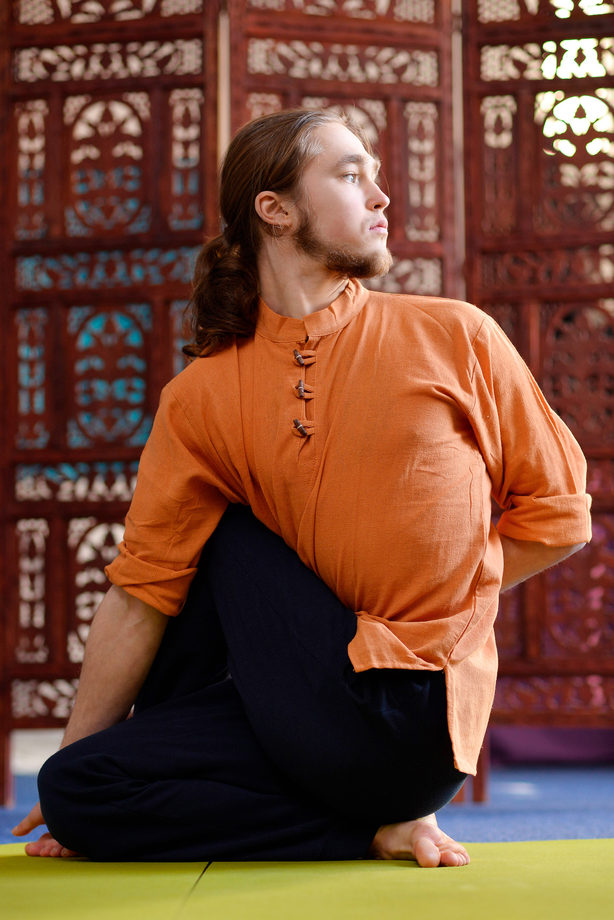
Ásanas are special exercises that prepare the body for meditation. While doing them, we learn to keep a comfortable and steady position in various postures. At first this may be hard, but over time the flexibility of the joints and the strength of the muscles increase, and it becomes easier for us to practice.
In ásanas it is important to take the correct starting position, find a point of support, direct the breath to a particular area and keep the focus on the right group of muscles. Developing full control over the whole body takes time and a good instructor.
Correct breathing
Breathing techniques, prańáyámas, make it possible to control the mind and increase vital energy. Variations of breathing through the nose or mouth, and holding the breath after inhaling or exhaling, have a beneficial effect on health and emotional state. They help us use all the respiratory muscle groups and the whole volume of the lungs, and learn to take in more oxygen with each breath.
It is better to practice prańáyáma under the guidance of an instructor, since incorrect practice can have a negative effect on the psyche.
Relaxation
After each ásana you need to give yourself time to feel its effect. The following positions are suitable for a short rest:
- Child's pose | Balasana
- Crocodile pose | Makarasana
- Mountain pose | Tadasana
- Corpse pose | Shavasana
Practice should end with deep relaxation, a final shavasana of 10–15 minutes. This exercise is the most important; it must not be skipped. While doing it, we try to switch off from outer sensations and from the mind, to turn to our inner "I"; we are doing a kind of meditation.
Diet
The principle of yama, nonviolence toward all living beings, excludes meat, fish and eggs from the diet. Followers of the ancient teaching from India keep to a lacto-vegetarian diet, because for them love stands higher than food. Their diet is based on grains, legumes, vegetables, fruit, nuts, milk and honey.
Foods that excite the mind are undesirable, such as:
- alcohol;
- coffee;
- black and green tea;
- chocolate made from cocoa beans;
- mushrooms;
- onions and garlic.
Food should also be fresh and prepared with love. Only then will it do good.
How to practice yoga at home
Yoga can also be practiced at home. Personal practice has a number of advantages. We choose a convenient time for ourselves, decide how many minutes we will practice, and select the ásanas and breathing techniques. We do not have to adapt to the level of a group as in a fitness-club class; we master the exercises at a pace that is comfortable for us.
It is recommended to practice on an empty stomach, ideally early in the morning or four hours after the last meal, so as not to feel discomfort while holding the ásanas.
A home session is conducted the same way as a group one. At the beginning we take a comfortable posture, close our eyes and silently state our intention for the practice. Then we practice full yogic breathing. Next come the ásanas; you need to do at least three a day. At the end, shavasana is best as the final exercise.
Meditation is an important part of yoga. It allows us to maintain a balanced inner state and to move from anxiety to peace and a positive frame of mind.
The best times for daily meditation are the morning before breakfast and the evening before dinner. At the start of the day we charge ourselves with energy and awaken our intuition, and in the evening we cleanse the mind of the accumulated bustle.
The longer we practice, the better we manage to keep a meditative state throughout the day. Our awareness grows, protects us from thoughtless words and actions, and makes us interesting to those around us.
So what is yoga?
Yoga is one of humanity's great inventions. It is at once the goal, the means and the path to achieving balance in all spheres. It builds harmonious relations with the world, strengthens health through physical and breathing exercises, and shows how to be present in every moment. The ancient practice expands our capacities and allows us to live long and happily.