Contents
- How does Rájádhirája yoga work?
- When did "Rájádhirája yoga" appear?
- Which human needs does this school of yoga "cover"?
- Features of practice in the Rájádhirája yoga style
- What is there little of, and what is missing altogether, in Rájádhirája yoga?
- How does any yoga affect a person's body and well-being?
How Rájádhirája yoga works — the style revived by Shrii Shrii Ánandamúrti: a slow pace, breath retention, short relaxations between ásanas and other features of the practice that help a person who meditates.
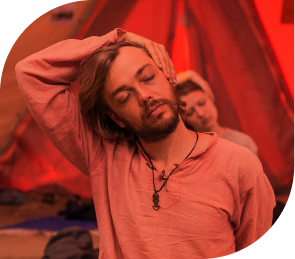
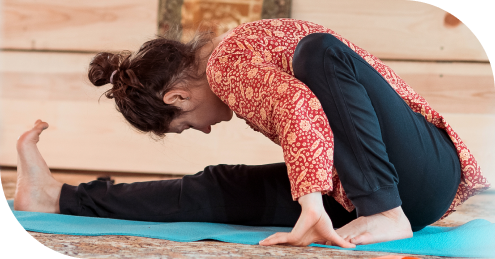
To calm the nervous system: yoga postures, breathing, meditation.
How does Rájádhirája yoga work?
Different styles of yoga place the emphasis of daily practice on different things: strength training and endurance, dynamic movement and raising the heart rate, breathing practices, the state of the mind, the adaptability of the nervous system, relaxation, and so on. Often all of these components are present in a practice, but in different proportions.
If A yoga posture held steadily and comfortably; it balances the glands and quiets body and mind for meditation. practice is seen as part of spiritual practice and as a helper in meditation, the emphasis falls on a slow pace, repetition in cycles, breath retention and activation of parasympathetic tone.
One such style is Rájádhirája yoga.
When did "Rájádhirája yoga" appear?
2,000 years ago
The first mention of this style is found about 2,000 years ago, from Maharishi Ashtavakra in his book Aśt́ávakra Saḿhitá. The book Yoga Psychology says this about it: "The process of controlling all the A center of psychic energy in the body; seven major ones lie along the spine. and propensities was invented by Astavakra over two thousand years ago. He wrote the book Aśt́ávakra Saḿhitá. He was a great saint and called this process Rájadhirája Yoga. He first taught this system of yoga to Alarka at Vakreswar in Bengal." — Shrii Shrii Ánandamúrti (Bábá) (Glands and Sub-Glands, 1990)
Modern times
In modern times Rájádhirája yoga was mentioned in the philosophy of the spiritual teacher Prabhát Ranjan Sarkar (Shrii Shrii Ánandamúrti), who revived this style in the 1950s with some adaptations for people of today.
Raja means "king"; raja dhi raja means "king of kings." In human life the mind is considered the king, and what controls the mind (the soul, or consciousness) is the king of kings.
The Rájádhirája yoga tradition offers practices that allow you to become the "king of kings" in your own life.
Like many others, this style is based on the eight steps of classical yoga, but it differs in its set of practices — in that very emphasis, which is aimed at helping the yogi who practices meditation.
Which human needs does this school of yoga "cover"?
It is held that every person has four basic longings of the mind:
- Káma vrtti — the longing for physical objects, such as food, a sexual partner, safe shelter, and so on.
- Artha vrtti — the longing for psychic objects: the need for emotional support and closeness, for varied impressions and experiences.
- Dharma vrtti — the longing for psycho-spiritual objects: love of the sciences and the arts, of philosophical ideas and of selfless service.
- Mokśa vrtti — the longing for spiritual objects: spiritual practice, the search for eternal truth and the realization of all that exists.
Teachers of Rájádhirája yoga say that the practices gathered in this style — 42 ásanas, 15 mudrás and bandhas, cleansing procedures, meditation practices, prańáyámas, diet and lifestyle recommendations — are aimed at satisfying all four human longings. Not all styles of yoga are like this; some of them may answer only two or three of these longings.
Features of practice in the Rájádhirája yoga style
Individual practices of Rájádhirája yoga can be found in other schools of yoga too. The effect lies in the details and combinations that help those who practice yoga not only as health-giving exercise, but also as a spiritual practice.
So what are these nuances?
A slow pace
The style is marked by a slow pace in all its practices, except for the yoga dances Kaośikii and Tańd́ava. Slow movement does not raise the pulse; it calms the nervous system and calms the mind. With a calm mind it is easier to meditate.
Short shavasanas in between
A short relaxation not only at the end of a session but after each ásana increases the parasympathetic effect of the practice, keeps the pulse from rising and holds the attention on inner calm.
Breath retention
Many ásanas are done together with holding the breath after inhaling or after exhaling. Holding the breath can be seen as the utmost lengthening of an inhalation or exhalation — that is, as very slow breathing. Holding after inhaling improves the outflow of venous blood from the brain (the expanded chest has a suction effect on the inhale), and so it also stimulates the inflow of arterial blood, which supplies the brain with oxygen; holding after exhaling improves the penetration of oxygen into the cells. All this makes brain cells more efficient and more resilient under load. Meditative practice is an unusual activity for an extroverted mind, and concentration requires a brain that works well.
Yogis also link the breath with the movement of prána (vital energy) and citta (the mind-stuff from which all images within the mind are formed). The Hatha Yoga Pradipika says: "When prána moves, citta moves. When prána is without movement, citta is also without movement. By this the yogi attains stillness of mind."
Each ásana in cycles
An ásana is done from 4 to 8 times. This helps you go physically deeper into a given position, through several movements in the joints and through staying in the position during the breath retention — that is, we give the muscles, ligaments and nervous system time to get used to the new position, release tension and find comfort. It also gives a greater effect from the breath retention, which we repeat with each cycle, thereby multiplying its effect on the brain.
Self-massage
It brings every part of the body into awareness and calms; it spreads the secretion of the sebaceous glands over the surface of the skin and removes residual tension, so it helps you not to be distracted by the body during meditation and strengthens the parasympathetic effect of the practice.
Mudrás and bandhas
These are auxiliary practices close to ásanas in their effect, but acting more precisely on one system or part of the body or another.
Working with the hormonal balance
Through movement of the body, the effect on hormones can be direct — a kind of "massage" of a gland (where this is possible) that has a positive effect on its function — or indirect, by stimulating the receptors of organs sensitive to hormones, and as a result, more precise hormonal regulation. For a person who meditates, a balanced hormonal background matters for the balance of the tendencies of the mind.
In yogic science, the large glands (or groups of them) are held to correspond to the energy centers of the body — the cakras — which in turn govern the propensities of the mind. By normalizing the endocrine system we also even out our emotional state, which helps us meditate more deeply without being distracted by turbulent thoughts or feelings.
Breathing through the left nostril (or through both nostrils)
When we breathe only through the left nostril, we activate id́á nád́ii — the energy channel in the body responsible for calm, introversion and concentration (the parasympathetic tone of the nervous system — its slowing and relaxing influence — also switches on). Breathing through the right nostril (the activity of piuṋgalá nád́ii) has a toning, activating effect; the heart rate may rise, a sympathetic effect. A calm state is more relevant for meditation, so for the time of practice (yoga and meditation) it is recommended to breathe either evenly through both nostrils, or when the left nostril is more active (the nostrils switch by themselves during the day, and they can also be switched "deliberately").
What is there little of, and what is missing altogether, in Rájádhirája yoga?
Even if a yoga satisfies all four human longings, this physical activity cannot be said to be enough for complete health. For example, the Rájádhirája yoga style has very little aerobic exercise. But there are the yoga dances Kaośikii and Tańd́ava, in which the practitioner can raise the heart rate within reasonable limits to train the cardiovascular system.
This style also has very few positions (ásanas) that provide strength training, so it will be useful to train muscle strength in addition.
The Rájádhirája yoga style has no:
- Asymmetric prańáyámas. It is understood that prańáyámas with the activity of one nostril have a powerful effect — for example, they can raise the heart rate and also intensify the tendencies of the human mind. If control over one's own state is insufficient, an inexperienced practitioner may, with a serious prańáyáma, intensify negative, destructive moods as well as unhealthy conditions.
- Forced breathing techniques. Despite many positive effects on the respiratory system, such techniques have a number of contraindications. Probably so that the style suits more people, and to keep the practice parasympathetic, these techniques are not included in Rájádhirája yoga.
- Ujjayi breathing. Breathing with the vocal cords not fully closed. Although this technique is calming, it is not part of this style. But calm of the nervous system is reached by other means, which we spoke about above.
- Props. Auxiliary aids for learning postures.
How does any yoga affect a person's body and well-being?
The postures of the body in yoga are called ásanas. The term "ásana" is explained by the Sanskrit shloka sthirasukham ásanam, which is translated as: "An ásana is a comfortable, calm posture for the body and the mind." When a person practices on the mat, they do a sequence of several ásanas, which together make up a set.
"Ásanas are calm, quiet and easy postures which are held with proper inhalation and exhalation. They exercise the nerves, tissues, glands and organs of the human body. While practising ásanas one enjoys physical comfort and mental composure," says the book Yoga Psychology. — Shrii Shrii Ánandamúrti (Bábá) (Questions and Answers on Meditation, None)
Some of the positive effects of ásanas can be had from other kinds of physical activity as well, and some only from practicing yoga.
Some strengths of yoga:
Joint mobility
Joint mobility, for example, is not given by yoga alone, but some ásanas involve movement in unusual planes or with a greater range. This in turn engages muscles that do not work in our everyday activity. And muscles keep the joints stable and nourish the tissues around and inside the joints — all of which keeps the joints young for longer.
Muscle elasticity
The elasticity of muscles and ligaments, and our ability to control them, lets us move safely and without pain in unexpected situations: when you slip on ice, drop something and try to catch it, suddenly scoop up a child, jump or play a sport, and so on.
Circulation
The effect of yoga on circulation and the cardiovascular system differs from that of cyclic cardio exercise. Doing ásanas, we most often affect circulation either by changing posture — from an ordinary one to upside down, when the pelvis and legs are above the heart — or by changing the breathing pattern: speeding it up, slowing it down, holding it; and also by changing the pressure in the chest or abdomen — this way we help the blood move toward an area of low pressure, improving its circulation.
Breathing
Improving the health of the respiratory system often includes yogic breathing practices. With them we can affect the volume and rate of breathing; by managing the pattern of breathing we can change the tone of the whole nervous system; we can affect the respiratory muscles through movements of the chest and shoulder girdle in different directions, and also strengthen the muscles through the breathing itself. Some practices also stimulate the clearing of excess mucus from the bronchi.
Nervous system
The nervous system changes its tone according to several systems of the body: the respiratory, circulatory and digestive systems. By influencing one of them, the breath for example, we can set off a change in how all the others work, and in the nervous system as a whole. That is, we can calm down when we need to, or, on the contrary, pull ourselves together and get to work. And a person who practices yoga tends more toward parasympathetic tone — calm and relaxation — on a lasting basis, which over time lowers the likelihood of cardiovascular disease.
Proprioception
Proprioception is the information in the brain about the body: its size, its boundaries, its position in space. In unusual yoga postures and movements we use a great many joints, not all of which we use every day, so the brain does not give them equal attention. By practicing ásanas we engage the less mobile parts of the body, which prompts the brain to send signals to nourish them and to enlarge their network of blood vessels. And this has a positive effect on their functions.
Self-massage
When we move, information reaches the brain not only from the surface of the skin but also from the internal organs. On the one hand, this refreshes the receptor apparatus of the organs: they become more responsive to the hormones in the blood, so hormonal regulation becomes more precise. On the other hand, there is a kind of "massage" of the endocrine glands (where this is possible), which has a positive effect on their functions.
The book Yoga Psychology says:
"The regular practice of ásanas keeps the body healthy and cures many diseases. Ásanas control the glands, the glands control the secretion of hormones, and the secretion of hormones controls the propensities. So ásanas help a sádhaka [spiritual aspirant] to balance the body and concentrate the mind." — Shrii Shrii Ánandamúrti (Bábá) (Questions and Answers on Meditation, None)
The Rájádhirája yoga style has exactly the kind of set of practices that answers these two tasks of a person who meditates.