Tańd́ava is an ancient yogic dance for men, created by Sadáshiva so that men could develop their vital force. What it gives, what it symbolizes, and how to do it.
Today we will talk about Tańd́ava. Tańd́ava is an ancient yogic dance for men. It was created by Sadáshiva, or Shiva, so that men could develop and increase their vital force. Its name [tan-da-va] is connected with the idea of jumping. In India there is a particular way of processing rice: to free the rice from its husks, it is tossed up into the air. Such rice is called tandula.
This ancient dance helps awaken the warrior spirit. This dance makes men strong. Different peoples have something similar — collective dances that raise the warrior spirit. It is an exclusively male practice; in women it can develop undesirable qualities. Tańd́ava can shift the hormonal balance in the direction that is natural for men. And when this happens to a man, he feels on top of the world!
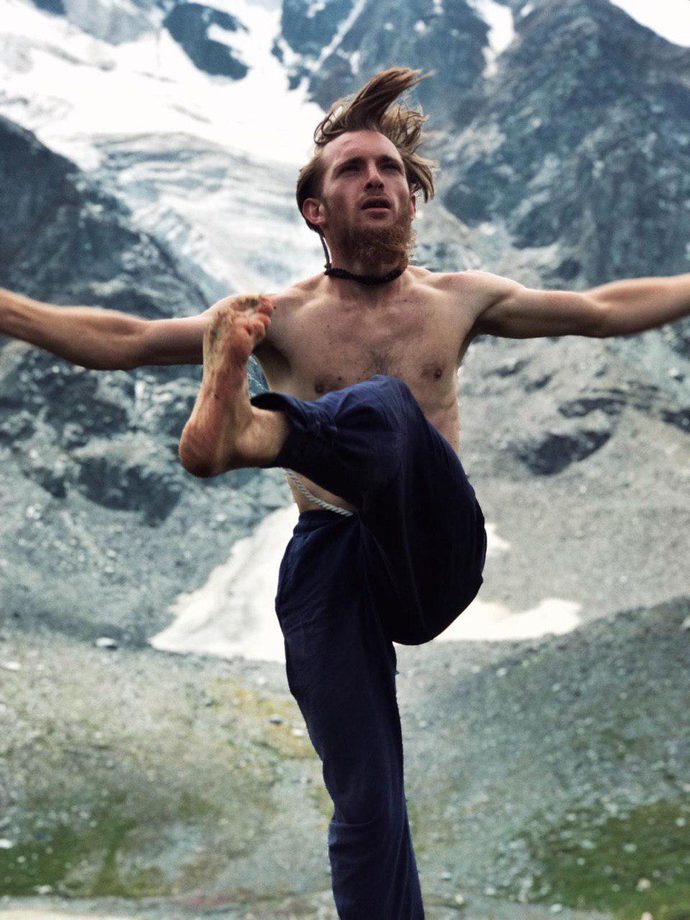
What does it feel like?
When the energy reaches the anáhata A center of psychic energy in the body; seven major ones lie along the spine., a feeling of manliness and confidence comes, the feeling that nothing can stop you. For men this is joy and the sweetest happiness! There is no fear, no anxiety, and in the mind there is absolute stability. You are no longer afraid of life, taking timid steps. You walk as a victor, understanding that you have come into this life — a life that shines for you and is lit up by your all-round success. In this way crude psychic energy and physical instinct are transformed into subtle psychic energy, and then pass into spiritual energy. This yogic dance gives birth to joy and kindness in men's hearts, because true kindness comes from strength.
Tańd́ava combines the singing of a A sound or set of sounds that, repeated with its meaning in mind, carries the mind toward the Infinite., dance movements and a mudrá. The dance is done with straight arms spread wide to the sides. This is a symbol of strength, invincibility and might. On the physical plane, this position of the arms lowers the level of cortisol — the hormone of stress, fear and aggression — and raises testosterone, which instantly gives courage and confidence. Tańd́ava uses symbols of life and death. In the left hand you imagine a skull, a snake or a torch as a symbol of death, of the unknown and of fear of what lies beyond perception. In the right hand, a knife — as a symbol of a person's fighting spirit, a symbol of the warrior, of one who defends their right to life relying on their own skill and courage. Tańd́ava embodies the struggle between life and death.
The struggle is going on always and at every level! We wake up in the morning, and at the very moment the alarm clock rings we have already entered the struggle. The force of life says: "Come on, act, succeed, expand!" The force of death whispers: "No need, it's fine as it is, just be, give in, do nothing." The same happens on the psychic plane: there is the curious intellect that wants to know the truth, and there is dogma, rigid thinking, already satisfied with some ready-made clichés. And either a pure, flexible and inquisitive mind will win, or rigid, stereotyped thinking.
How to do Tańd́ava
The dance is done with increasing speed; dance to the mantra “Only the name of the Supreme Consciousness”, or “there is only Supreme Consciousness”: the mantra sung in kiirtan, open to anyone..
| Count | Position |
|---|---|
| 1. Get ready | 1. Stand on your toes and spread your arms to the sides; the arms must be at exactly 90 degrees to the body. |
| 2. One, two, three, jump | 2. Jump, and in the jump strike your buttocks with your heels; land on your toes in a squat |
| 3. Ta-ta-dhin-ta. | 3. Jump on "dhin," touching your chest with your knees in the jump; on "ta" land on your toes in a standing position |
| 4. Ta-ta-dhin-ta | 4. On the last "ta" jump on your left leg, at the same time raising your right leg, slightly bent at the knee, toward the left side (the knee should be above the waist) as far as possible |
| 5. Ta-ta-dhin-ta | 5. On the first "ta" land on your right leg; on the next "ta" jump, raising your left leg, slightly bent at the knee, toward the right side |
| 6, 7. Ta-ta-dhin-ta | 6, 7. Continue the exercise, jumping alternately on the right and left leg |
| 8. Stop! | 8. Stop the dance and stand straight on your toes |
| 9–11. Final position, jump. | 9–11. Jump, and in the jump strike your buttocks with your heels; land on your toes in a squat, then stand up |
One last story
A friend of mine became a sannyasi at eighteen. The Guru, the spiritual master, called him and said: "How will you teach anything and inspire other people if you have neither a beard nor a mustache? You look very young, and people will think there is a child in front of them!" The sannyasi said: "I don't know." Then the Guru said: "That's no great problem — do this dance for seven minutes morning and evening." My friend began doing this dance, and in three months he had grown a beard — a big, thick beard. Undoubtedly this was a special blessing of the spiritual teacher. And, of course, the effect of the dance.