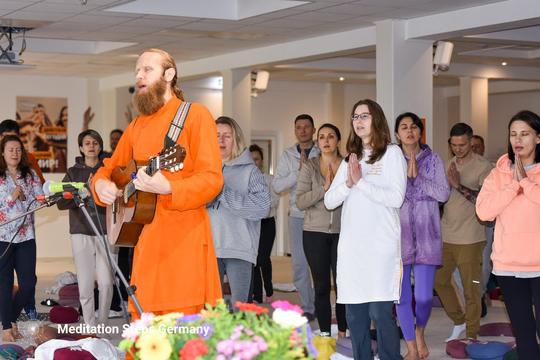
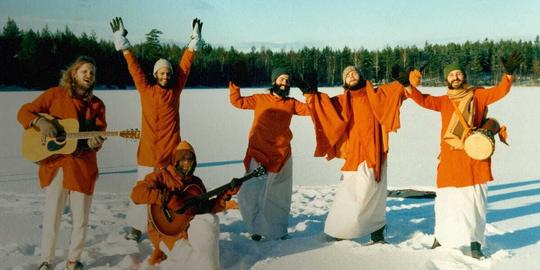
In this practice a simple dance and the singing of a universal mantra gently guide the mind toward a spiritual idea, while the mind expresses itself in the outer world.
The technique of dynamic meditation
Dynamic meditation prepares our mind for silent meditation. Through singing a universal A sound or set of sounds that, repeated with its meaning in mind, carries the mind toward the Infinite. and a simple dance, the mind is gently guided toward a spiritual idea.
This practice engages the organs of perception — hearing, sight, touch — and the motor organs. They help us focus on the mantra. The more we concentrate on it, the more sweetness and joy we receive. A wish arises to stop, to become still and sink into silent meditation. This means that dynamic meditation has done its job.
Let's look at each element of this practice:
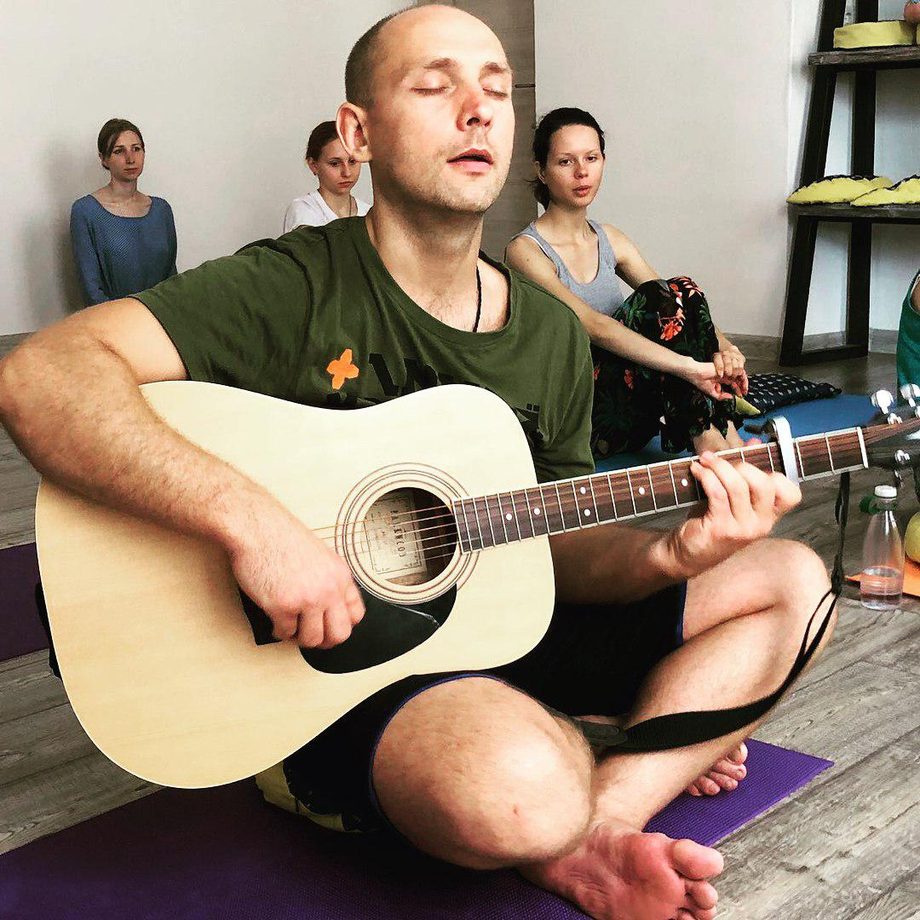
Singing the mantra — Singing a name of the Supreme together, often with a simple dance; in Ananda Marga the words are Bábá Nám Kevalam.
To create a meditative mood, it is recommended to sing the universal mantra before every meditation, for at least a few minutes.
Why?
Beautiful music and a universal idea uplift the mind and lead it away from the pull of the material world. This is what happens when we sing the mantra Bábá Nám Kevalam, and in the process a special feeling arises — bhava (the flow of the idea contained in the meaning of the mantra).
- Bábá means "infinite Consciousness" or "cosmic Consciousness."
- Nám means "name."
- Kevalam means "only" or "all that exists."
So Bábá Nám Kevalam means "Only the name of infinite Consciousness," or "Everything is an expression of cosmic Consciousness."
Since the idea of supreme Consciousness is transcendent and lies beyond understanding, it is hard to approach. But we can try to come closer to the idea of the mantra through elevated feelings that are still within the reach of our mind: love, freedom, joy, inspiration, rapture, peace and others.
Find the feeling that inspires you right now. It will help you reach elevated states of mind.
Neither the practice of meditation nor the practice of singing the mantra is effective when done mechanically, without feeling.
The dance "Lalita Mármika"
The word lalita means beauty, grace, tenderness, and marma is the very center of our heart. So the name of the dance translates as "the dance of inner beauty." Through it we can touch our Higher Self, the very depths of our being.
The dance is done standing and has two elements: rhythm and mudra.
Rhythm
The rhythm is made by the movement of the feet. Carefully and gently, we tap alternately behind the heels with the tips of the big toes, bending the supporting leg slightly. The tap of the toes falls on the strong beat of the mantra being sung. This helps to keep the rhythm and the flow during group dynamic meditation.
On the pad of the big toe there is a point linked by a meridian to the sahasrára A center of psychic energy in the body; seven major ones lie along the spine., which is at the crown of the head. Stimulating it creates a favorable mood for meditation.
Bending the legs warms up the knees and prepares them for the meditation posture. Shifting the body's weight from one leg to the other calms the mind, much as a child feels when rocked by its mother. This movement of the feet also has a symbolic meaning, expressed in the idea "I walk upon the earth gently, harming no one."
Mudra
A mudra is a gesture that expresses our inner mood in the outer world. In this dance we use two mudras.
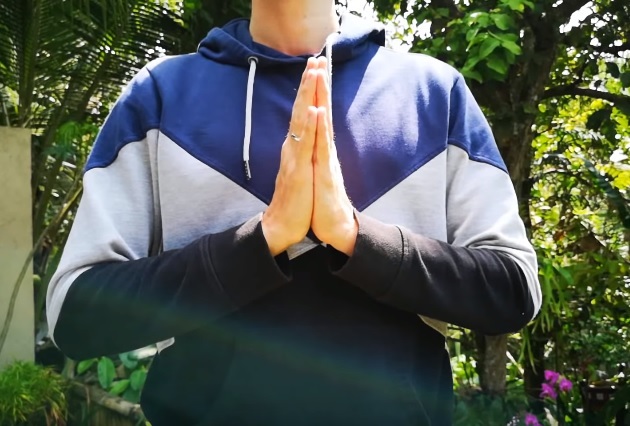
1. Palms joined at the level of the chest. When a person is absorbed in a deep spiritual feeling, feeling gratitude or love, their palms come together at the chest. This gesture symbolizes directing the five sensory organs (one palm) and the five motor organs (the other palm) toward the highest goal.
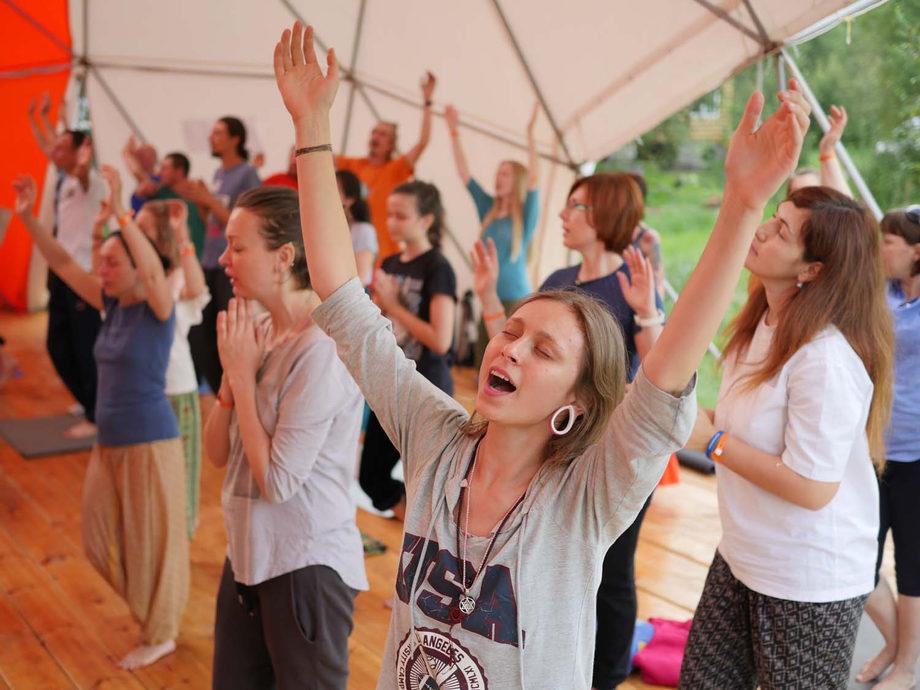
2. Arms raised above the head. During dynamic meditation, concentration on the idea of the mantra can awaken spiritual feelings, rapture for example.
Then the arms rise up by themselves. This gesture symbolizes the unit consciousness coming out of its shell. A person opens up to the universe, throws off the shackles of the mind and is freed from fears, anxieties and a limited perception of the world. One begins to feel a contact with the infinite and eternal.
During dynamic meditation the mudras may alternate. Ideally the arms should not come down, but that depends on concentration on the idea of the mantra. The higher the concentration, the easier it is to keep the arms above the head, thanks to the awakening of energy in the anáhata cakra.
As you continue the dynamic meditation, a feeling will come that nothing remains but infinity!
It is better to close your eyes, but sometimes you need to open them so as not to bump into something, or to check that you haven't wandered off into the kitchen :)
The length of the practice can vary. At first it is quite all right to sing the mantra and dance Lalita Mármika for 3–5 minutes, but the practice can last 20–30 minutes (or longer).
It takes some time to get used to Lalita Mármika and singing the mantra. But dynamic meditation is definitely important. So cast aside all doubt, shyness and hesitation and simply do it. After a while — perhaps even the very first time — you will see that this practice is a real treasure.