
Ananda Marga

Stories and Quotes

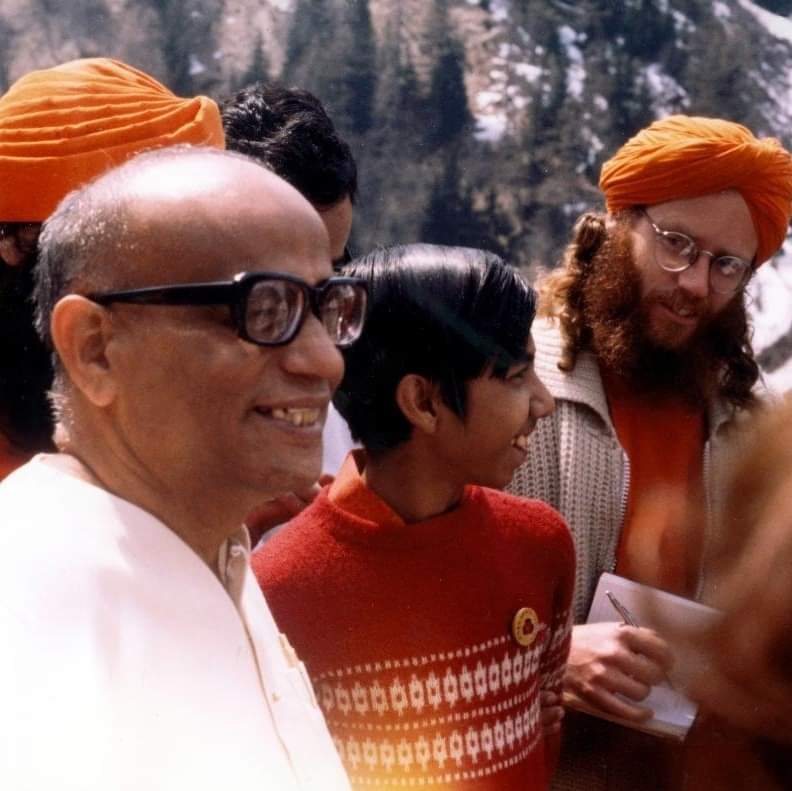
Shrii Shrii Ánandamúrti smiling among disciples, a boy and a bearded man beside him, mountains behind
You are never alone or helpless. The force that guides the stars, guides you too.

His disciples called him Bábá. Here are the things they saw him do and heard him say, each told by someone who was there, and below them his own words.

Stories

  • The hard years · 1972 · Patna

    Water for the thirsty convicts

    One evening in 1972 in Bankipur jail, Shrii Shrii Ánandamúrti was walking alone between the cells while his disciples meditated. Convicts in a distant ward were calling out: they had been locked in after a hurried dinner with no water, and the guards ignored them. Shrii Shrii Ánandamúrti fetched the earthen jar and tumbler from his own cell and, despite their protests, gave each of them water with his own hand. He said nothing about it. When asked the next morning, he replied that it had only been his duty, and duty needs no announcement.

    Bábá stubbornly continued to persuade them. He cajoled them by saying that, contrary to their apprehensions, He would get pleasure if He could serve them. At last, Bábá gave them all water, one by one. Their thirst quenched, they gazed at Bábá, not knowing how to express their gratitude.

    — Ác. Sarveshvaránanda Avadhúta, My Days With Bábá

  • The hard years · Buxar

    Years that do not count

    For the first two months of his imprisonment Shrii Shrii Ánandamúrti was held in Buxar prison, where a convict, Ramcheej, a simple villager, was given to him as a helper and soon served him with great devotion. One day Shrii Shrii Ánandamúrti asked his age. 'Around fifty,' Ramcheej said. Shrii Shrii Ánandamúrti remarked that he looked older. Ramcheej explained that he had not added the ten years spent in jail: those were a sentence, not years lived. Shrii Shrii Ánandamúrti laughed. He told the story himself two days after his release in 1978.

    Ramcheej innocently replied, "Those years were spent in my jail sentence-how can I add them to the years I have lived!" (Bábá, u to sajá me katal bá, umar me kaise jorai). Bábá laughed, and understood that he was more than sixty years old.

    — Ácárya Keshavánanda Avadhúta, Reminiscences of Bábá

  • The hard years · 1972 · Patna

    Commas in the court record

    On 16 September 1972 Shrii Shrii Ánandamúrti, weak and ill, was brought from jail by ambulance and carried into a Patna court on a stretcher to make his statement. Asked in which language it should be recorded, he chose English. Speaking from a small cot for about ninety minutes, he called the charges concocted. When the magistrate read the statement back, Shrii Shrii Ánandamúrti asked where the comma and full stop had been placed in one sentence, showed that this changed his meaning, and the sentence was corrected.

    Another point: after the statement had been given, the magistrate read it back. On one sentence my Master asked the magistrate, "Where have you put the comma and the full stop?" The magistrate explained, and my Master said, "According to your placement the meaning of the sentence is different from what I said." The magistrate then changed the sentence according to my Master.

    — Ácárya Krpánanda Avadhúta, About Bábá and Ananda Marga

  • The hard years · 1970s · Patna

    Four visitors ask him to eat

    During Shrii Shrii Ánandamúrti's long fast in jail, his disciples persuaded four national political figures to visit him and press for his release on bail. They urged him to give up the fast, reminding him that Gandhi's longest fast had lasted 21 days. He politely refused: he had taken a vow and could not break it. Afterwards the four described the meeting so differently that it seemed they had seen different men. One feared he would not survive a fortnight; another said he was roaring like a lion.

    Afterwards, when we asked them to describe their meeting with Bábá, it was almost as if all four had different experiences! Their opinions of Bábá's condition were strikingly different. Prof. Guha said, "Bábá will not survive a fortnight, because, as I observed, He is too weak." Shyam Lai Jadav said, "Who says that He has grown weak? He was roaring like a lion!"

    — Ác. Shraddhánanda Avadhúta, My Spiritual Life With Bábá

  • The hard years · 1978 · Patna

    Release, and his sister's first meal

    After the High Court acquitted him, Shrii Shrii Ánandamúrti was released from jail in Patna on 2 August 1978. He had asked that his elder sister, Hiraprabha, be there. A huge crowd threw flowers as his old car moved slowly out of the gate, his hands folded in greeting the whole way. He had kept his fast in jail for more than five years. Many wanted to cook his first meal, but all gave way to his sister, who served him coconut water and then kitchuri.

    Though there were many who wanted the privilege of preparing his first meal in nearly five and a half years, all agreed to accept the precedence of his elder sister, Hiraprabha. It was well known how much she loved her brother and how much he loved and respected her.

    — Acharya Ramananda Avadhuta, Ashutosh Bábá: The Memoirs of Acharya Ramananda Avadhuta

Showing 5 of 5

Quotes

  • What is then the most precious thing in human life? It is devotion. If one has gotten devotion, one has gotten everything, and nothing remains unrealized.

  • Life is a spiritual sádhaná and the result of this sádhaná is to be offered at the altar of the Supreme.

  • Since the Supreme Father is with me, why should I be afraid of anyone? Why should I fear at all? There is no reason to be fearful. I have to move forward. Fearfulness is not my duty. Let the fear fear me, I will not fear.

  • You have no right to hate even a single living creature. The best you can do is only to serve.

  • Human society is one and indivisible, don’t try to divide it. Each and every individual should be looked upon as the manifestation of the Cosmic Entity.

  • Struggle is the essence of life. Yours should be a pauseless struggle against corruption, hypocrisy and animality.

  • Don’t compare life to a pool of muddy, stagnant water. Life resembles an ever-flowing spring.

  • Knowing oneself is the real knowledge; serving all with the ideation of Náráyańa, the real action, and the vow to please Parama Puruśa the real devotion.

  • You all know that Parama Puruśa is very close to you. He is so near that nothing can be nearer.

  • Morality is the foundation of Sádhaná (spiritual practice). It must, however, be remembered that morality or good conduct is not the culminating point of the spiritual march.

  • Do all your works unitedly. No work is hard for you, no work is difficult. Move forward easily and smilingly, solving all the problems of the world. Your victory is assured.

  • Remember that your service does not oblige the Supreme, rather you are obliged because you have such a chance to serve the Supreme in the form of living beings.

Showing 12 of 45

Show more