
Collective practices · Together · Read together at Dharmacakra
Supreme Command
Read together at every Dharmacakra
Part of: Dharmacakra →Shrii Shrii Ánandamúrti’s Supreme Command, read together at every Dharmacakra.
Why we do it
The aim of yoga is Supreme Consciousness
- 1
The aim is Supreme Consciousness. The goal of yoga is far off, like a distant star system.
- 2
The instrument to reach that goal is the mind. It is the subtlest part of us, so it is the only part fine enough to reach the aim.
- 3
The method is meditation. Seeing a star takes a telescope pointed at it; reaching Supreme Consciousness takes the mind pointed at it. That is meditation.
- 4See how it leads to the goal ↓
The preparation and care. A telescope has to be looked after, cleaned and set right to see the stars. The mind is the same. Every practice does this for the mind, directly or through the body, because the mind is connected with the body.
Reaching the goal through Supreme Command
The Supreme Command brings us to the goal by keeping the minimum of a disciple's life before the mind every day: sádhaná twice a day, yama and niyama, and bringing others to the path. It is said aloud and together, because this path is walked with many. Kept, these three keep the mind on Parama Puruśa, and one who thinks of Him becomes Him. That is the goal of yoga.
- 01
The minimum
Sádhaná twice a day, yama and niyama, and bringing others to the path: this is the least that a disciple's life asks.
- 02
A daily reminder
A minimum is easily forgotten. So it is read again at every dharmacakra.
- 03
Aloud, together
It is said aloud and together: each one hears it from the others too, because this path is walked with many.
“On this path one must move in unison with many, because this path is the path of synthesis, of non-differentiation.”
Subháśita Saḿgraha 6, “In Adoration of the Supreme” - 04
Sádhaná twice a day
First: sádhaná twice a day, whatever the circumstances.
“Whether one is healthy or sick, whether in a sitting or lying posture, or in a vehicle, full Iishvara prańidhána (meditation) will have to be performed twice a day.”
Caryácarya 2, “Sádhaná (Intuitional Practice)” - 05
Yama and Niyama
Second: yama and niyama, because without them sádhaná is not possible.
“It must, therefore, be emphasized that even before beginning Sádhaná, one must follow moral principles strictly.”
A Guide to Human Conduct, “Introduction” - 06
Others too
Third: to bring others to the path. Those going the wrong way are warned and guided, as a road sign warns of danger ahead.
“So intelligent people should point out their mistakes and inspire them to move along the path of progress.”
Subháśita Saḿgraha 7, “The Supreme Question – 2” - 07
One who thinks of Him
Kept every day, these three keep the thought of Parama Puruśa in the mind, and one who thinks of Him becomes Him. This is the goal.
“Brahmavid Brahmaeva bhavati – “One who thinks of Parama Puruśa becomes Parama Puruśa.””
Namámi Krśńasundaram, “Párthasárathi Krśńa and Aesthetic Science”
What it is
The Supreme Command is a short text of Shrii Shrii Ánandamúrti. It lays down three things: to perform sádhaná twice a day without fail, to follow yama and niyama, and to endeavor to bring all to the path of bliss. It is said aloud, together.
When it is read
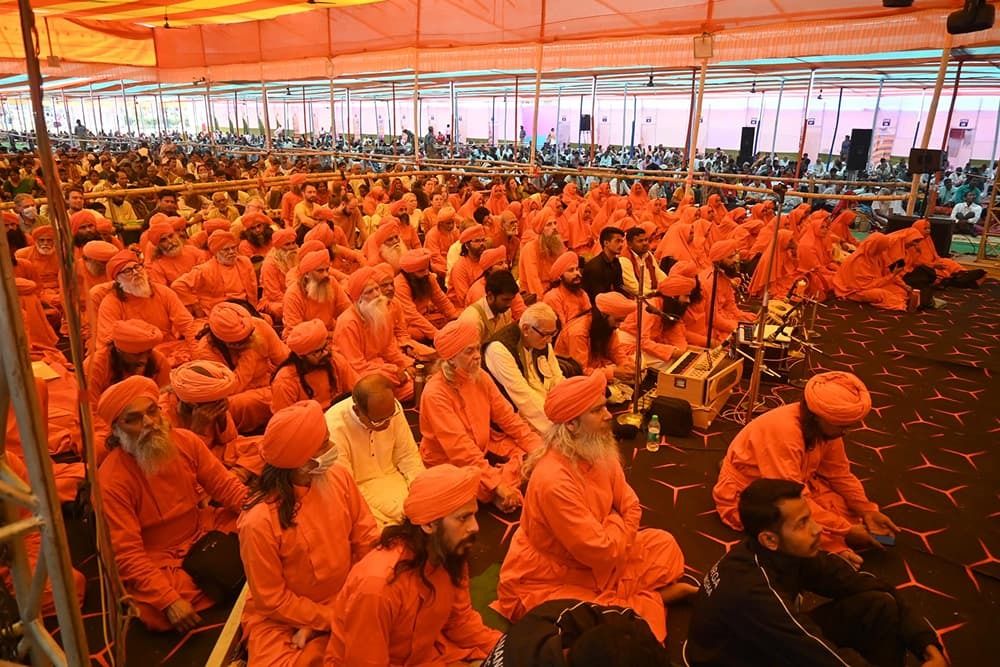
Only at dharmacakra, aloud and together.
The text
Those who perform sádhaná twice a day regularly, the thought of Parama Puruśa will certainly arise in their minds at the time of death; their liberation is a sure guarantee. Therefore every Ánanda Márgii will have to perform sádhaná twice a day invariably; verily is this the command of the Lord. Without yama and niyama, sádhaná is an impossibility; hence the Lord’s command is also to follow yama and niyama. Disobedience to this command is nothing but to throw oneself into the tortures of animal life for crores of years. That no one should undergo torments such as these, that everyone might be enabled to enjoy the eternal blessedness under the loving shelter of the Lord, it is the bounden duty of every Ánanda Márgii to endeavour to bring all to the path of bliss. Verily is this a part and parcel of sádhaná, to lead others along the path of righteousness.
Shrii Shrii Ánandamúrti, the Supreme Command, as printed at the front of Ananda Marga books