
Ananda Marga

Collective practices · Together · Every Sunday

Dharmacakra

Dharmacakra

“Dharmacakra is a congregation of spiritual aspirants for collective performance of Iishvara Prańidhána and spiritual discussions.”Caryácarya 1

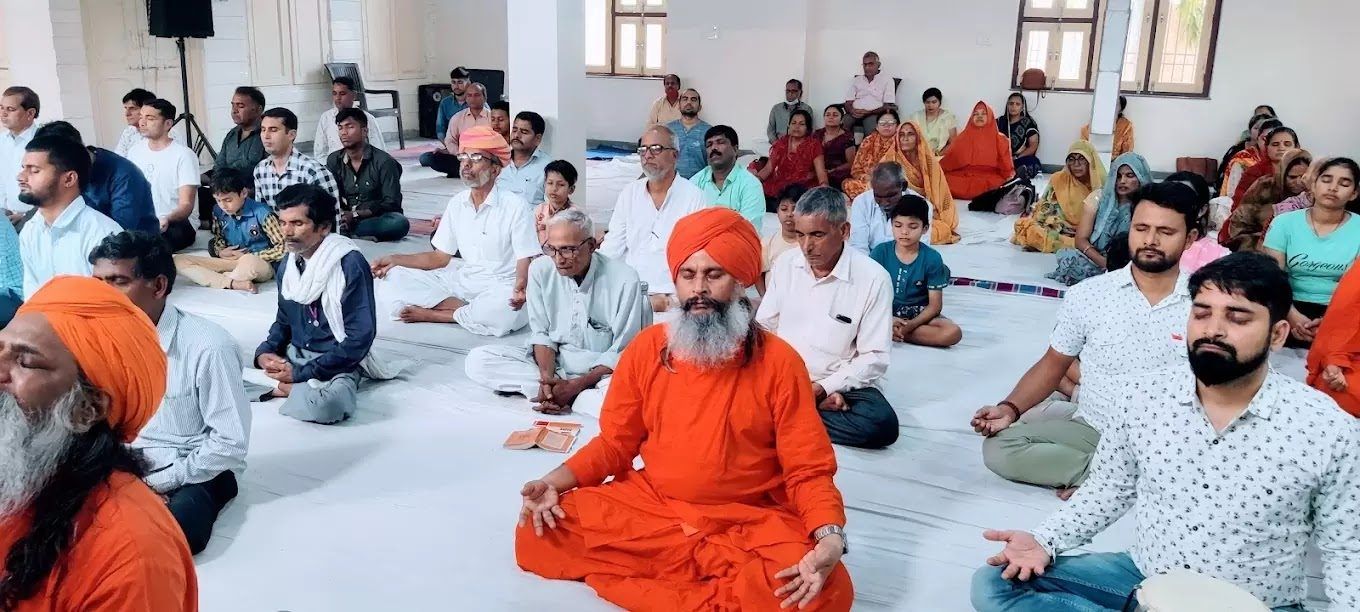
Men and women meditating together in rows on white sheets in a large hall, an ácárya in orange in front

Why we do it

The aim of yoga is Supreme Consciousness

  1. 1

    The aim is Supreme Consciousness. The goal of yoga is far off, like a distant star system.

  2. 2

    The instrument to reach that goal is the mind. It is the subtlest part of us, so it is the only part fine enough to reach the aim.

  3. 3

    The method is meditation. Seeing a star takes a telescope pointed at it; reaching Supreme Consciousness takes the mind pointed at it. That is meditation.

  4. 4

    The preparation and care. A telescope has to be looked after, cleaned and set right to see the stars. The mind is the same. Every practice does this for the mind, directly or through the body, because the mind is connected with the body.

    See how it leads to the goal ↓

Reaching the goal through Dharmacakra

Dharmacakra brings us to the goal through collective Iishvara prańidhána. Once a week sádhakas sit down together with one aim. Each mind moves toward Parama Puruśa, the Supreme Shelter, and the minds of all work together, so the signs of deep ideation come in a very short time. After meditation come the reading and the talk, and good company straightens the flow of the mind. A mind gathered at one point, dwelling on the Infinite, expands until it merges with Him. That union is yoga.

  1. 01

    One aim, one mind

    Dharmacakra begins with Saḿgacchadhvam, sung three times: let us move together, let our minds be as one mind. All of us come from one Macrocosm and will become one with it, so many people sit down with one aim.

    “So, while they are in society, while they are in the phenomenal world, they should remember this Supreme truth: that actually they are one, one Entity expressing itself through so many different corporeal structures.”
    Ánanda Vacanámrtam 3, “Saḿgacchadhvaḿ”
  2. 02

    Toward the Supreme Shelter

    Then comes Iishvara prańidhána. The mind is taken away from worldly things and moves toward Parama Puruśa, taking Him as its shelter. It is a mental effort entirely: an ideation, not a show.

    “So Iishvara prańidhána means to move with accelerated speed towards that Supreme Shelter, God.”
    A Guide to Human Conduct, “Iishvara Prańidhána”
  3. 03

    Many minds, faster

    Alone each mind makes its own effort. Together the efforts of all the minds work as one, and the higher signs come in a very short time: the signs of deep ideation, when the mind is vibrated with Cosmic feeling and the body shows it, in tears, trembling or horripilation.

    “In collective Iishvara prańidhána the combined mental efforts work together, and so give rise to the expression of the higher signs in a very short time.”
    A Guide to Human Conduct, “Iishvara Prańidhána”
  4. 04

    Good company straightens the mind

    After meditation the scriptures are read out and explained, and a talk follows. The talk of good people works on the mind: it is purified, its curvatures grow less and its flow becomes straight.

    “If you are in the company of good people – that company – their discourses and talks will influence your mind, and your mind will be purified. The curvatures will be less and the flow will be straightened.”
    Subháśita Saḿgraha 12, “Man and His Ideological Desideratum”
  5. 05

    The mind at one point

    The straighter the mental wave, the easier Iishvara prańidhána becomes. In it the mind is held for a while at one point, and so it leads to savikalpa samádhi.

    “Iishvara prańidhána is a more effective practice for the attainment of savikalpa samádhi, because during iishvara prańidhána the mind is temporarily concentrated in the state of ekagrabhumi (the fourth stage of mental development – the state of one-pointedness of mind).”
    Subháśita Saḿgraha 8, “Psychic Assimilation in Psycho-Spiritual Practice”
  6. 06

    The mind grows like what it dwells on

    A mind that dwells on the Infinite One grows: it expands step by step, and the enlarged mind finally merges with Him. Oneness in the object brings oneness in the subject.

    “Thus if the finite subjectivity (unit mind) dwells on the infinite One as its objectivity, it results in the gradual expansion of its self and this enlarged mind finally merges with Puruśottama.”
    Idea and Ideology, “Pratisaiṋcara and Manah”
  7. 07

    One with Him

    The closer the mind comes to Him, the smaller the gap, until the two merge. This union of the unit mind with the Supreme is yoga, the goal.

    “This supreme union of Puruśottama and the unit mind is known as yoga: Saḿyogo yogo ityukto jiivátmá Paramátmanah.”
    Idea and Ideology, “Pratisaiṋcara and Manah”

What it is

Dharmacakra is a gathering of spiritual aspirants for collective Iishvara prańidhána and spiritual discussion. It is held every week, on Sunday at a time set by the local ácárya, at the jágrti, the common house of Ananda Margiis. Regular participation is one of the Sixteen Points.

The lessons of sádhaná are practiced alone, in a lonely place. Iishvara prańidhána is practiced alone too, and also collectively; the opportunity to do it together should not be missed.

In the sources

“Regular participation in the weekly dharmacakra at the local jágrti should be considered mandatory.”Caryácarya 2, “Sixteen Points”

“The jágrti will be utilized for your assemblies and as a place for collective spiritual functions. The jágrti is the common property of Ananda Margiis, hence its sanctity must be meticulously maintained by all.”Caryácarya 1, “Jágrti”

“It is desirable to practise various lessons of sádhaná alone, in a lonely place, but Iishvara prańidhána can be practised both individually as well as collectively. In collective Iishvara prańidhána the combined mental efforts work together, and so give rise to the expression of the higher signs in a very short time. Therefore, like all other aspects of sádhaná, Iishvara prańidhána should positively be practised alone, in a lonely place; but in addition, do not miss the opportunity of collective Iishvara prańidhána whenever some of you conveniently meet together.”A Guide to Human Conduct, “Iishvara Prańidhána”

“In all family celebrations, perform collective Iishvara Prańidhána. Dharmacakra should be arranged in all social functions, and spiritual discourses may also be arranged, according to convenience.”Caryácarya 1, “Social Functions and Festivals”

How to do it

  1. 1

    Prabhát Saḿgiita

  2. 2

    Kiirtanabout 30 minutes

  3. 3

    SaḿgacchadhvamCaryácarya 1, “Dharmacakra”

    “The following mantra will be recited three times at the beginning of Iishvara Prańidhána.”

  4. 4

    Collective meditationabout 30 minutes

    “After the expiry of the time of Iishvara Prańidhána fixed by an ácárya/á, as soon as the signal is given, everyone (including those still in meditation) should be ready to join the collective meeting.”Caryácarya 1, “Dharmacakra”

  5. 5

    Nityaḿ shuddhaḿ

  6. 6

    Guru pújá

  7. 7

    Supreme Commandread together

  8. 8

    Svádhyáya

    “To read out and explain Ananda Marga scriptures before assembled sádhakas is called aopadhyáyik svádhyáya.”Caryácarya 1, “Svádhyáya”

  9. 9

    Pravacana

    Commentary on the spiritual text read in svádhyáya.

Take care

  • “All will sit in rows adjacent to each other. Women and men will sit in separate rows. Anyone joining dharmacakra (after Iishvara Prańidhána has started) will silently occupy a suitable seat in proper order.”Caryácarya 1, “Dharmacakra”
  • “In dharmacakra everybody will sit on common seats and wear clothes acceptable to the society.”Caryácarya 1, “Dharmacakra”
  • “Non-Margiis having an ardent spiritual longing may attend dharmacakra as a spectator or audience. In that case they will have to make known their intentions and obtain prior permission of the jágrti manager. Only Ananda Margiis are entitled to ask or answer questions at dharmacakra. It is the exclusive prerogative of the jágrti manager to allow or disallow a non-Margii to be present at dharmacakra.”Caryácarya 1, “Dharmacakra”

Done within it

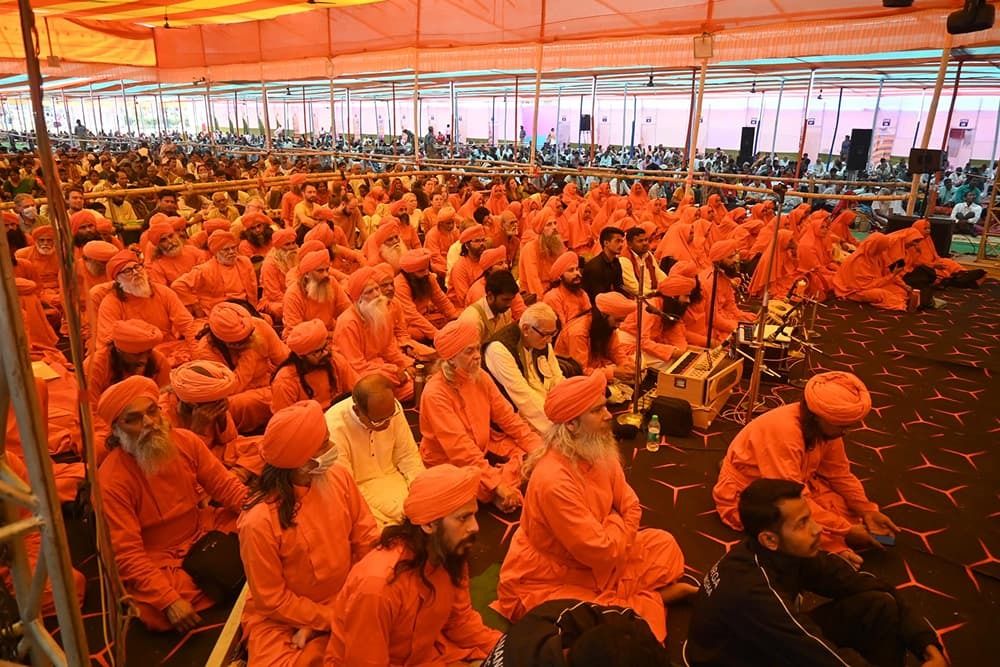
Hundreds of monks in orange and other people sitting together under a huge tent at a dharmacakra, a large crowd stretching into the distance

Supreme Command

Shrii Shrii Ánandamúrti’s Supreme Command, read together at every Dharmacakra.

How to do it, step by step →

Saḿgacchadhvam

“Here “moving together” does not mean march or double march, here “moving together” means that all portions of society, all portions of the collective body, should have the spirit to move ahead. Suppose you have gathered sufficient money, and there is no dearth of food in your house, but the remaining portion of society, your neighbours, your friends, are suffering from a dearth of money, or food, or clothes. Then it means that you are not following the spirit of “saḿgacchadhvam”.”Ánanda Vacanámrtam 3, “Saḿgacchadhvaḿ”

“Just to represent the spirit of “saḿgacchadhvam”, I propounded the theory of PROUT. So the entire theory of PROUT stands upon this Vaedika sermon of “saḿgacchadhvam”.”Ánanda Vacanámrtam 3, “Saḿgacchadhvaḿ”

“When everything cometh from the same source, from the same Progenitor, and when finally everything goeth back to the same desideratum, there must be the same aspirations, the same longing, in the heart of each and every individual.”Ánanda Vacanámrtam 3, “Saḿgacchadhvaḿ”

Let us move together, SamgachadvamOpen on YouTube ↗
Let us move together, Samgachadvam

Nityaḿ shuddhaḿ

“Paramátman does not undergo any change and cannot be touched by impurity, so He alone can be called pure, or shuddha. He is pure for all time, and nothing else can be like that.”Ánanda Vacanámrtam 3, “Nityaḿ Shuddhaḿ”

“So no one should feel disconcerted about anything. All should know that He is concerned about their welfare. Just as parents are concerned for their child, so is He even more concerned for each of His children. Therefore, do not be afraid or perplexed under any circumstances.”Ánanda Vacanámrtam 3, “Nityaḿ Shuddhaḿ”

The text

Saḿgacchadhvaḿ saḿvadadhvaḿ saḿ vo manáḿsi jánatám, Devábhágaḿ yathápúrve saḿjánáná upásate. Samánii va ákútih samáná hrdayánivah, Samánamastu vo mano yathá vah susahásati. Nityaḿ shuddhaḿ nirábhásaḿ nirákáraḿ niraiṋjanam; Nityabodhaḿ cidánandaḿ Gurubrahma namámyaham.

Translation

Let us move together, let us radiate the same thought-wave, let us come to know our minds together, let us share our wealth without differentiation, like sages of the past, so that all may enjoy the universe. Let our aspirations be united, let our hearts be inseparable, let our minds be as one mind, so that we live in harmony and become one with the Supreme. Eternal, pure, void of reflection, formless, without stain; ever awake, consciousness and bliss: to Guru-Brahma I make my salutation.

Word by word

sam
in the proper style, in the proper way, in the proper rhythm
gacchadhvaḿ
move (from the root gam, which denotes velocity, and life also)
saḿvadadhvaḿ
speak in the same line, without ambiguity (va, to speak)
vo, vah
your (plural)
deva
a divine existence
devábhágaḿ yathápúrve
the divine vibrations of the past
samánii ákútih
the same aspirations
nityaḿ
unchangeable, permanent
shuddhaḿ
pure: remaining as it should be, untouched by change
nirábhásaḿ
that which cannot be conceptualized, which has no semblance in other things
nirákáraḿ
without shape or size, under no bondage of limitation
niraiṋjanam
spotless
nityabodhaḿ
the one who knows fully about each and every object and mind
cidánandaḿ
cognition and bliss: His very existence is bliss

Word meanings: Ánanda Vacanámrtam Part 3, “Saḿgacchadhvaḿ” and “Nityaḿ Shuddhaḿ” (1978)

Download PDF

Every week

When in good health, every sádhaka takes part in the weekly dharmacakra. One who cannot come at the set time because of government duties or caring for patients goes to the jágrti any time that day and does Iishvara prańidhána there. If even that is not possible, one forgoes one principal meal at the end of that week.

Shrii Shrii Ánandamúrti
“The indomitable mental force aroused as a result of collective Iishvara prańidhána will help you solve any problem, great or small, on this earth. It is for this reason that you should always be zealous to attend weekly dharmacakra regularly.”
Shrii Shrii Ánandamúrti, A Guide to Human Conduct, “Iishvara Prańidhána”

What a study of weekly gatherings found

Stories

  • The tomcat at Dharmacakra

    … Dharmacakra was soon introduced at the Monghyr and Bhagalpur units as well. A curious incident occurred the day Dharmacakra started in Bhagalpur. It is indelibly imprinted in the minds of those who were there. On instructions from Jamalpur to the unit secretary of Bhagalpur that Dharmacakra should start as soon as possible, Márgiis gathered at the appointed place the day after getting the news. They had just finished chanting the Saḿgacchadhvaḿ mantra when a huge tomcat jumped through the window and stood staring at everyone. The tomcat was huge, with eyes big as saucers. He let out a terrible miaow. Everyone's eyes flew open, then the cat left. They were all mystified. Again they closed their eyes and continued Dharmacakra. The next day Ác. Pashupati, a senior ácárya of Bhagalpur, along with many sádhakas, went to Jamalpur to attend the general darshan. Márga Guru inquired about everyone's well-being. He then asked whether or not Dharmacakra had started in Bhagalpur. Márga Guru was pleased with Pashupatijii's answers. A little while later, turning to the whole assembly, he said with a mysterious smile, "Do you know that the sádhakas in Bhagalpur do Dharmacakra with their eyes open? Yesterday when they were doing Dharmacakra, I sent a tomcat to inspect them. Its duty was to see whether the sádhakas do their Dharmacakra as per the system or not. After that the tomcat reported to me that the Márgiis are practising Dharmacakra with their eyes open." Márga Guru inquired from Ác. Pashupati whether it was true or not. Ác. Pashupati spoke frankly about everything that happened the night before, and everyone laughed heartily. … Thus Dharmacakra was introduced in all branches of the Márga. Through the participation of many sádhakas a collective spiritual vibration was generated in these Dharmacakras. Their sense of brotherhood and their social awareness became stronger. …Read the story

    — An ácárya’s account, Bhagalpur and Jamalpur, 1955, Ácárya Vijayánanda Avadhúta, “The Life and Teachings of Shrii Shrii Ánandamúrti”, “Dharmacakra”

  • A wave that cannot be destroyed

    Three other ácáryas and I were in Bábá's bedroom in Lake Gardens one evening. Then Bábá said, "Look out the window." There were many stars in the sky. He continued, "There is a star in the far sky, thousands of light-years away. Around that star is a planet you can't see the size of Jupiter. That planet had humans like us long ago, but now it is dead. However, each and every one of the humans on that planet used to do sádhaná twice a day, eat only sentient food, etc. The collective spiritual wave they created was so strong that it is still there. If you could go there now and sit for sádhaná, you would get samádhi in five minutes. That is because the waves created millions of years ago are still strong. Collective spiritual vibration is a straight line; it can't be destroyed." "Do you know why I came to this planet?" Bábá paused and looked at us. "My goal is to create a spiritual vibration as powerful here on Earth. The time is coming very soon when there will be no communism, no capitalism on this planet. Each and every human being will do sádhaná and eat sentient food. They'll do it naturally—no one will be forced. A powerful spiritual wave will be created," Bábá said.Read the story

    — An ácárya, with three others in Bábá’s room, Lake Gardens, Calcutta, Ác. Shamitánanda Avadhúta, “Bábá Unparalleled: 102 Stories”, story 2

  • At least once a week

    … After this elaborate explanation of the importance of páiṋcajanya, Bábá emphasized the significance of dharmacakra. Dharmacakra is one of those spiritual practices that are mandatory for Ananda Márgiis. It involves the coming together of Márgiis in a particular area to do collective meditation in a prescribed manner once a week. This practice generates a powerful collective vibration and removes problems confronting Márgiis. Dharmacakra also helps those who are weak in spiritual practice. He stressed, “It is My saḿkalpa that every sádhaka should participate in dharmacakra at least once a week.” …Read the story

    — A worker who travelled with Bábá, Mumbai, 1979, “Living With Bábá”, “Páiṋcajanya”

  • The spirit of living together

    … When Bábá first gave his social code, the number of Márgiis was very small, and they had all been following the Hindu way of life. So several Márgiis asked Bábá why he had given such a detailed social code when they were only a few hundred in number. Bábá answered, "I foresee a time when our Ananda Marga Caryácarya will serve as the new social code for common people. … All this will surely change one day when people understand what the true purpose of life is. Then they will embrace the spirit of living together. Whatever I am doing now is for the benefit of the society of that time." Bábá paid special attention to creating a collective spirit through social and spiritual events. The most important way that he did this was through the introduction of a weekly collective meditation, which he made compulsory for every Ánanda Márgii. This weekly meditation was named dharmachakra (the wheel of dharma). He prescribed a Sanskrit verse from the end of the Rig-Veda to be sung in chorus before the collective meditation: … This verse became the quintessence of the philosophy of Ananda Marga that Bábá was slowly unfolding before the eyes of his disciples. …Read the story

    — A biographer’s account, Ác. Pranavátmakánanda Avadhúta, “Advent of a Mystery”, “16.1. Caryácarya”

What Shrii Shrii Ánandamúrti said

  • “So let everybody feel that everybody in this expressed universe belongs to the same big human family.”
    Ánanda Vacanámrtam 3, “Saḿgacchadhvaḿ”
  • “The difference among the units is the difference in their microcosmic reactive momenta, but you should remember always that the source of all these microcosms is the Singular Entity, the Singular Macrocosm. Then the relationship among human beings will become closer and closer.”
    Ánanda Vacanámrtam 3, “Saḿgacchadhvaḿ”
  • “Everybody should get the chance to develop their natural longings for Him.”
    Ánanda Vacanámrtam 3, “Saḿgacchadhvaḿ”
  • “I have told you that you are never alone in this world – the Entity that guides the stars guides you also.”
    Ánanda Vacanámrtam 3, “Nityaḿ Shuddhaḿ”
  • ““Saḿgacchadhvam” means to build a strong, well-knit society where there shall be no exploitation, no superiority complex or inferiority complex.”
    Ánanda Vacanámrtam 3, “Saḿgacchadhvaḿ”

Videos

  • Sixteen points 15. The Importance of Collective MeditationOpen on YouTube ↗

    Sixteen points 15. The Importance of Collective Meditation

  • Let us together move as oneOpen on YouTube ↗

    Let us together move as one

  • COLLECTIVE PRACTICE - BENEFIT BY GIVINGOpen on YouTube ↗

    COLLECTIVE PRACTICE - BENEFIT BY GIVING

  • Join the Flow: Meditate, Grow, and Contribute to the Collective EnergyOpen on YouTube ↗

    Join the Flow: Meditate, Grow, and Contribute to the Collective Energy

Music

Questions

Ask a question →