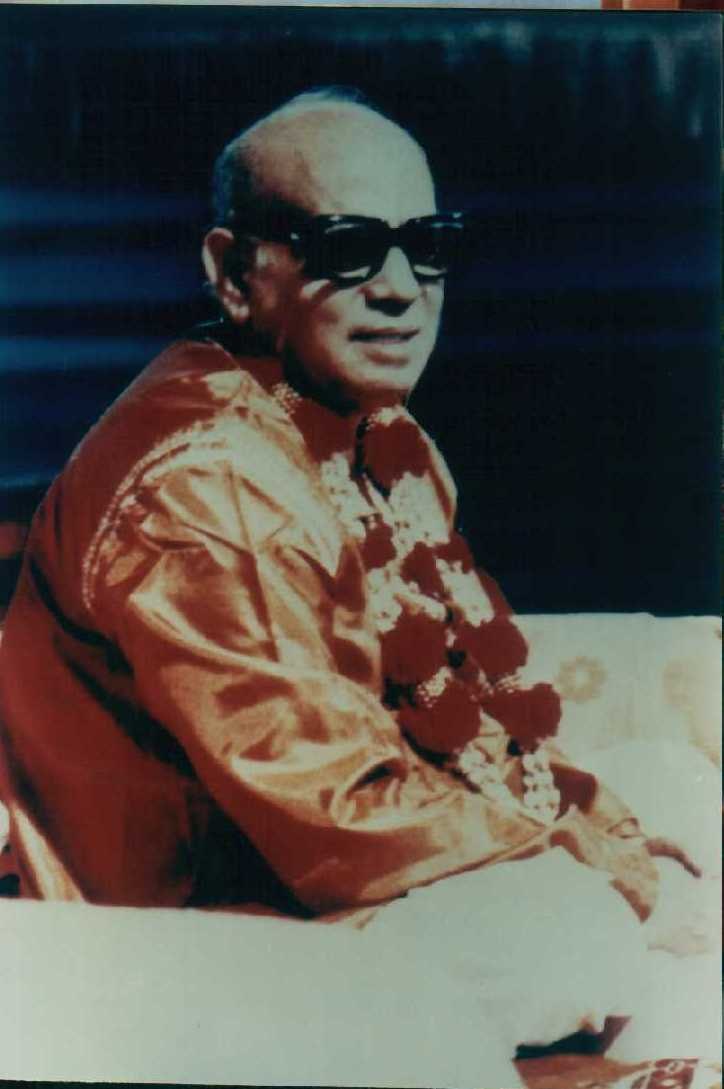
“A body of 5018 spiritual and psycho-spiritual songs composed by Prabhat Ranjan Sarkar (Shrii Shrii Ánandamúrti).”Caryácarya 1, “Páiṋcajanya”, translators’ footnote
The aim is Supreme Consciousness. The goal of yoga is far off, like a distant star system.
2
The instrument to reach that goal is the mind. It is the subtlest part of us, so it is the only part fine enough to reach the aim.
3
The method is meditation. Seeing a star takes a telescope pointed at it; reaching Supreme Consciousness takes the mind pointed at it. That is meditation.
4
The preparation and care. A telescope has to be looked after, cleaned and set right to see the stars. The mind is the same. Every practice does this for the mind, directly or through the body, because the mind is connected with the body.
Prabháta Saḿgiita brings us to the goal through feeling. A song is heard in the physical world but works on the subtle layers of the mind: it straightens the waves of the mind until they touch the soul, and a song whose soul is the feeling for Parama Puruśa grows into devotion.
Devotion brings one closest to Him, and moving from the subtle to the subtlest, the limited “I” is lost in Him in joy. That is the goal of yoga.
01
A mind in balance
A mind left without balance in daily life grows irritated and cannot concentrate in sádhaná. So Shiva gave song, dance and instrumental music: things of the everyday world that help spiritual life.
“In the absence of this adjustment, the mind becomes irritated and degenerates, and no concentration in sádhaná is possible for such a mind.”
A Few Problems Solved 3, “Song, Dance and Instrumental Music”
02
Song reaches the subtle mind
A song is sung and heard in the physical world, yet it works on the subtler layers of the mind.
“Songs [vocal] are rooted in the physical world, but their impact is on the subtler layers of the human mind.”
A Few Problems Solved 3, “Song, Dance and Instrumental Music”
03
The subtle drives out the crude
Once the mind has tasted something subtle, it lets the crude go by itself.
“Thus the general psychology is that once people experience something subtle, they automatically discard the crude.”
A Few Problems Solved 4, “Supra-Aesthetic Science and Music”
04
The waves straightened
The wave of a song straightens the waves of the mind, and the straightened waves reach the point of the soul.
“Songs produce a vibrational wave which makes our mental waves straight, and these straightened mental waves in turn ultimately touch the point of the soul.”
A Few Problems Solved 3, “Song, Dance and Instrumental Music”
05
Feeling is its soul
For that a song needs rhythm and melody, but above all feeling, bháva, and so a deep idea. In Prabháta Saḿgiita the feeling is that of a devotee toward Parama Puruśa, in daily life and in deep meditation.
“Now to touch the embodied soul, the songs must have rhythm, melody and feeling (bháva). If there is no feeling, the song will lack sweetness. Therefore, songs must have deep ideas.”
A Few Problems Solved 3, “Song, Dance and Instrumental Music”
06
Devotion grows
Sung again and again, this feeling grows into devotion, a sweet love for Him; and it is through devotion that one comes closest to Him.
“Human beings (jiivas) come closest to Parama Puruśa through devotion, through sweet love for Him (Rádhá bháva).”
Namámi Krśńasundaram, “Vraja Krśńa and Párthasárathi Krśńa – 2”
07
Lost in Him
From the subtle to the subtlest, refined feeling carries one into Eternal Beauty, and there the joy is so great that the limited “I” is lost. This is the goal.
“Then those who attain such a state will no longer possess the ability or capacity to taste the beauty of anything: the beauty of music or the beauty of dance will no longer remain an object of experience for them; because at that time they will have attained a state so intoxicated with joy that they will lose their limited identity, and thus their ability to experience anything.”
A Few Problems Solved 4, “Supra-Aesthetic Science and Music”
What it is
Prabháta Saḿgiita, the songs of the new dawn, are 5018 songs composed by Shrii Shrii Ánandamúrti (Prabhat Ranjan Sarkar), the words and the melodies both, from September 14, 1982 to October 20, 1990. Most are in Bengali; there are songs in eight languages. They are sung in the original language and to the melodies given.
Most of the songs are on spiritual themes: the feelings of a devotee in daily life and in deep meditation. Many others are for festivals and seasons or speak of society. A song of Prabháta Saḿgiita is addressed to Parama Puruśa directly, one to one.
In the sources
“The collective name of dance, song and instrumental music is saḿgiita, or music.”A Few Problems Solved 3, “Song, Dance and Instrumental Music”
As Ác. Parmeshvaránanda Avadhúta recalls: “Bábá initiated a new school of music & set each song to tune at Deoghar, a small town in Bihar. It was that memorable day of 14th of September 1982, when he composed the first song and this process continued until 20th October 1990 — a day before His physical departure from our planet. He called the new school of music — Prabhat saḿgiitá. Prabhat saḿgiitá is a store house of a staggering 5018 songs. The compositions are in eight different languages.” (My Bábá: English Rendering of Divyánubhúti, “You will not speak a lie under any circumstances”)
As Ácárya Keshavánanda Avadhúta recalls: “Bábá created a flow of songs, mostly in Bengali, as well as in Sanskrit, Hindi, English, Mathilii, Magahii, Urdu and Angiika. They were composed in different styles, to be sung at different occasions, festivals and seasons. The songs express the different devotional feelings felt both in daily life and deep meditation in a very poetic and expressive language.” (Reminiscences of Bábá: Memoirs, “5.21. Prabháta Saḿgiitá” (2011))
As Ácárya Keshavánanda Avadhúta recalls: “Bábá gave the melodies of the songs as well as composing the lyrics. The lyrics of Prabháta Saḿgiitá should be sung in the original language and to the melodies given by Bábá.” (Reminiscences of Bábá: Memoirs, “5.21. Prabháta Saḿgiitá” (2011))
When it is sung
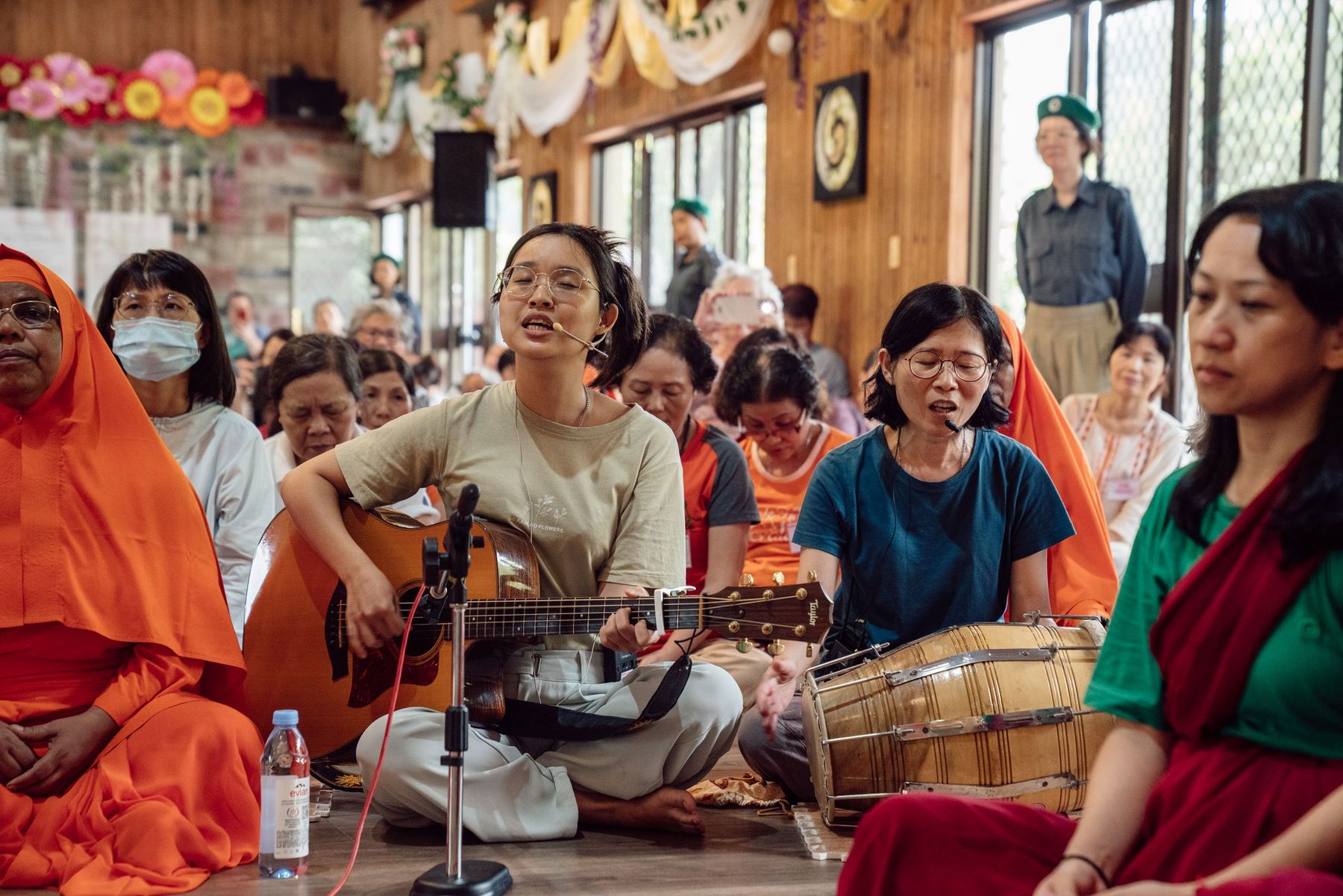
Before kiirtan and meditation, to open them.
“At five o’clock every morning, sádhakas [spiritual aspirants] will assemble at a jágrti, and where there is no jágrti, at a fixed convenient place, and participate in singing five minutes of Prabháta Saḿgiita, in performing fifteen minutes of kiirtana, and lastly in performing ten minutes of collective meditation.”Caryácarya 1, “Páiṋcajanya”
“This should be the practice on all days of the week except Sundays. On Sundays, there should be singing of ten minutes of Prabháta Saḿgiita, performance of fifteen minutes of kiirtana, and performance of at least ten minutes of collective meditation. This programme is known as páiṋcajanya.”Caryácarya 1, “Páiṋcajanya”
Bhajana and kiirtana
“In more recent times, Mahaprabhu Caetanya Deva also encouraged these three things: he said that the lyrics of the song should directly reflect Parama Puruśa Himself. And this category of song, directly reflecting Parama Puruśa is known as Kiirtana. The other category of song that also reflects Parama Puruśa, but which expresses many tangential ideas before returning to the one central idea of Parama Puruśa, is called bhajana. This is the basic difference between bhajana and kiirtana. In this respect, I fully agree with the previous propounders: I also encourage these three things.”A Few Problems Solved 3, “Song, Dance and Instrumental Music”
Lecture "How to Practice Indian Spiritual Songs - the Principles of Classical Indian Poetry Singing"Open on YouTube ↗Lecture "How to Practice Indian Spiritual Songs - the Principles of Classical Indian Poetry Singing"
All the songs in one app
All 5018 songs can be heard in the Prabhat Samgiita Player, with the words of each song and its translation. The app is free, for iPhone and Android.
Members of an amateur choir reported more positive and less negative mood after an hour of singing, and showed higher levels of an immune marker, salivary immunoglobulin A.
A meta-analysis of 104 randomized trials found that music reduces stress, both in the body (heart rate, blood pressure, hormone levels) and in how stressed people feel.
There were a number of márgiis and acharyas in Ananda Marga who used to compose devotional songs and sing them in front of Bábá: for example, Kshitij, Natkat Kedar, Muphlish, and several workers, such as Nityasatyananda. At some point Bábá began saying that Ananda Marga should have its own system or school of music, its own gharáńá. In the present age, he’d say, music has gone in the wrong direction; it has become distorted. …
Early one morning—it was September 14—Bábá came out of his room and asked me to gather some good singers, those who were knowledgeable about music, and have them ready when he called.
“I will give you half an hour to bring them,” he said. It was barely 4:30 but I managed to round up four or five people whom I knew to be good singers. Devatmananda was one. Didi Ananda Gita was another. Bábá was still in his room but the door was partially open and I could hear him humming a melody. Then he came out and sat down.
“I want to say something about songs,” he said. “Many márgiis are singing devotional songs but they do so without any acknowledged system. For this reason, I am thinking of introducing a new gharáńá, which I think will benefit everyone. But first I want your advice. Do you think that there will be any interest in this?”
We were all very enthusiastic in our response. We knew how much the márgiis would appreciate it and we told Bábá so.
“Then let us go ahead. Let it be introduced from here, from Deoghar.”
Bábá started singing the melody that he had been humming in his room. Then he asked those workers to sing the melody back to him. When he was satisfied that they had memorized the melody correctly, he sang it with the words and they noted them down and then sang the song in front of him.
When they were done, he asked, “How do you like this song? Should it remain and become the first Prabhat Saḿgiitá?”
“Yes, Bábá, it is very beautiful, both words and music.”
“Are you sure? If you don’t like it, then I will cancel it.”
“No, Bábá, don’t cancel it. We love the song.”
“Okay then. If you approve of it, then let the song remain.”
That was how the first Prabhat Saḿgiitá, bandu he niye calo, was given. …Read the storyCollapse
— A worker who was with Bábá, Deoghar, September 1982, Acharya Ramananda Avadhuta, “Ashutosh Bábá: The Memoirs of Acharya Ramananda Avadhuta”, “Prabhat Saḿgiitá”
A pot for the milk
Bábá was fond of music, especially devotional songs. Before Prabhát Saḿgiitá was composed, Bábá enjoyed listening to the songs of the devotees, whether they were in literary language or not. Even songs that were monotonous or lacked poetic rhythm could send Him into a reverie. In the early days some of the songs sung by the devotees in Bihar were, to my ears at least, only a mixture of deafening drums, noisy clapping and ear-splitting tuneless singing. Nevertheless Bábá would be lost in a trance of pleasure. He used to say that though the songs bordered upon cacophony there was a spontaneous flow of devotion. It was the devotional feeling that made Bábá happy and applaud the singers. …
Once Bábá came to Ánandanagar for DMC. It was a beautiful morning. After having made a song to a very sublime rága, He was eating breakfast.
Suddenly He said to me, "The tune I used today I once used in an Urdu song that I composed in my school days. Would you like to hear it?"
"Oh yes, please," I said. Bábá sang that Urdu song. I was spellbound by the lyrics and the melody. Though the theme of the song was social and lacked spiritual content, I liked it very much.
Bábá added, "I composed many poems in those days."
I said, "You composed such marvelous songs when you were a student, but it seems you have waited a long time before beginning Prabhát Saḿgiitá. Why is that?"
Bábá explained smilingly, "I have told you that I always act at the proper time in accordance with the plans I've made. Let us say that I have a cow that gives an immense amount of milk. Should I start milking it right away, or should I first see to it that I've a pot to put the milk in? If I start milking without a pot, all of it will spill to the ground and be lost. So, I had a plan to create something special in the world of music that would be a unique fusion of devotion and exuberance to bring about a great spiritual vibration all over the world. But until now there was no proper medium to contain that vibration. It was only when I was convinced that the right people were there and the infrastructure existed to sustain and utilize those spiritual vibrations that I was able to start Prabhát Saḿgiitá with the first song, Bandhu He Niye Calo ('O Friend, Guide Me')." …Read the storyCollapse
— A worker who took down the songs, Ánanda Nagar, Ác. Sarveshvaránanda Avadhúta, “My Days With Bábá”, “6.1. Prabhát Saḿgiitá”
New songs for a new age
I was touring in Central America when I heard that Bábá had started composing songs. I had loved the songs of Rabindranath Tagore all my life; when I heard the first songs of Prabhát Saḿgiitá I liked them, but my attachment to Tagore songs was very strong. Anyway, I thought, surely Bábá cannot sing.
I was suddenly called to Calcutta. The day after I arrived I went to his room. I did sastaung prańám, and Bábá told me to get up; I sat in front of Him. Bábá started singing! He sang "Bandhu He," and it was the most beautiful thing I had ever heard.
He smiled at me and asked, "Do you like this song? Can I sing nicely?"
"Bábá," I said, "You sing more beautifully than anyone I have ever heard."
"Do you like Prabhát Saḿgiitá?" He asked.
I answered yes but internally I was thinking how much I liked Tagore songs.
"You know," said Bábá, "Tagore songs are now old and monotonous. In a new age, in a new time, we need new songs. Is it not?"
"Yes, Bábá," I replied, and I decided from that day to learn Prabhát Saḿgiitá. Today I love Bábá's songs above all others.Read the storyCollapse
— A worker called back from Central America, Calcutta, Ác. Shamitánanda Avt., “101 Bábá Stories”, no. 40
Like a mountain spring
Calcutta, 1988. I had left my notebook in the reporting hall just outside Bábá’s room. Side-stepping the security guard, I ran back up the stairs. When I was about to burst into the room, I had a shock—Bábá Himself was sitting there with the General Secretary and two other workers I knew well. I slammed to a halt on the stairway, and pulled back just enough to see, but not be easily seen.
Within a moment, I guessed their purpose: Bábá had composed a new song and He wanted them to record it.
This was a sight extraordinaire, a private matter seen by few. I held my breath, hoping I would not be noticed.
Though they spoke in Bengali, I caught the gist. The drama and their conversation went like this.
“I’ve composed a new song,” Bábá said. “Do you want to hear it?” He sat in His big chair, they at His feet.
They turned to each other saying, “I don’t want to hear it. Do you?”
“No, not me.”
“Another time, Bábá.” They giggled like children playing with their father. He also laughed.
“Well, I’ll sing it anyway,” He said.
“No, no, Bábá!”
He put His finger to His lips to silence them, and began singing only one sound: “Na na na na na na na na na…”
After He finished, He asked, “How do you like the melody?”
They looked at each other, smiling.
“Not very good.”
“I wouldn’t say one of Your best.”
“Don’t You have anything better?”
Then He sang the words. At the time, I felt He was like a mountain spring—effortlessly and naturally singing without hesitation or thought. His voice was different than I had imagined, different from His speaking voice (which was usually slightly nasal). He played with His voice like an instrument, with perfect control—mellow, unstrained and pleasing. Of course, He had no written notes. They feverishly scribbled as He sang, trying to write every word. When He finished, there were no wisecracks. They were moved by the song, moved almost to tears. He waved His hand, and they began singing. At first their voices did not perfectly reflect the melody—each sang to some extent in his own way. But as they continued, the differences diminished, and they fell into the true tune. …
Now Bábá was explaining their mistakes, while they buried their faces in their notes, correcting them. Again the three of them sang, as Bábá nodded in approval. Even though I did not clearly understand the song’s meaning, by the time they came to the final notes, I, too, felt their ecstasy. …Read the storyCollapse
— A monk who happened to be on the stairs, Calcutta, 1988, Dada Dharmavedananda, “Travels with the Mystic Master”, “Like a mountain spring”
A song made that morning
We had not been able to materialize some of our work targets, so we had no permission to enter M.G. Quarters. We mostly stayed outside His house. I was very sad because I could not talk to Bábá. I stayed outside His house for months. One morning Bábá's P.A. conveyed a message to us that Bábá would be going to Tiljala and we could go inside M.G. Quarters there, because there was no organizational work, so We all went to Tiljala. After seeing the garden Bábá came into the General Darshan hall in His quarters, and I was sitting at the back of the hall. It had been a long time since I had seen Bábá so close up.
Bábá was sitting on a chair. Someone was singing some Prabhát Samgiit songs.
In the middle of Prabhát Samgiit Bábá asked them to stop and said loudly, "Is Dhyaneshananda here?"
I stood up and said, "Yes Bábá, I am here."
Bábá asked, "What do you feel about this line of the song."
I said, "Bábá, it is very touching." I was not in a condition to say anything more, as my voice was choked by tears.
Bábá said, "Yes, Yes, he has understood this." The meaning of that line, was, "You may be away from Paramapuruśa physically but He is always with you, He can't go away from you." Bábá had made that song the same morning. I felt in the morning Bábá had thought about us and made this song. He wanted to tell me this through His song so He called us to His quarters in Tiljala.Read the storyCollapse
— A worker kept away for months, Tiljala, Calcutta, Ac. Dhyaneshananda, “Stories of Bábá”, no. 49
Singing through the night
There was a time when Bábá remained at Ranchi for several months. During that period there was a very strong flow of Prabhat Samgiit. Bábá used to walk daily, sometimes just in front of His residence. The Márgiis sang Prabhat Samgiit, while standing on both sides of the path where He walked. Sometimes, the Márgii sisters presented a dance interpretation of Prabhat Samgiit. Many Márgii families came in the morning, stayed the entire day and returned to their homes at night. A joyous and colorful festive atmosphere prevailed.
During one of those days, Bábá requested for Akhańd́a Prabhat Samgiit, which was the continuous singing of Prabhat Samgiit the whole night. We informed the Márgiis about Bábá’s request, and they all came happily in droves. We joyfully sang Prabhat Samgiit throughout the entire night. Bábá told us that no song should be repeated.
We organized the program to the best of our ability. We carefully selected the songs and the singers. The Akhańd́a Prabhat Samgiit started in the evening and ended the next morning. At every hour Bábá opened His door and said, “I am listening to the songs!” It was such a beautiful, magical function. Sometimes, we felt a little sleepy. But the moment we heard His sweet voice at His door, a surge of inspiration refreshed us and kept us in the flow of the music. What a divine atmosphere it was! …Read the storyCollapse
— A worker who organized the singing, Ranchi, “Living With Bábá”, “Akhańd́a Prabhat Samgiit”
What Shrii Shrii Ánandamúrti said
“This is the reason why devotees should sing bhajana (devotional songs) and kiirtana as much as possible, and the result will be that the nucleus of Puruśottama will be shifted to the place of kiirtana, producing a very powerful devotional vibration that elevates all the human minds.”
Subháśita Saḿgraha 11, “The Supreme Desideratum of the Microcosms”
Videos
Lecture "Introduction to Spiritual Songs for Meditation" by Dada DiiptimananandaOpen on YouTube ↗
Lecture "Introduction to Spiritual Songs for Meditation" by Dada Diiptimanananda
Lecture "How to Practice Indian Spiritual Songs - the Principles of Classical Indian Poetry Singing"Open on YouTube ↗
Lecture "How to Practice Indian Spiritual Songs - the Principles of Classical Indian Poetry Singing"