
Where the fear of spiritual practice comes from, whether one must leave society to follow a spiritual path, and what happens to our desires when we begin to meditate.
The answer to this question does not lie on the surface. To understand the essence, we need to go deeper and ask ourselves: what do we live for? After all, every living being has a meaning and a purpose of existence. So what is mine?
Everything around us is moving and is part of the flow of evolution. All living beings travel the path from imperfection to perfection; the mind grows subtler, and a primitive intellect becomes developed.
How does a person usually answer the question about the purpose of life? Either they cannot answer it for themselves, or they say there is no purpose at all. This is a fundamentally wrong approach. There is an answer to this question, and people have known it since ancient times. At the moment when a person realizes that their small mind is identical with the cosmic Mind, their separate "I" merges with the cosmic "I," and then the individual consciousness dissolves in the cosmic Consciousness — and the main purpose of life is achieved.
Along with the development of the intellect comes greater responsibility. More challenges appear, and they are of a higher order. A spiritual person will keep moving forward and will not want their former life.
What keeps us in a state of imperfection
Moving from imperfection to perfection means struggling with and overcoming the force of ignorance. Struggling with and overcoming ignorance is effort, Spiritual practice: the daily effort, above all meditation, to move the mind toward the Infinite., a spiritual process, intuitional practice.
Some people, once they have the chance to learn the path of intuitional practice, become frightened and don't want to go forward. It is very important to work out:
- what kind of fear this is;
- where it comes from;
- how well founded and justified it is.
1. What kind of fear this is
Every fear arises from attachment. In this case it is attachment to the objects of pleasure of the material world. It is precisely attachment that triggers the fear of intuitional practice. Why?
2. Where the fear comes from
There is a misconception that spiritual practice means a path of asceticism — renouncing society and pleasures and living as a hermit somewhere in the mountains or the forest. Clearly this will frighten almost anyone who seriously considers following a spiritual path. It is worth working out whether one really has to leave society for a forest or a cave in order to follow a spiritual path.
3. How well founded and justified the fear is
It is said that the hermit's life has two advantages.
The first: solitude and silence, if a person lives far from people. It is believed that in such conditions it is easier to make progress in meditation. However, this is a matter of habit. If a person lives in a very noisy city, they have fitted naturally into their environment and no longer notice the noise and bustle. A city dweller's spiritual practice may be more productive precisely in the environment they are used to. Beginners in meditation are distracted by external objects, but over time a person learns to detach and simply filters out external noise. So the first "advantage" turns out to be rather doubtful and useless.
The second: getting away from temptations. Of course, in the city, among people, it is much easier to satisfy one's sensual desires. So a person develops the illusion that if they go off into a dense forest or a cave, the temptations will vanish from their mind. But this is a completely groundless expectation. Desires will not leave a person as long as the force of ignorance is present in their mind.
For example, in the city you are dependent on food, and you think you will conquer this by going off to the forest. But sitting there in the forest in the lotus pose, your brain will be busy creating pictures of pear and plum trees whose fruit the neighboring hermit might pick first. So the objects of desire change, but the extroversive tendency of the mind remains.
Of course, sitting in a bar, it is hard to stop drinking alcohol. It is right to avoid such places or the company of drinking people. But isn't it better to change inwardly, so that even if you find yourself among drinkers or in a bar, you stay true to yourself?
External isolation from the objects of desire helps one get rid of them to some extent, but it does not heal completely. There is a firm belief that alcoholism and drug addiction are incurable diseases. By abstaining, a person supposedly gets rid of their harmful habits, but they may relapse at any moment. The desire torments them from within, and they hold themselves back by willpower. And anything can happen if this wound is not fully healed.
Sádhaná is the balm that heals such wounds.
So by running away from desires into a hermit's life, it is impossible to get rid of them. Desires are provoked by the force of ignorance, and the only thing that can help is spiritual practice. One can live an ordinary life in society and do spiritual practices. There is one more very important point here: as a hermit, a person is deprived of the opportunity to serve.
The very fact that a person lives by moral and ethical principles and does spiritual practice is already a kind of service, because they set an example for others. People see this and think: "Oh, what a beautiful, radiant being! I want to be like that!" Is there such an opportunity for service in the forest? Who would you set an example for there? The hares or the foxes?
Society and spiritual practice
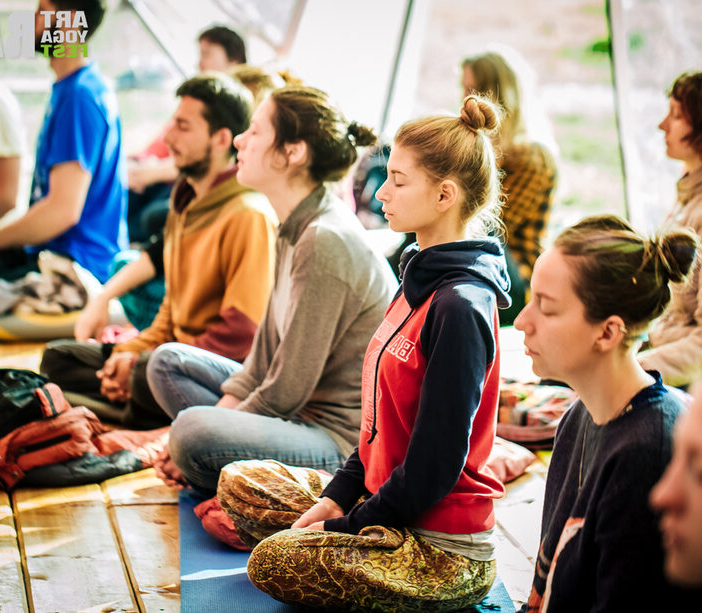
Living in society, there are no obstacles at all to doing spiritual practice. It is the key to overcoming ignorance — the ignorance that torments and tortures a person. But some people do not even understand what exactly is causing their suffering! They are mistaken in thinking that ignorance brings them happiness. Dogs sometimes behave like this. They find a dry bone and gnaw at it. The bone, dry and sharp, wounds the dog so that its gums bleed. And when the dog tastes the blood, it thinks: "Oh, what a juicy bone!" And it gnaws at it harder and harder. For people, the bone is their desires.
To understand what is happening to us and how our desires work, we do not need to go off to the forest. Will the purpose of life not be achieved if you live in a family, in society, as a citizen of a state, healing your inner wounds, overcoming your inner crudeness, finding a subtler path and subtler goals in life?
The fear of no longer wanting
People often think: "If I start meditating now, all my desires will disappear, and I'll become impotent toward life."
A person will certainly not become impotent toward life. But all their inclinations will be healthy. The body is healthy when it has vital energy. Then the nervous system, the glands, the hormones — everything will work efficiently. But the nature of a person's desires will change. For example, if you tell an alcoholic about the prospect of life without alcohol, he will take it as a threat and will suffer. But if you tell a teetotaler, "Listen, there's one condition: you'll have to go a whole year without drinking alcohol," he'll answer, "I don't drink anyway."
If some desires fall away from a person, it will not be suffering for them. Suffering is felt when a desire is present but there is no way to fulfill it. Besides, it is impossible for all desires to fall away. Rather, a process of transformation takes place, and crude desires become subtle.
Forcibly suppressing one's desires leads either to a person's downfall or to their acquiring qualities that make for a "difficult" character. Either way, suppression does not lead to a positive result. But what should one do with a desire if not suppress it? What if I want what is bad and don't want what is good? Only spiritual practice can solve this problem — only inner work and inner transformation. There is no other way. When the vibration of a person's mind is crude, naturally they are drawn to crude objects. But when the vibration of the mind becomes subtler, it is attracted to objects with subtle vibrations.
What you think about, you become
When you constantly think about the highest idea, that idea "remelts" you, transforms you. It is important to understand that spiritual development happens gradually, and that absolutely everyone needs sádhaná.
If people did sádhaná, no one would abuse their power, no one would steal or kill. All bad deeds are committed because of the extroversive tendencies of the mind. When the mind is satisfied within, however, a person is incapable of an immoral act. Besides, the mind has the property of mobility, and if it does not move forward, it will move backward.
We are told, "This is bad, and this is good." But no one explains what we need to do so that things are always good and never bad. Of course, there are external levers of repression: "we will punish you," "we will take this away from you." But no one offers ways of inner transformation. The most effective means of inner change is sádhaná.
The force of ignorance does not sit idle. It exerts a very strong influence. How does it happen that people leave the spiritual path? A person gradually begins to meditate less often. The light within them grows dim, and over time they drown, entangled in the web of their desires, from which they cannot escape.
When such a person sees bright, radiant people around them, they tell them: "You're a bit fanatical; you should know when to stop." If we recall the film Star Wars, we could say that at this moment Anakin Skywalker has already become Darth Vader and gone over to the dark side of the Force. He already feels negativity toward the people who are on the light side of the Force.
As Master Yoda said: "Is the dark side stronger? No, not stronger — easier and more seductive, but not better and not happier."