
What consciousness is, and why it can be grasped only by the yogic method — by exploring the observer in one's own inner laboratory. With stories from Dada Sadananda.
Today's topic is an abstract one: what consciousness is. To grasp the answer to this question in practice is the goal of yoga. Explaining consciousness from the standpoint of science is a very big problem. What has consciousness, and what does not? Is consciousness memory, or experience? A computer has memory too, but does it have consciousness? Yoga has a tool that makes it possible to answer these questions, because the method of inquiry in yoga differs from the scientific one. In material science we always investigate what lies outside us. The yogic method of inquiry, however, means that we try to understand the observer. And in this process comes the understanding that the outer world and the observer are inseparably linked, that the outer world is in one way or another built according to the inner world of the observer — it is the observer's projection. A personal outer world takes shape for you.
But the question of the objective world remains open. Where does the objective world come from?
The inner laboratory
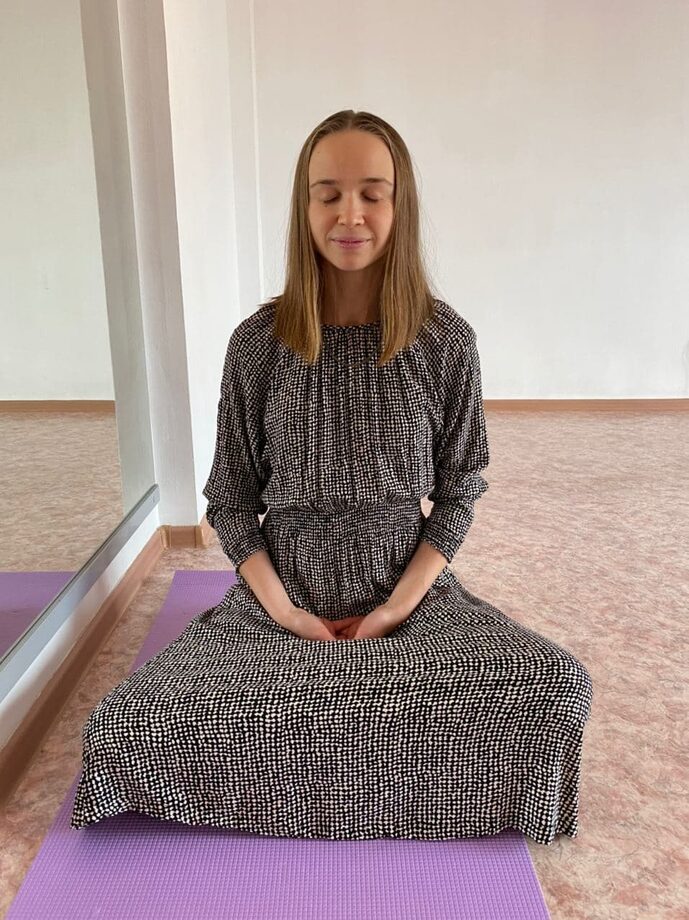
The great philosophy says that the objective world is a thought projection of the cosmic Mind. Out of cosmic Consciousness the material, objective universe is formed, and the universe itself is nothing other than a transformed form of Consciousness. We all exist within one Consciousness. We are an inseparable part of this Consciousness.
Exploring Consciousness is a fascinating thing. Because we know anything and everything — we know everything that has been created out of this Consciousness — but we do not know Consciousness itself; we do not know the Creator of all that exists.
Yoga proceeds by gradual abstraction. And the practice of meditation is a science, an inquiry that takes place in your inner laboratory. You withdraw from the outer world, then from your body, from your thoughts. Because a thought is a projection.
For example, right now I picture an elephant inside my mind. I can make it smaller or bigger. What is this elephant, where is it? Where did it come from? My mind created it.
Psychologists divide people into introverts and extroverts. From the point of view of psychology, an extrovert is a person who is more turned out toward the outer world. An introvert is one who stays more in their inner world. But from the point of view of meditation, both of them are extroverts. One is extroverted toward the outer world: he learns about and interacts with the objects of the outer world; the other is extroverted toward his so-called inner world. But the inner world is his projection. The metaphor of a projector and its projection fits here very well. In a projector, a large image on the wall appears from a small source. In the same way, from your "I," the spark of life, a projection arises within, in the space of the mind, and you see various thoughts.
Why it is important to explore Consciousness
It is important to explore Consciousness because it is the original material, and anything at all can be made from it.
Here is a story on this from Dada Sadananda:
Twenty years ago I went to India, and I had a to-do list: try all the Indian sweets; buy goods to sell when I got back, to recover the money spent on tickets; see various places; meet some great meditation teachers… And the last item on the list read: have the experience of samádhi.
I was in India for a month and did everything on the list, but the last item would not come. One meditation teacher, a very serious practitioner, gave me advice on how to deepen my meditation.
I followed the advice. I meditated for a long, long time, and then something happened to me. People call it by different names. It was very special and very good. It cannot be explained; you can try to describe it, but the description will not be enough. In fact, you don't know what it is; you perceive only the outer symptoms: you see infinite light, feel great love, bliss, and so on.
When I got back home, people told me, "Oh, you've changed — something has happened to you."
This was an experience of Consciousness, an experience of coming closer to a purer form of Consciousness. Consciousness is that which has no form.
There is a song:
TUMI RUPÁTITO OPORUPO CHHONDOSHOBÁR TUMI ÁNONDO >You, the formless, incomparable rhythm.You are the bliss of all.
It says here that consciousness cannot be described, and yet it is.
Here is another interesting observation on this from Dada Sadananda:
I often speak in public. Sometimes it is hard, and sometimes it is easy. And do you know when it is easy? When there is a feeling inside: I know I am about to say something, but I don't know what exactly I am going to say. That is, I sense the presence of this formless substance. I know that I am about to start speaking, and what has no form will take on some form. And it will take a form according to the circumstances of time, place, and person — that is, the most fitting form for that moment.
The same thing happens, for example, with poets and musicians. A musician feels a melody inside, but it is not yet a melody; it is TUMI RUPÁTITO OPORUPO CHHONDO — the formless, incomparable rhythm. That is Consciousness. Consciousness is a spiritual thing; it is beyond the mind. You cannot describe it, cannot explain it, cannot make it obey you. You yourself must surrender to it. If your mind tries to force Consciousness into some form, into a cage, and does not let it flow and express itself freely, it simply slips away. And your light goes out; emptiness remains. There is form, but no content. And in order to "catch" Consciousness, you have to come to it and say, "I agree, I am obedient. I have calmed my mind; it has surrendered." And then Consciousness can manifest.
But discipline of the mind is not enough. The irony is that usually you chase after something outside and cannot catch what is within.
Searching for Consciousness means that you will cast aside all outer expressions and go within yourself, asking: "Who am I, then? What is this 'I'? And what stands behind this 'I'? What is the nature of this 'I'? What is the substance of this 'I'?"
A mind that is turned inward becomes introverted. It reaches toward its source: what is "I," what is my first cause, where is this "I," what is this real "I." In the course of this inquiry, the mind begins to be permeated by ever purer forms of Consciousness.
The Indian philosopher Prabhát Ranjan Sarkar once said:
"I do not think that I know nor do I think that I don't know." "Because whether I know or I do not know, both of them are my mental projections only." — Shrii Shrii Ánandamúrti (Bábá) — «Knowing and Not Knowing» (Ánanda Vacanámrtam Part 6, 1978)
Supreme consciousness is something elusive — the subtlest of all that is subtle, the most fascinating, the most amazing, the newest and the divine.