This article is about Neohumanism — a social philosophy of the highest order, born as a social worldview, with spirituality at its foundation.
This article is about Love and care extended past humanity to every living being and the whole of creation. — a social philosophy of the highest order, which was born as a social worldview and has spirituality at its foundation.
The concept of Neohumanism was proclaimed by the spiritual teacher Shrii Shrii Ánandamúrti in 1982. Bábá formulated it as a social philosophy. "Neohumanism" means "new humanism."
Humanism is the peak of human thought, the most exalted idea. But it is not without defects. First, the human being is proclaimed the summit of existence, and no room is left for the transcendent; second, this idea does not include care for the welfare of all other beings. Neohumanism removes these defects because it is based on spirituality. We do not merely reflect intellectually on love for all beings; we take concrete steps to experience this love within ourselves, so that it becomes an inner feeling that fills our life.
The concept of Neohumanism is marked by a holistic view of the human being, nature and society, and questions of economics, politics, culture and education are resolved in the light of spiritual philosophy. Neohumanism also speaks of raising the role of the human being not only in the destinies of cultures, peoples and the world as a whole, but also of taking on responsibility for the development and preservation of the plant and animal kingdoms, and of non-material objects as well.
A spiritual philosophy is born when life and its tasks begin to be seen from the standpoint of a single spiritual idea. This idea is reflected in the A sound or set of sounds that, repeated with its meaning in mind, carries the mind toward the Infinite. Bábá Nám Kevalam, which means that Supreme Consciousness is all there is. That is, we strive to raise the mind to a higher level and gain the ability to perceive reality more widely and deeply.
There is a parable about three blind men who tried to describe an elephant. One touched the tail, another a leg, the third the trunk. And in the end each described the elephant in his own way. One called the elephant a rope, another a column, and the third a python. Each was right in his own way, but they did not see the whole picture. The same can be said of our everyday reality: we perceive it according to the breadth of our outlook and our mental and spiritual state.
If we were saints like the Buddha, Christ or Caitanya Mahaprabhu, we would perceive the world with eyes full of love, as one whole, as a living organism in which each organ is inseparably linked with the others and performs a particular task. One can speak of a Neohumanist perception of reality only when there is an understanding of the deep interconnection of all that exists. If we carry this perception over into the sphere of philosophy, we get the philosophical concept of Neohumanism.
Our worldview depends directly on our level of awareness. If the level of consciousness is high and a person is filled with love, they will perceive the world in its wholeness and unity. At a lower level, a person will see the world through the prism of their past experience and of the ideas they absorbed in childhood, shaped by literature, cinema, upbringing at school and in the family, and so on. That is, the person will see the world through the prism of their saḿskáras.
Our perception of the world determines our relationship with it, and this lies at the basis of the socio-economic life of every individual. What is our life — heaven or hell? That depends entirely on the ideas that prevail in our mind.
It is very important that humanity follow the right social philosophy; otherwise the place of the true philosophy will be taken by some other philosophy. It is fitting to recall the saying: "All that is needed for evil to triumph is for good people to do nothing." In the mind of almost every person and in the collective intellect of the planet there are certain ideas that harm both the personal and the collective life of society. So we need to begin cultivating a different social worldview, free of these destructive ideas. Such a worldview is Neohumanism.
The mind is the cause of bondage and the cause of liberation. So if the mind is led in the proper direction with the right ideas, it will bring us to liberation from the fetters of imperfection.
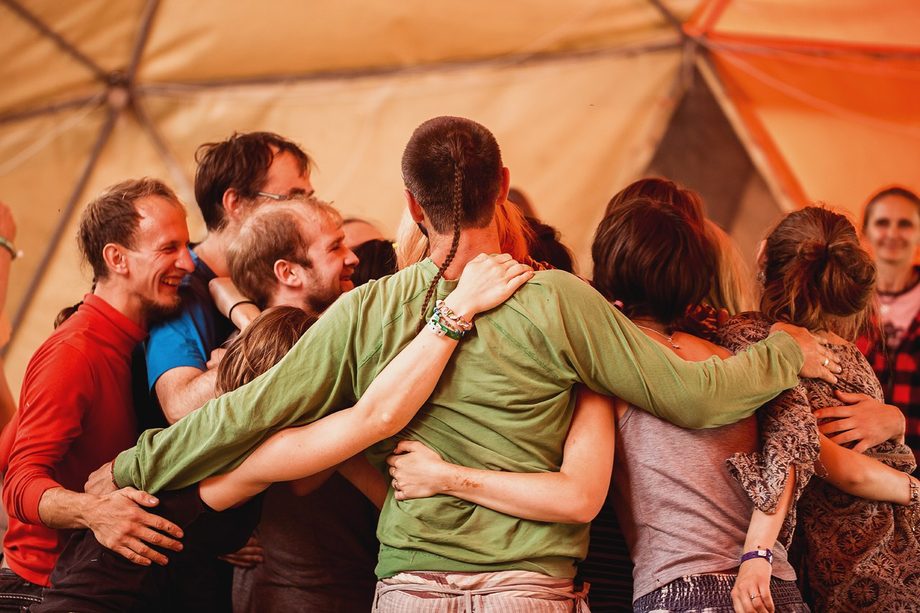
It is very important to put the ideas of Neohumanism into practice, for a number of reasons.
The first reason has to do with the individual life of a person. It is that today there is a huge gulf between a person's inner needs and what the outer world offers. The outer world offers a philosophy of consumption, a consumerist ideology. Within us there is a desire for the infinite, and a world made of finite objects does not satisfy this main inner need. If the inner thirst is not quenched, a feeling of disappointment arises. Seeking a substitute for the infinite happiness that it is their destiny to attain, a person joins the chase after material wealth, which gives only short-lived satisfaction. Disappointed again and again, the person tries new material ways of getting pleasure, developing selfishness, sinking into cynicism, abusing their talents and official powers, and undermining their health. Unsatisfied inner needs give rise to a mass of social evils — alcoholism, drug addiction, suicidal tendencies, decadent culture and others. The main characteristic (The inherent nature of a thing; for a human being, the longing for the Infinite and the effort to reach it.) that distinguishes a human being from an animal is the longing for infinite happiness, the longing for self-knowledge and self-realization. And if a person does not fulfill this longing in their life, they will never be able to be happy inside. That is why it is so important to restore the right worldview in human society.
The second reason for spreading Neohumanism is collective. In today's world, at the collective level, the sense of trust, of respect, of mutual love between members of society and between peoples has been lost. We see a vast number of conflicts in the socio-economic and political spheres. Besides this, people destroy nature, cut down forests, pollute rivers, and destroy or damage the habitats of various animals and plants. Nor do they show respect for animate and inanimate nature. The reason is the absence of the right philosophy, the right ideology.
Neohumanism is a philosophy of love, permeated with the spirit of universalism. Individual or group selfishness still prevails in society. An example of group selfishness is family selfishness: for the sake of their family a person is ready for anything, even to cause suffering to a whole people, a whole planet. Only one thing matters to them — the prosperity of their own family. Neohumanism proposes changing this point of view and seeing the whole universe as one's family, working for its good. If the planet is healthy, humanity and each of its inhabitants will be healthy. And life will become beautiful.
But in the way of the Neohumanist worldview stands selfishness — a sentimental attachment to narrow interests, reinforced by what we call dogma. Dogma is a dangerous factor, a rigid idea that does not let one go beyond its periphery and does not allow one to think rationally. Dogma justifies selfishness.
There are three obstacles on the way to Neohumanism:
- geo-sentiment;
- socio-sentiment;
- humanism.
1. Geo-sentiment is based on attachment to one's land, one's country. It is a vestige of the distant past. Even reptiles had a territorial sense. Geo-sentiment makes us divide territory into ours and theirs and demands that we develop our own locality, even if this harms the interests of other territories. Geo-sentiment sprouts into various social evils — geopolitics, geo-economics, geo-religion. Here is an example of geo-religion: some place is declared holy, which leads to a great stream of pilgrims and, accordingly, an inflow of money that makes this holy place prosper. Examples of geopolitics: the conquest of colonies, plunder, the slave trade. That is, the people of one territory begin to exploit another territory. There are those who justify this by appealing to geo-patriotism. They call for developing their own territory even if an ocean of tears is shed by the peoples living on the conquered lands. But in the end people deceive themselves, because one cannot create an island of well-being in an ocean of suffering. This suffering will surely come back to those who caused it. Lasting well-being in human society is possible only if all peoples live in dignity.
2. Socio-sentiment arises where one social group begins to consider itself superior to others, regarding them as "unworthy," and fights in every way for its own well-being at the expense of the interests of the rest. Groups may form along religious, linguistic, racial and other lines. Human history has many examples of militant groups justifying wars for "sacred" ideals.
3. Humanism is not the worst ideology, but, feeling their superiority, people allow themselves to justify criminal actions toward other beings. For example, they say that God created animals for humans to use in every way. People do not want to see that animals also feel both pain and joy. Instead of taking responsibility for the protection and development of their younger brothers and sisters, people, endowed with a far more developed mind, exploit all the other beings on this planet, supposedly "for the good of humanity." The destruction of the other kingdoms that inhabit the Earth directly affects the quality of life of people themselves, however hard people try to close their eyes to it.
There is the notion of the utility value and the existential value of beings. We are used to judging the world from our narrow point of view of usefulness — utility value — forgetting that every object of creation has its own existential value, that is, the very existence of that object matters. Once the concept of Neohumanism is accepted, the understanding will arise that there is not a single being that is useless to this world. We all play important roles in the universe.
In the creation of any sentiment, one of the human complexes always takes part: the fear complex, the inferiority complex or the superiority complex. And demonic personalities manipulate these sentiments, steering the crowd in any direction to achieve their own selfish political and economic aims. So it is important to overcome sentiments of every kind in society.
How can this be done?
Geo-sentiment must be overcome by spreading education and knowledge, by broadening one's outlook. It is very important to travel, to see everything with your own eyes, rather than listen to scary stories and tall tales about other people and other lands. Geo-sentiment is overcome with the help of rational thinking. The more well-rounded, educated people there are in a society, the less susceptible it is to "brainwashing."
There are three factors for developing rational thinking, described long ago by Patanjali.
- Trusting your own perception. What you see and hear matters. Perception gradually expands thanks to scientific achievements.
- Following logic. One needs to understand the connection between cause and effect, and to draw conclusions with the help of logic.
- Following the right authority. There is no sense in reinventing the wheel, so one should rely on those authorities whose work has been confirmed by practical success. In the spiritual sphere there are authorities too. These are people who have reached the summit of self-awareness — saints and spiritual masters. One can rely on them as a source of reliable information.
Socio-sentiment is based on group selfishness, when for the good of their group a person is ready to do anything, even if the whole planet suffers from it.
If we want to overcome this sentiment and move forward on the path of evolution, we need to learn to think as the Supreme thinks: all creatures living in this universe are one big family, brothers and sisters, and God is the great Father of this creation.
The last obstacle to be overcome on the way to Neohumanism is humanism. Let me remind you that its limitation is that it will not lead a person into the infinite transcendental sphere. Humanism regards the attainment of material values as the summit of existence. In the absence of spirituality, humanism degenerates into pseudo-humanism, when humanism is used as a screen, and under the guise of good works for some group of people selfish interests are pursued: geopolitical, geo-economic and so on. One can replace humanism in oneself with Neohumanism through spiritual practices. Spirituality gives birth to selfless love in people's hearts, and people become truly ready to live and work for the good of all humanity.
Source: the book "Neohumanism" by P. R. Sarkar (in English, The Liberation of Intellect: Neohumanism)