
Ananda Marga

Stories and Quotes

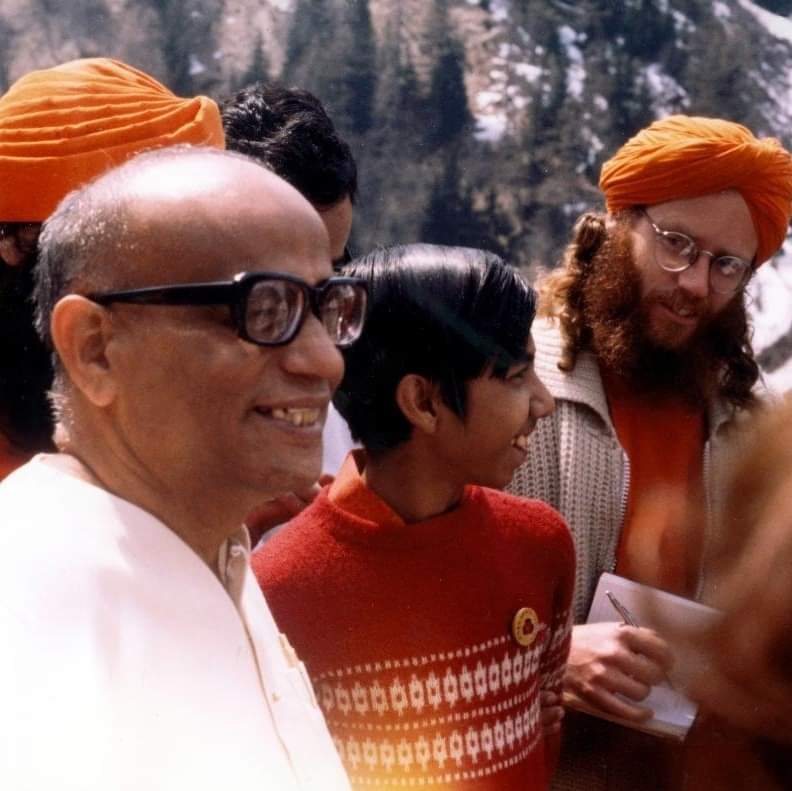
Shrii Shrii Ánandamúrti smiling among disciples, a boy and a bearded man beside him, mountains behind
You are never alone or helpless. The force that guides the stars, guides you too.

His disciples called him Bábá. Here are the things they saw him do and heard him say, each told by someone who was there, and below them his own words.

Stories

  • Early years · Jamalpur

    The mattress in the washing water

    As a boy in Jamalpur, Prabhat Ranjan Sarkar invited a classmate from an 'untouchable' caste into his room and sat him on his bed. After the boy left, his mother Abharani was angry that custom had been broken, and she washed the bedcover and pillowcase. Shrii Shrii Ánandamúrti watched in silence, then put the mattress and pillow in the water as well. If the boy's touch had polluted anything, he told her, it had polluted everything, himself included. Nobody was untouchable to him, he said, because everyone was a child of God. His mother could only answer that nobody in the world could convince him of anything.

    She then removed the bedcover and pillowcase and washed them. Prabhát Ranjan silently watched her without saying a word. Then he took the mattress and the pillow and also immersed them in water. "Bubu! What are you doing?" shouted Abharani. "Since he has polluted everything with his touch, then these are also polluted. So I am cleaning them as well," responded Prabhát Ranjan nonchalantly.

    — Ác. Pranavátmakánanda Avadhúta, Advent of a Mystery

  • How people came · 1939 · Calcutta

    The robber called by name

    In 1939 Prabhat Ranjan Sarkar was a student in Calcutta. One full-moon evening he sat alone at Kashi Mitra Ghat on the Ganges, where robbers gathered after dark. Kalicharan Banerjee, a notorious robber, crept up behind him with a knife. Without turning round, Shrii Shrii Ánandamúrti called him by name and said he had been waiting for him. Kalicharan lowered the knife and sat down, and Shrii Shrii Ánandamúrti told him the story of his life. The robber bathed in the river and was initiated that night, and became the sádhaka Kalikánanda.

    But what was that? Someone called him by name. So distinctly, and so mild the voice. Kalicharan was stunned. He could not believe His own ears. He was puzzled; his steel nerves trembled. Who could it be?

    — Ác. Sarveshvaránanda Avadhúta, My Days With Bábá

  • He knew · 1979 · Rotterdam

    Now the boy says yes

    In 1979 a young volunteer traveled with Prabhat Ranjan Sarkar through Europe as a guard. In Rotterdam the crowded lodging put him in a thoroughly negative mood, which he told no one about. That evening he walked a few metres behind Shrii Shrii Ánandamúrti in a large park. For about 45 minutes every thought he had was a 'no': no to Rotterdam, no to the lodging, no to the rest of the trip. At the end Shrii Shrii Ánandamúrti quietly asked whether he liked the park that evening. He said yes.

    Then, just as He was passing in front of me, He said, as if talking aloud to Himself: "Ah, now the boy says yes." And He continued to His car.

    — Ac. Jyotirupananda Avt., Divine Love: European Experiences with Shrii Shrii Anandamurti

  • Compassion · Ranchi

    Book royalties for a crumbling school

    Shrii Shrii Ánandamúrti set aside the royalties from his books for people in need. One day in Ranchi he read a newspaper notice from a school whose building was falling apart; many rooms could no longer be used, and it was asking for funds. The next morning, before his walk, he took his royalty money and had his driver take him to the school. The astonished principal received him. Shrii Shrii Ánandamúrti handed over an envelope he thought would cover the repairs and said he trusted the principal to use it well.

    The next morning Bábá took his royalty money with him, the money he received from the sales of his books, and asked his driver and security personnel to take him to that school before proceeding with his morning field walk. When Bábá entered the premises, the principal and staff were astonished to see him and his entourage.

    — Acharya Ramananda Avadhuta, Ashutosh Bábá: The Memoirs of Acharya Ramananda Avadhuta

  • The teacher · 1982 · Kolkata

    Never lie, not even to meet me

    In 1982 Shrii Shrii Ánandamúrti ruled that workers who wished to see him privately must first organize five Prabhat Samgiita concerts. A worker from Manila had organized one, so he changed his report to claim five and was given an appointment. Shrii Shrii Ánandamúrti's first question was whether the five concerts had really taken place. The worker kept silent rather than lie to his face. Shrii Shrii Ánandamúrti rebuked him sharply and asked why he had lied; the worker said he only wanted to be near him. Shrii Shrii Ánandamúrti softened and told him never to lie for any reason, even to meet him: a renunciate's life must rest on truth.

    By this time, Bábá was in a much more relaxed mood, and the tone of His voice was less harsh. I was immensely relieved. He advised me that I should never again resort to lying for any reason, even to meet Him.

    — Ácárya Parameshvaránanda Avadhúta, Divine Experiences: An Autobiography

  • Humour · Jamálpur

    Surprising news, with a wink

    A new disciple scoffed when a friend claimed that Shrii Shrii Ánandamúrti knew all the world's languages. The next day Shrii Shrii Ánandamúrti's talk was on linguistics: he began with the Sanskrit letter ka and wrote words in Chinese, Latin, Hebrew and more. The friend smiled at the doubter, and Shrii Shrii Ánandamúrti asked him why. When he explained, Shrii Shrii Ánandamúrti said this was surprising news to him; he had not been aware he knew every language, and thanked him for letting him know. Everyone laughed, and he laughed with them.

    "Bábá, yesterday I told Dasharath Babu that you knew all the languages of the world and he did not believe me." "Do I know all the languages of the world? That is surprising news to me. I was not aware of it. Thank you for letting me know," said Bábá with a wink. Everyone laughed, and Bábá joined in.

    — Ác. Pranavátmakánanda Avadhúta, Advent of a Mystery

  • The hard years · 1972 · Patna

    Water for the thirsty convicts

    One evening in 1972 in Bankipur jail, Shrii Shrii Ánandamúrti was walking alone between the cells while his disciples meditated. Convicts in a distant ward were calling out: they had been locked in after a hurried dinner with no water, and the guards ignored them. Shrii Shrii Ánandamúrti fetched the earthen jar and tumbler from his own cell and, despite their protests, gave each of them water with his own hand. He said nothing about it. When asked the next morning, he replied that it had only been his duty, and duty needs no announcement.

    Bábá stubbornly continued to persuade them. He cajoled them by saying that, contrary to their apprehensions, He would get pleasure if He could serve them. At last, Bábá gave them all water, one by one. Their thirst quenched, they gazed at Bábá, not knowing how to express their gratitude.

    — Ác. Sarveshvaránanda Avadhúta, My Days With Bábá

  • Across the world · 1979 · Switzerland

    On the road to Fiesch

    After landing in Geneva in 1979, Shrii Shrii Ánandamúrti set off by car for Fiesch with two Swiss disciples. He had been awake for thirty-three hours and asked to stop to meditate; a smoky café proved unsuitable, so he meditated in the car. Afterwards, finding that the Swiss knew little about their own valley, he described its irrigation, farming and animal care, explained why local cows lack the hump of Indian cattle, and talked about Swiss grape-growing.

    After His meditation, Bábá's mood became happy and alert. After asking the two Swiss brothers about this valley and finding they had little knowledge of the local area, Bábá began to tell them about the agriculture and farming. He explained in very much detail the irrigation systems used, the farming techniques and the particulars of local animal care.

    — Bodiishvara (ed. Ác. Subuddhyananda Avt.), Divine Love: European Experiences with Shrii Shrii Anandamurti

  • The scholar · 1983

    Naranja and the excited elephants

    In 1983 a monk brought Shrii Shrii Ánandamúrti an orange seedling from Paraguay. Shrii Shrii Ánandamúrti asked its Spanish name, naranja, and where the word came from. None of the senior workers present knew; he joked that he had thought he was the only fool in the world but now had many friends. Then he explained: Sanskrit naga, elephant, and ranga, excitement, made nagaranga, because elephants rejoice at a tree full of oranges; through Urdu narangi it became Spanish naranja. He went on to link Spanish numbers and family words to Sanskrit.

    Then Bábá's mood softened and He began a long explanation. "The Saḿskrta word 'naga' means both 'elephant' and 'snake'. Here it means 'elephant'. Ranga in Saḿskrta means 'excitement'. When elephants see a green orange tree full with brightly-colored oranges, they become excited and go into jubilation. So oranges are called 'nagaranga' in Saḿskrta.

    — Dádá Haratmananda, Bábá's Love for South America

  • Early years · Bamunpara

    His name in ten scripts

    The family spent holidays at its ancestral village of Bamunpara in Burdwan district. On one of these visits his elder sister Hiraprabha teased him for being a daydreamer and a slow learner. She said he could not even write his own name in his mother tongue. He picked up a pencil and wrote his name in ten different scripts, most of which she did not recognize, and told her the name of each one. The memoir says she never spoke to him lightly again.

    While vacationing in Bamunpara, Bábá’s sister Hiiraprabhá commented that Bábá was always roaming in his dream world and was a slow learner. She teased him that he could not even write his name in his own mother tongue. Bábá took a pencil and wrote his name in ten scripts, most of which she did not even recognize. He told her the name of each script.

    — Ácárya Shambhúshivánanda Avadhúta, Towards a Brighter Future

  • How people came · 1949 · Jamalpur

    The atheist who threw away the mantra

    P. K. Chatterjee, a young clerk at the Jamalpur railway workshop, did not believe in palmistry. He asked 'Prabhat Da' to read his palm anyway. Shrii Shrii Ánandamúrti asked about his aim in life and warned him of danger on the path he wanted. Then he gave him a mantra on a slip of paper. Chatterjee was an atheist and said he had no respect for it, so he was told to throw it into the river. He kept coming back anyway. On 8 August 1949 Prabhat Ranjan Sarkar initiated him at the Tiger's Grave, his first disciple in Jamalpur.

    The next night, Chatarji arrived on time at the Tiger's Grave. Prabhát Dá gave him a piece of paper with a mantra written on it and told him to recite it when he had a bath and after eating breakfast. When Chatarji read the mantra at home, he found that it was Shiva's Dhyána Mantra. He was an atheist and he did not believe in any god or goddess.

    — Ácárya Maháviiránanda Avadhúta, The Tantric Guru

  • He knew · 1958

    The lawyer's meditation

    In September 1958 Vaidyanath Prasád, a lawyer, was walking with Shrii Shrii Ánandamúrti when he was asked why he had skipped one part of his morning meditation for three days. Vaidyanath insisted he had not. Sitting in the posture while planning how to argue the day's court cases, Shrii Shrii Ánandamúrti said, was not meditation. Then he described what Vaidyanath had been thinking, and even mimicked how he meant to put his arguments to the judge. Vaidyanath asked forgiveness and promised to be more careful.

    Bábá then revealed many details about what Vaidyanath had been thinking about during his morning meditations. He even mimicked the style in which Vaidyanath was planning to place his arguments before the judge. Everyone laughed at the sight of Bábá parodying the court scenes so flawlessly.

    — Ác. Pranavátmakánanda Avadhúta, Advent of a Mystery

  • Compassion · Calcutta

    Massaging the hands that massaged him

    After a long tour of India, Shrii Shrii Ánandamúrti came back to Calcutta very tired. A worker massaged his feet and then his arms, and within a few minutes Shrii Shrii Ánandamúrti fell asleep. Almost two hours later he woke, took the worker's hands in his own and began to massage them. The massage had let him sleep, he said, so he should do something in return.

    Within a few minutes Bábá slept. After almost two hours, He woke up and took my hands in His. He started massaging my hands, saying, "Due to your good massage, I was able to sleep today. You did so much hard work for me, I should also do something for you."

    — Ác. Shamitánanda Avt., 101 Bábá Stories

  • The teacher

    He apologized for being late

    One afternoon a worker came to give his report and found Shrii Shrii Ánandamúrti out in the garden, instructing the workers there about plants. Shrii Shrii Ánandamúrti stayed in the garden a long time while the worker waited in front of his room. When he finally came and saw him, he said he thought the worker had been waiting a long time, and that he was very sorry for being late. The worker had never expected to hear such words from him, felt ashamed, and replied that he had no important work just then.

    After some time Bábá came, and when He saw me, He said, "I think you have been waiting for a long time. I am very sorry for being late. I was very busy in the garden." I was never expecting to hear such words from Bábá in this way.

    — Ac. Dhyaneshananda, Stories of Bábá

  • Humour · Jamálpur

    “My ego was very heavy”

    On a walk near Jamálpur, rain drove Shrii Shrii Ánandamúrti and a group of disciples into a hut, and afterwards the field lay under knee-deep water. Harikishan, a police inspector who taught wrestling, offered to carry him the thirty metres to the road. Shrii Shrii Ánandamúrti said it might be too far, but Harikishan said he lifted heavier men every day. After two steps he was panting, and on the third he dropped Shrii Shrii Ánandamúrti into the water. Shrii Shrii Ánandamúrti got up drenched and smiling and softly asked what had happened.

    Bábá got up fully drenched in water and with a sweet smile on his lips looked at Harikishanji and with a very soft voice asked, "Harikishan! What happened?" Harikishanji, a great devotee of Bábá replied, "Bábá, my ego was very heavy." All others were laughing.

    — Ác. Krtashivánanda Avadhúta, The Great Advent

  • The hard years · Buxar

    Years that do not count

    For the first two months of his imprisonment Shrii Shrii Ánandamúrti was held in Buxar prison, where a convict, Ramcheej, a simple villager, was given to him as a helper and soon served him with great devotion. One day Shrii Shrii Ánandamúrti asked his age. 'Around fifty,' Ramcheej said. Shrii Shrii Ánandamúrti remarked that he looked older. Ramcheej explained that he had not added the ten years spent in jail: those were a sentence, not years lived. Shrii Shrii Ánandamúrti laughed. He told the story himself two days after his release in 1978.

    Ramcheej innocently replied, "Those years were spent in my jail sentence-how can I add them to the years I have lived!" (Bábá, u to sajá me katal bá, umar me kaise jorai). Bábá laughed, and understood that he was more than sixty years old.

    — Ácárya Keshavánanda Avadhúta, Reminiscences of Bábá

  • Across the world · 1979 · Amsterdam

    A language for the whole world

    At Amsterdam airport Shrii Shrii Ánandamúrti walked the long corridors and climbed the stairs rather than use moving walkways. Waiting for the plane, he had a young monk sit beside him, who asked whether he would create a world language, and whether Esperanto was any use. A language for all citizens of the globe would one day be constituted, Shrii Shrii Ánandamúrti said. Esperanto was well meant but rooted mainly in European languages; the new common language would draw on both Western and Eastern languages, Sanskrit among them.

    While waiting for our plane, Bábá told me to sit next to Him. We discussed several subjects. One of these concerned some hearsay about which I had wondered. “Bábá, is it true that You will make a world language in the future?” “A language suitable for all citizens of this globe will one day be constituted,” He said.

    — Dada Dharmavedananda, Travels with the Mystic Master

  • The scholar

    Without the papers

    During a gathering, Shrii Shrii Ánandamúrti took reports from his workers and asked each of them to name the villages of their district. Everyone began searching through their papers. He leaned forward and asked what they were doing. Why depend on papers? He remembered everything without reading or writing; why could they not do the same? One worker asked him to tell them the secret. He only asked why they did not know without charts, and smiled broadly at them all.

    During DMC, Bábá was taking reports from all the workers; I was fanning Him. Bábá asked the workers one by one the names of the villages of the district. Everyone began to look through their papers to find the answers. Suddenly Bábá leaned forward. "What are you doing?" He asked.

    — Ác. Shamitánanda Avt., 101 Bábá Stories

Showing 18 of 56

Show more

Quotes

  • What is then the most precious thing in human life? It is devotion. If one has gotten devotion, one has gotten everything, and nothing remains unrealized.

  • Life is a spiritual sádhaná and the result of this sádhaná is to be offered at the altar of the Supreme.

  • Since the Supreme Father is with me, why should I be afraid of anyone? Why should I fear at all? There is no reason to be fearful. I have to move forward. Fearfulness is not my duty. Let the fear fear me, I will not fear.

  • You have no right to hate even a single living creature. The best you can do is only to serve.

  • Human society is one and indivisible, don’t try to divide it. Each and every individual should be looked upon as the manifestation of the Cosmic Entity.

  • Struggle is the essence of life. Yours should be a pauseless struggle against corruption, hypocrisy and animality.

  • Don’t compare life to a pool of muddy, stagnant water. Life resembles an ever-flowing spring.

  • Knowing oneself is the real knowledge; serving all with the ideation of Náráyańa, the real action, and the vow to please Parama Puruśa the real devotion.

  • You all know that Parama Puruśa is very close to you. He is so near that nothing can be nearer.

  • Morality is the foundation of Sádhaná (spiritual practice). It must, however, be remembered that morality or good conduct is not the culminating point of the spiritual march.

  • Do all your works unitedly. No work is hard for you, no work is difficult. Move forward easily and smilingly, solving all the problems of the world. Your victory is assured.

  • Remember that your service does not oblige the Supreme, rather you are obliged because you have such a chance to serve the Supreme in the form of living beings.

  • All the beings of this universe are the kith and kin of one another. No one is despicable. All are equally respectable and entitled to equal love and affection.

  • We must not forget, even for a single moment, that the entire animate world is a vast joint family. Nature has not assigned any portion of this property to any particular individual.

  • The most valuable treasures on the path of human progress are honesty, simplicity and spiritedness.

  • Book knowledge that cannot be utilized in life has no value.

  • The devotional sentiment is the highest and most valuable treasure of humanity.

  • The goal of sádhaná [spiritual practice] is the all-round elevation of human beings. Spiritual practices do not teach renunciation of the world, they teach only the proper utilization of the subtle and crude potentialities.

  • Everywhere you are with Parama Puruśa, and never in this universe, nowhere in this universe, are you alone. So you are never helpless.

  • If you want to please a mother, simply serve her children and the mother will be pleased.

  • Why should the love and affection of developed human minds be restricted to human beings only? Why should it not include all living beings, including plant life?

  • Social life must take morality as its starting point – it must take inspiration from morality.

  • As long as people sleep, their fortune also sleeps. When they awake and think to rise up, their fortune also begins to awaken. The moment they sit up, their fortune also rises; and as soon as they start moving, their fortune also advances.

  • In my opinion, real education means proper, adequate knowledge and the power of understanding. In other words, education should impart an awareness of who I am and what I ought to do.

  • Your only qualification is that you are the affectionate progeny of the Supreme Progenitor. You are His object of affection. Even if you forget Him He won’t forget you.

  • Persistent endeavour and practical cult are essential to reach the goal. Hence, in sádhaná one should remember two essential factors: constant awareness of one’s goal, and persistent endeavour to attain that goal.

  • Every jiiva, every living being, is the child of Immortality. You have been born in eternity and you are moving towards immortality. Therefore there is no need to be afraid, despondent, or sorry in any condition.

  • Forget whatever you were in the past, or whatever you did in the past, and from this auspicious moment on dedicate yourself to the service of humanity.

  • This love should include all plants, birds, animals etc., because everything has life, everything has feeling. We should think that others feel as I feel, and this feeling should include plants, animals and inanimate objects.

  • If one person rolls in affluence, in most cases others will be deprived of even their minimum requirements. The failure to recognize the needs of others is itself a disease.

  • You should live such a benevolent life and do such glorious deeds that when you leave this world, smiles will blossom on your face while the people mourn your departure with copious tears.

  • Educated are those who have learnt much, remembered much and made use of their learning in practical life.

  • To love Parama Puruśa and the creation is the only Dharma of spiritual aspirants.

  • The mind has infinite potentialities and controlling these infinite potentialities is sádhaná.

  • The Father’s love is for all, so nobody is helpless. Nobody is shelterless. And nobody’s future is sealed forever.

  • The entire human society is anxiously waiting for you, for your service. You will have to shoulder a great responsibility for the suffering humanity.

Showing 36 of 45

Show more