
Ananda Marga

Stories and Quotes

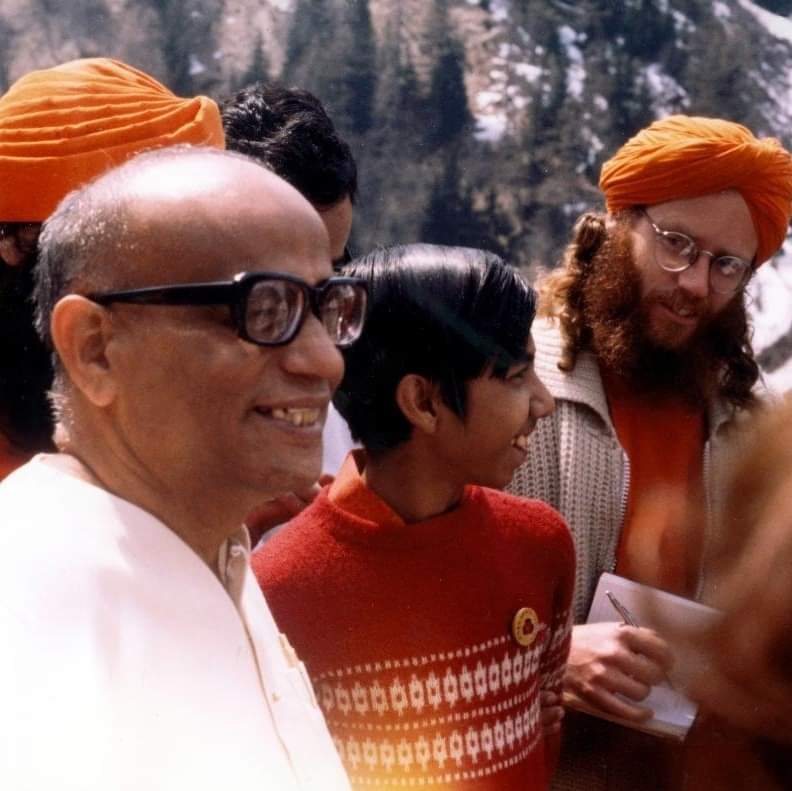
Shrii Shrii Ánandamúrti smiling among disciples, a boy and a bearded man beside him, mountains behind
You are never alone or helpless. The force that guides the stars, guides you too.

His disciples called him Bábá. Here are the things they saw him do and heard him say, each told by someone who was there, and below them his own words.

Stories

  • The teacher · 1982 · Kolkata

    Never lie, not even to meet me

    In 1982 Shrii Shrii Ánandamúrti ruled that workers who wished to see him privately must first organize five Prabhat Samgiita concerts. A worker from Manila had organized one, so he changed his report to claim five and was given an appointment. Shrii Shrii Ánandamúrti's first question was whether the five concerts had really taken place. The worker kept silent rather than lie to his face. Shrii Shrii Ánandamúrti rebuked him sharply and asked why he had lied; the worker said he only wanted to be near him. Shrii Shrii Ánandamúrti softened and told him never to lie for any reason, even to meet him: a renunciate's life must rest on truth.

    By this time, Bábá was in a much more relaxed mood, and the tone of His voice was less harsh. I was immensely relieved. He advised me that I should never again resort to lying for any reason, even to meet Him.

    — Ácárya Parameshvaránanda Avadhúta, Divine Experiences: An Autobiography

  • The teacher

    He apologized for being late

    One afternoon a worker came to give his report and found Shrii Shrii Ánandamúrti out in the garden, instructing the workers there about plants. Shrii Shrii Ánandamúrti stayed in the garden a long time while the worker waited in front of his room. When he finally came and saw him, he said he thought the worker had been waiting a long time, and that he was very sorry for being late. The worker had never expected to hear such words from him, felt ashamed, and replied that he had no important work just then.

    After some time Bábá came, and when He saw me, He said, "I think you have been waiting for a long time. I am very sorry for being late. I was very busy in the garden." I was never expecting to hear such words from Bábá in this way.

    — Ac. Dhyaneshananda, Stories of Bábá

  • The teacher · 1966 · Ánandanagar

    A time to meditate, a time to work

    In early 1966 the workers at Ánandanagar were putting up new buildings day and night. So that nobody let meditation slip under the workload, Shrii Shrii Ánandamúrti ordered collective meditation every morning and evening. At ten o'clock one morning he saw a worker meditating during working hours and was displeased. The time for meditation and the time for work must not be mixed up, he said, and the man joined the work. After that, the teller recalls, nobody needed reminding of a schedule twice.

    "Humans have come to earth for a limited time only," Bábá once said. "One won't get time to do great deeds or achieve success in life unless one learns to make the most of each moment." Bábá ensured that every moment was utilized completely. We had not to be reminded of schedules more than once.

    — Ác. Sarveshvaránanda Avadhúta, My Days With Bábá

  • The teacher · 1965 · Jamálpur

    Failed twice, then examined by him

    In April 1965 five trainee teachers in Jamálpur had failed their examination twice under a strict trainer. Two days later Shrii Shrii Ánandamúrti came to the ashram and asked why they were sitting there instead of going out to teach. When they told him, he remarked that their trainer was so strict he would fail Shrii Shrii Ánandamúrti too. Then he asked them a few questions himself, and all five answered correctly. Puzzled, the trainer examined them again one by one, and this time they all passed.

    Bábá said, "Dádá Dasaratha is such a strict teacher, if he gave Me an exam, I would also fail!" Then Bábá asked us a few questions and we all replied correctly. Fifteen minutes later Bábá left for His residence.

    — Ac. Krpananda, With My Master

  • The teacher · 1971 · Ranchi

    Scolding the post, not the man

    In 1971 a newly appointed regional organiser came to Ranchi to report. Shrii Shrii Ánandamúrti found the report unsatisfactory, asked why his workers were not keeping to their tour programs, and rebuked him sternly. Then his mood changed: he was not scolding the man, he said, but the post. He questioned a worker who had skipped a town because nobody there practiced. An approved program must be followed, Shrii Shrii Ánandamúrti told him; he should have gone anyway and sung kiirtan alone under a tree.

    In the heat of the reprimand, my eyes glanced at His feet under the table. I tried to mentally surrender at His feet. At that very moment, His mood changed. He said, “I am not scolding Tapeshvarananda. I am scolding the AO East.”

    — Tapeshvarananda, Living With Bábá

  • The teacher · 1990 · Kolkata

    Only for those who practice

    In early 1990, during talks in Kolkata on the science of smell, Shrii Shrii Ánandamúrti offered a demonstration and asked for a volunteer. The first man to stand had not yet learned the dhyána lesson of meditation, so Shrii Shrii Ánandamúrti told him to sit down. A second man, who did practice it, came forward. When Shrii Shrii Ánandamúrti touched his palm with his stick, he smelled jasmine, rose and other flowers. Afterwards Shrii Shrii Ánandamúrti asked the first man how long he had been practicing: four years, he said. Shrii Shrii Ánandamúrti said he had worked hard to construct the lessons, and everyone must learn and practice them all.

    Bábá inquired, "Do you do the dhyána lesson?" He replied, "No, Bábá, I have not yet learnt the dhyána lesson." Bábá said, "Then sit down. You cannot be the medium for this demonstration."

    — Ácárya Keshavánanda Avadhúta, Reminiscences of Bábá

  • The teacher · Ranchi

    Questions passed round the circle

    In a small room in Ranchi, after talking about the last Nawabs of Bengal, Shrii Shrii Ánandamúrti questioned those present one by one. If someone could not answer, he passed the question to the next person, until every question had gone round the circle. At the end he explained why: so that the day's discussion would stay in their minds.

    Then Bábá began to question us one by one — to one He said: tell me, what was the name of Alivardi Khan's wife? If the one asked could not answer, He asked the next. In this way every question went round the circle. At the very end Bábá said: do you know why I did this? I did it so that today's discussion should stay well in your minds.

    — Ácárya Kiirtánánanda Avadhúta, Remembering Bábá

Showing 7 of 7

Quotes

  • What is then the most precious thing in human life? It is devotion. If one has gotten devotion, one has gotten everything, and nothing remains unrealized.

  • Life is a spiritual sádhaná and the result of this sádhaná is to be offered at the altar of the Supreme.

  • Since the Supreme Father is with me, why should I be afraid of anyone? Why should I fear at all? There is no reason to be fearful. I have to move forward. Fearfulness is not my duty. Let the fear fear me, I will not fear.

  • You have no right to hate even a single living creature. The best you can do is only to serve.

  • Human society is one and indivisible, don’t try to divide it. Each and every individual should be looked upon as the manifestation of the Cosmic Entity.

  • Struggle is the essence of life. Yours should be a pauseless struggle against corruption, hypocrisy and animality.

  • Don’t compare life to a pool of muddy, stagnant water. Life resembles an ever-flowing spring.

  • Knowing oneself is the real knowledge; serving all with the ideation of Náráyańa, the real action, and the vow to please Parama Puruśa the real devotion.

  • You all know that Parama Puruśa is very close to you. He is so near that nothing can be nearer.

  • Morality is the foundation of Sádhaná (spiritual practice). It must, however, be remembered that morality or good conduct is not the culminating point of the spiritual march.

  • Do all your works unitedly. No work is hard for you, no work is difficult. Move forward easily and smilingly, solving all the problems of the world. Your victory is assured.

  • Remember that your service does not oblige the Supreme, rather you are obliged because you have such a chance to serve the Supreme in the form of living beings.

  • All the beings of this universe are the kith and kin of one another. No one is despicable. All are equally respectable and entitled to equal love and affection.

  • We must not forget, even for a single moment, that the entire animate world is a vast joint family. Nature has not assigned any portion of this property to any particular individual.

  • The most valuable treasures on the path of human progress are honesty, simplicity and spiritedness.

  • Book knowledge that cannot be utilized in life has no value.

  • The devotional sentiment is the highest and most valuable treasure of humanity.

  • The goal of sádhaná [spiritual practice] is the all-round elevation of human beings. Spiritual practices do not teach renunciation of the world, they teach only the proper utilization of the subtle and crude potentialities.

  • Everywhere you are with Parama Puruśa, and never in this universe, nowhere in this universe, are you alone. So you are never helpless.

  • If you want to please a mother, simply serve her children and the mother will be pleased.

  • Why should the love and affection of developed human minds be restricted to human beings only? Why should it not include all living beings, including plant life?

  • Social life must take morality as its starting point – it must take inspiration from morality.

  • As long as people sleep, their fortune also sleeps. When they awake and think to rise up, their fortune also begins to awaken. The moment they sit up, their fortune also rises; and as soon as they start moving, their fortune also advances.

  • In my opinion, real education means proper, adequate knowledge and the power of understanding. In other words, education should impart an awareness of who I am and what I ought to do.

  • Your only qualification is that you are the affectionate progeny of the Supreme Progenitor. You are His object of affection. Even if you forget Him He won’t forget you.

  • Persistent endeavour and practical cult are essential to reach the goal. Hence, in sádhaná one should remember two essential factors: constant awareness of one’s goal, and persistent endeavour to attain that goal.

  • Every jiiva, every living being, is the child of Immortality. You have been born in eternity and you are moving towards immortality. Therefore there is no need to be afraid, despondent, or sorry in any condition.

  • Forget whatever you were in the past, or whatever you did in the past, and from this auspicious moment on dedicate yourself to the service of humanity.

  • This love should include all plants, birds, animals etc., because everything has life, everything has feeling. We should think that others feel as I feel, and this feeling should include plants, animals and inanimate objects.

  • If one person rolls in affluence, in most cases others will be deprived of even their minimum requirements. The failure to recognize the needs of others is itself a disease.

  • You should live such a benevolent life and do such glorious deeds that when you leave this world, smiles will blossom on your face while the people mourn your departure with copious tears.

  • Educated are those who have learnt much, remembered much and made use of their learning in practical life.

  • To love Parama Puruśa and the creation is the only Dharma of spiritual aspirants.

  • The mind has infinite potentialities and controlling these infinite potentialities is sádhaná.

  • The Father’s love is for all, so nobody is helpless. Nobody is shelterless. And nobody’s future is sealed forever.

  • The entire human society is anxiously waiting for you, for your service. You will have to shoulder a great responsibility for the suffering humanity.

Showing 36 of 45

Show more