
Ananda Marga

Stories and Quotes

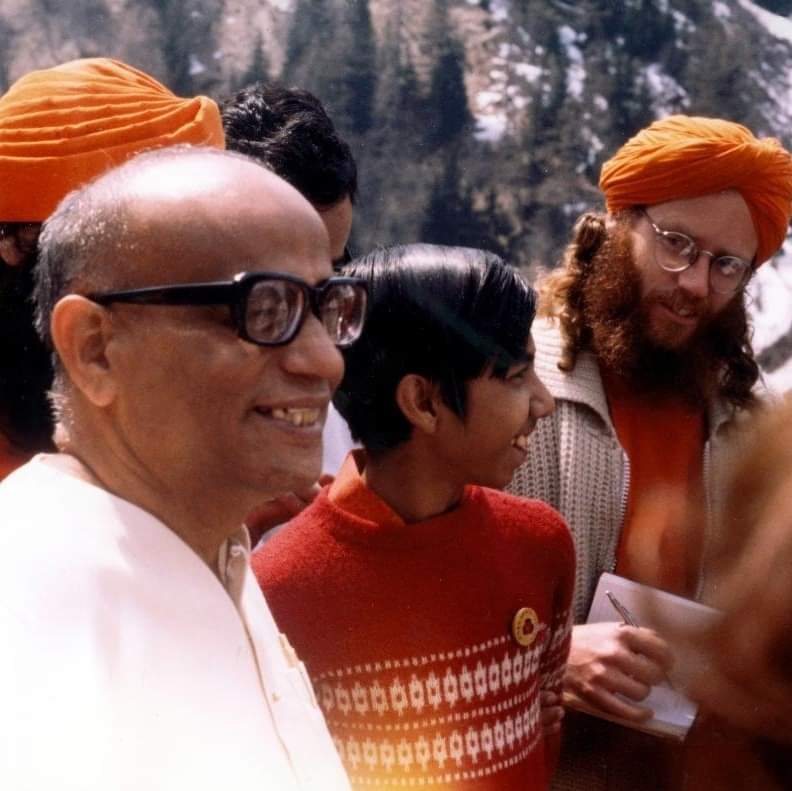
Shrii Shrii Ánandamúrti smiling among disciples, a boy and a bearded man beside him, mountains behind
You are never alone or helpless. The force that guides the stars, guides you too.

His disciples called him Bábá. Here are the things they saw him do and heard him say, each told by someone who was there, and below them his own words.

Stories

  • He knew · 1979 · Rotterdam

    Now the boy says yes

    In 1979 a young volunteer traveled with Prabhat Ranjan Sarkar through Europe as a guard. In Rotterdam the crowded lodging put him in a thoroughly negative mood, which he told no one about. That evening he walked a few metres behind Shrii Shrii Ánandamúrti in a large park. For about 45 minutes every thought he had was a 'no': no to Rotterdam, no to the lodging, no to the rest of the trip. At the end Shrii Shrii Ánandamúrti quietly asked whether he liked the park that evening. He said yes.

    Then, just as He was passing in front of me, He said, as if talking aloud to Himself: "Ah, now the boy says yes." And He continued to His car.

    — Ac. Jyotirupananda Avt., Divine Love: European Experiences with Shrii Shrii Anandamurti

  • He knew · 1958

    The lawyer's meditation

    In September 1958 Vaidyanath Prasád, a lawyer, was walking with Shrii Shrii Ánandamúrti when he was asked why he had skipped one part of his morning meditation for three days. Vaidyanath insisted he had not. Sitting in the posture while planning how to argue the day's court cases, Shrii Shrii Ánandamúrti said, was not meditation. Then he described what Vaidyanath had been thinking, and even mimicked how he meant to put his arguments to the judge. Vaidyanath asked forgiveness and promised to be more careful.

    Bábá then revealed many details about what Vaidyanath had been thinking about during his morning meditations. He even mimicked the style in which Vaidyanath was planning to place his arguments before the judge. Everyone laughed at the sight of Bábá parodying the court scenes so flawlessly.

    — Ác. Pranavátmakánanda Avadhúta, Advent of a Mystery

  • He knew · 1979 · Taiwan

    A forgotten university subject

    On a late walk in the mountains of Taiwan, a disciple asked Shrii Shrii Ánandamúrti about the relationship between the Chinese and the Japanese. He did not answer directly. For about twenty minutes he spoke about the ancient human races, how climate shaped their features, and how peoples and languages moved and mixed. Then he turned to her with a grin and asked whether this had been her subject. It had: she had studied anthropology and sociology at university and had forgotten all about it.

    I was standing just a few steps from Bábá. After His talk, He turned to me with a grin and said, "This was your previous subject, wasn't it?" I was taken aback. Oh my God! How could Bábá know this? I didn't even remember it myself. My university major had indeed been anthropology and sociology.

    — Avadhutika Ánanda Lalita Ác., A Garland of Lights: Bábá's Love for Taiwan

  • He knew · 1955 · Jamalpur

    Sent home to see his father

    One evening in April 1955 Shrii Shrii Ánandamúrti told Nagina that he had not been home for many days and should visit his family now, not after the coming festival. Nagina had not planned the trip but went because he was told to. He found his parents happy, and when he took leave on 19 April his father wept as they parted. On 22 April his father died, at prayer. Only then did Nagina understand why he had been sent home.

    I had no thought to come home, but came only on Bábá's instructions. Even then I did not know that Bábá was sending me home to see my father for the last time. It was a great kindness of Bábá that he gave me this chance. Otherwise, I could have regretted all my life.

    — Ácárya Nagina, Ananda Katha

  • He knew · Jamálpur

    Custard apples in the paddy store

    A girl of six from a family of disciples did not believe her mother, who said that Bábá knew everything she did. So, a few days before a visit, she picked custard apples in an orchard and hid them in the family's paddy store. If he could tell her what she had done, she decided, she would believe. When she bowed to him in Jamálpur, he said at once that he knew she had hidden custard apples in the paddy store.

    Immediately, Bábá said to me,' I know, you hid custard apples in your paddy store. Is it not true?' I was surprised that he should know this. From that time, I understood that Bábá was so close to me that he knew everything about me.

    — Didi Ánanda Prajiná Páramitá, Tantric Women Tell Their Stories

  • He knew · Patna

    The missed evening yoga postures

    In Patna a young American monk met a Filipino Dádá who had just come out of nine months in the same jail as Shrii Shrii Ánandamúrti. They had never met, yet the Dádá greeted him by name: Shrii Shrii Ánandamúrti had often spoken of him. It was good to see American boys becoming teachers, Shrii Shrii Ánandamúrti had said, but this one never did his yoga postures in the evening. The American was shocked. He moved from room to room every evening and was sure nobody had noticed.

    I was shocked. Yes, I accepted that Bábá was omniscient. But I never expected He would notice and expose such mundane things about me when I was not in His presence.

    — Dada Dharmavedananda, Travels with the Mystic Master

  • He knew · 1986 · Calcutta

    A name for an unborn child

    In September 1986 Vishvanath, a young disciple from Curitiba, Brazil, met Prabhat Ranjan Sarkar for the first time. As he was leaving, Shrii Shrii Ánandamúrti twice asked whether he knew an 'Antoni Neitan', who, he said, was already living in Brazil, very close to him. Back home Vishvanath mentioned the name to his pregnant sister-in-law. It was the name she had chosen for her unborn son. Apart from her husband, no one knew.

    When I came back to Brazil, I spoke by telephone to my sister-in-law who was pregnant. I told her about the experience that I had in India with Bábá. When I mentioned this name, Antoni Neitan, she immediately gasped and entered a state of shock. Because this name, Antoni Neitan, was the name she had chosen for her unborn son.

    — Vishvanath, Bábá's Love for South America

Showing 7 of 7

Quotes

  • What is then the most precious thing in human life? It is devotion. If one has gotten devotion, one has gotten everything, and nothing remains unrealized.

  • Life is a spiritual sádhaná and the result of this sádhaná is to be offered at the altar of the Supreme.

  • Since the Supreme Father is with me, why should I be afraid of anyone? Why should I fear at all? There is no reason to be fearful. I have to move forward. Fearfulness is not my duty. Let the fear fear me, I will not fear.

  • You have no right to hate even a single living creature. The best you can do is only to serve.

  • Human society is one and indivisible, don’t try to divide it. Each and every individual should be looked upon as the manifestation of the Cosmic Entity.

  • Struggle is the essence of life. Yours should be a pauseless struggle against corruption, hypocrisy and animality.

  • Don’t compare life to a pool of muddy, stagnant water. Life resembles an ever-flowing spring.

  • Knowing oneself is the real knowledge; serving all with the ideation of Náráyańa, the real action, and the vow to please Parama Puruśa the real devotion.

  • You all know that Parama Puruśa is very close to you. He is so near that nothing can be nearer.

  • Morality is the foundation of Sádhaná (spiritual practice). It must, however, be remembered that morality or good conduct is not the culminating point of the spiritual march.

  • Do all your works unitedly. No work is hard for you, no work is difficult. Move forward easily and smilingly, solving all the problems of the world. Your victory is assured.

  • Remember that your service does not oblige the Supreme, rather you are obliged because you have such a chance to serve the Supreme in the form of living beings.

  • All the beings of this universe are the kith and kin of one another. No one is despicable. All are equally respectable and entitled to equal love and affection.

  • We must not forget, even for a single moment, that the entire animate world is a vast joint family. Nature has not assigned any portion of this property to any particular individual.

  • The most valuable treasures on the path of human progress are honesty, simplicity and spiritedness.

  • Book knowledge that cannot be utilized in life has no value.

  • The devotional sentiment is the highest and most valuable treasure of humanity.

  • The goal of sádhaná [spiritual practice] is the all-round elevation of human beings. Spiritual practices do not teach renunciation of the world, they teach only the proper utilization of the subtle and crude potentialities.

  • Everywhere you are with Parama Puruśa, and never in this universe, nowhere in this universe, are you alone. So you are never helpless.

  • If you want to please a mother, simply serve her children and the mother will be pleased.

  • Why should the love and affection of developed human minds be restricted to human beings only? Why should it not include all living beings, including plant life?

  • Social life must take morality as its starting point – it must take inspiration from morality.

  • As long as people sleep, their fortune also sleeps. When they awake and think to rise up, their fortune also begins to awaken. The moment they sit up, their fortune also rises; and as soon as they start moving, their fortune also advances.

  • In my opinion, real education means proper, adequate knowledge and the power of understanding. In other words, education should impart an awareness of who I am and what I ought to do.

  • Your only qualification is that you are the affectionate progeny of the Supreme Progenitor. You are His object of affection. Even if you forget Him He won’t forget you.

  • Persistent endeavour and practical cult are essential to reach the goal. Hence, in sádhaná one should remember two essential factors: constant awareness of one’s goal, and persistent endeavour to attain that goal.

  • Every jiiva, every living being, is the child of Immortality. You have been born in eternity and you are moving towards immortality. Therefore there is no need to be afraid, despondent, or sorry in any condition.

  • Forget whatever you were in the past, or whatever you did in the past, and from this auspicious moment on dedicate yourself to the service of humanity.

  • This love should include all plants, birds, animals etc., because everything has life, everything has feeling. We should think that others feel as I feel, and this feeling should include plants, animals and inanimate objects.

  • If one person rolls in affluence, in most cases others will be deprived of even their minimum requirements. The failure to recognize the needs of others is itself a disease.

  • You should live such a benevolent life and do such glorious deeds that when you leave this world, smiles will blossom on your face while the people mourn your departure with copious tears.

  • Educated are those who have learnt much, remembered much and made use of their learning in practical life.

  • To love Parama Puruśa and the creation is the only Dharma of spiritual aspirants.

  • The mind has infinite potentialities and controlling these infinite potentialities is sádhaná.

  • The Father’s love is for all, so nobody is helpless. Nobody is shelterless. And nobody’s future is sealed forever.

  • The entire human society is anxiously waiting for you, for your service. You will have to shoulder a great responsibility for the suffering humanity.

  • The universe does not consist only of humans; other animals, other creatures, other plants, also have the right to live.

  • With the very extinction of honesty, civilization too will not survive; the long sádhaná of the human race will go in vain, and all intellectual achievements will become meaningless.

  • It is the youth, and the youth only, who have the vigour to bring about the necessary change.

  • Modern, educated people must be liberated from all sources of dogma and petty isms. They should reject the worn out shackles of the past and welcome the new, crimson dawn with an open mind.

  • If you think that He is near, then He is not only near, He is more near. He is much closer than you can ever imagine.

  • Remember that victory does not come by itself. Victory has to be invited and welcomed with sweat, the warmth of the blood and the fiery flames of hard labour.

  • You have achieved the human frame. You must make it meaningful by your sádhaná, service and sacrifice.

  • Where animality ends, humanity begins, where humanity ends, divinity begins.

  • Where there is no logic, where there is no support of intellectuality, where there is no debate and free discussion, but there is only a severe imposition forcing people to accept something, there is dogma.

Showing 45 of 45