
Ananda Marga

Stories and Quotes

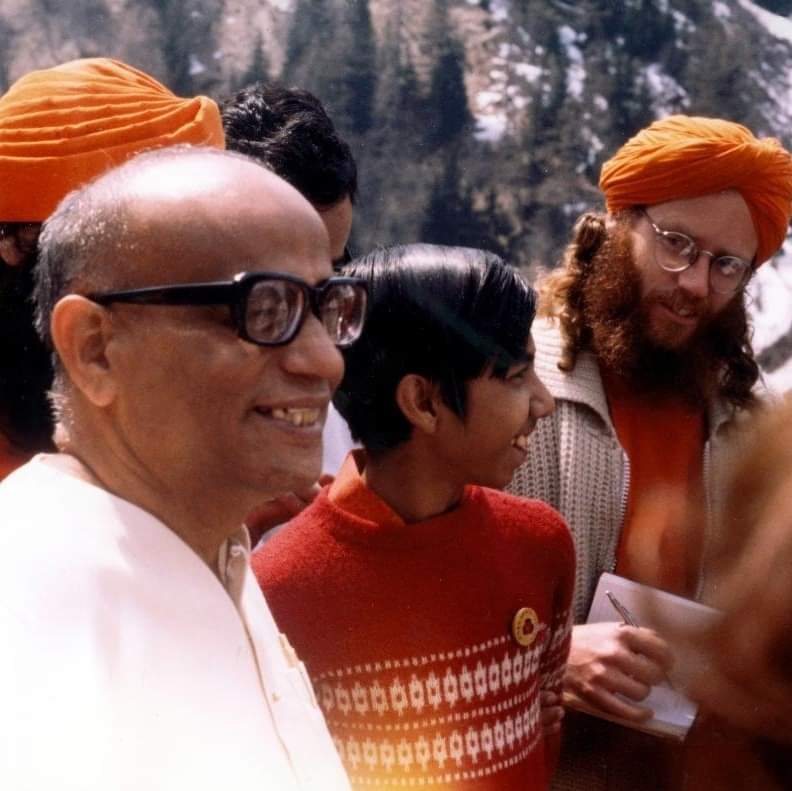
Shrii Shrii Ánandamúrti smiling among disciples, a boy and a bearded man beside him, mountains behind
You are never alone or helpless. The force that guides the stars, guides you too.

His disciples called him Bábá. Here are the things they saw him do and heard him say, each told by someone who was there, and below them his own words.

Stories

  • Humour · Jamálpur

    Surprising news, with a wink

    A new disciple scoffed when a friend claimed that Shrii Shrii Ánandamúrti knew all the world's languages. The next day Shrii Shrii Ánandamúrti's talk was on linguistics: he began with the Sanskrit letter ka and wrote words in Chinese, Latin, Hebrew and more. The friend smiled at the doubter, and Shrii Shrii Ánandamúrti asked him why. When he explained, Shrii Shrii Ánandamúrti said this was surprising news to him; he had not been aware he knew every language, and thanked him for letting him know. Everyone laughed, and he laughed with them.

    "Bábá, yesterday I told Dasharath Babu that you knew all the languages of the world and he did not believe me." "Do I know all the languages of the world? That is surprising news to me. I was not aware of it. Thank you for letting me know," said Bábá with a wink. Everyone laughed, and Bábá joined in.

    — Ác. Pranavátmakánanda Avadhúta, Advent of a Mystery

  • Humour · Jamálpur

    “My ego was very heavy”

    On a walk near Jamálpur, rain drove Shrii Shrii Ánandamúrti and a group of disciples into a hut, and afterwards the field lay under knee-deep water. Harikishan, a police inspector who taught wrestling, offered to carry him the thirty metres to the road. Shrii Shrii Ánandamúrti said it might be too far, but Harikishan said he lifted heavier men every day. After two steps he was panting, and on the third he dropped Shrii Shrii Ánandamúrti into the water. Shrii Shrii Ánandamúrti got up drenched and smiling and softly asked what had happened.

    Bábá got up fully drenched in water and with a sweet smile on his lips looked at Harikishanji and with a very soft voice asked, "Harikishan! What happened?" Harikishanji, a great devotee of Bábá replied, "Bábá, my ego was very heavy." All others were laughing.

    — Ác. Krtashivánanda Avadhúta, The Great Advent

  • Humour · 1988

    A cow's eggs and a lesson in instinct

    At a meeting of workers in 1988, Shrii Shrii Ánandamúrti asked what instinct is. The answers did not satisfy him, so he asked one worker whether he had seen the eggs his cow had laid; if not, surely he had seen an elephant's eggs. The room burst out laughing. Shrii Shrii Ánandamúrti pretended to be angry, asked who had given permission to laugh, then smiled: this was instinct. He made the worker promise not to laugh for five minutes, then tickled him with his cane until he did.

    Not long after, He touched my navel area with His cane and started tickling me. I couldn't control myself and started laughing. I had just broken my promise. Then Bábá looked around the room and remarked, "This is instinct independent of the psychic controlling faculty."

    — Ácárya Bhaktapráńánanda Avadhúta, Garland of Devotion

  • Humour · 1988 · Calcutta

    Tell the jokes, don't laugh alone

    In January 1988 a visiting worker stood quietly out of sight while Shrii Shrii Ánandamúrti took reports after his walk. When Shrii Shrii Ánandamúrti was told he was there, he welcomed him with mock formality and asked how he liked his stories. The worker said he enjoyed all the funny ones. Shrii Shrii Ánandamúrti asked whether he laughed alone or told them to others, and advised him to tell them, or people would think he was crazy. The worker had been in a heavy mood that day, and it lifted completely.

    "Do you laugh alone, or do you tell them to others also?" Bábá asked. "Sometimes I tell them to others," I replied. Bábá said, "You should tell them to others. Otherwise, if you laugh alone, people will think you are crazy!"

    — Ac. Dhruvananda Avt., The Supreme Friend

  • Humour · 1979 · Fiesch

    “But don't tell them”

    In Fiesch, Switzerland, in 1979, women were allowed to join Shrii Shrii Ánandamúrti's walks for the first time. On one walk he explained that in the past women had far more influence than men: they inherited everything, and men inherited nothing. Then he laughed, leaned towards the group and said not to tell the women, or they would be puffed up with vanity. Back at the car he said he hoped women would discover the lost glory of their history.

    On another field walk, with sisters present, Bábá was explaining how in the past women had much greater influence than men. They inherited everything, while men didn't inherit a thing. Women were socially much more important once. Then He laughed. He leaned down to us and said, "But don't tell them, otherwise they will be puffed up with vanity." We all laughed.

    — Brahmadeva, Divine Love: European Experiences with Shrii Shrii Anandamurti

  • Humour · 1966 · Muzaffarpur

    An oath sworn on an umbrella

    After a gathering in Muzaffarpur in 1966, Prabhat Ranjan Sarkar told a few disciples about a frightened young man he had met. When Prabhat Ranjan Sarkar pointed out a few faults, the young man promised never to repeat them. Prabhat Ranjan Sarkar asked him to give his word with his hand on his chest, using the Bengali word cháti. But cháti also means a small umbrella, and one was hanging on the wall. The young man seized it with both hands and swore on it. Prabhat Ranjan Sarkar said he could not laugh at the time, though laughter was bursting inside him.

    As luck would have it, in that room, right in front of the boy, a ladies' umbrella — a small cháti — was hanging on the wall. What did this boy do? Catching hold of that very umbrella with both hands, he said, "Bábá, holding this cháti with my hand I give You my word that I shall never commit such an offence again on any day."

    — Ácárya Diliip jii, Bábá Saḿsmarań Auṋka (Memories of Bábá)

  • Humour · 1979 · Taipei

    Never again will I wear trousers

    In Taipei a disciple asked Shrii Shrii Ánandamúrti to give a talk in her flat. She draped it in white silk and had a formal Chinese silk tunic made for him, which he wore with trousers. After the talk he stood and asked what they thought. No one had noticed his clothes; once they did, they hurried to say it looked wonderful. Back in his room he insisted they had not liked it. He had not worn trousers since army duty in the Second World War, he said, and never would again.

    When He got back to His room, He said, "They didn't like it, they didn't like it. You know, I haven't worn trousers since doing army duty in the Indian army during WWII. They didn't like it. Never again will I wear trousers." Then Ramánanda said, "They liked it, Bábá."

    — Dádá Krsnabuddhyánanda, A Garland of Lights: Bábá's Love for Taiwan

Showing 7 of 7

Quotes

  • What is then the most precious thing in human life? It is devotion. If one has gotten devotion, one has gotten everything, and nothing remains unrealized.

  • Life is a spiritual sádhaná and the result of this sádhaná is to be offered at the altar of the Supreme.

  • Since the Supreme Father is with me, why should I be afraid of anyone? Why should I fear at all? There is no reason to be fearful. I have to move forward. Fearfulness is not my duty. Let the fear fear me, I will not fear.

  • You have no right to hate even a single living creature. The best you can do is only to serve.

  • Human society is one and indivisible, don’t try to divide it. Each and every individual should be looked upon as the manifestation of the Cosmic Entity.

  • Struggle is the essence of life. Yours should be a pauseless struggle against corruption, hypocrisy and animality.

  • Don’t compare life to a pool of muddy, stagnant water. Life resembles an ever-flowing spring.

  • Knowing oneself is the real knowledge; serving all with the ideation of Náráyańa, the real action, and the vow to please Parama Puruśa the real devotion.

  • You all know that Parama Puruśa is very close to you. He is so near that nothing can be nearer.

  • Morality is the foundation of Sádhaná (spiritual practice). It must, however, be remembered that morality or good conduct is not the culminating point of the spiritual march.

  • Do all your works unitedly. No work is hard for you, no work is difficult. Move forward easily and smilingly, solving all the problems of the world. Your victory is assured.

  • Remember that your service does not oblige the Supreme, rather you are obliged because you have such a chance to serve the Supreme in the form of living beings.

  • All the beings of this universe are the kith and kin of one another. No one is despicable. All are equally respectable and entitled to equal love and affection.

  • We must not forget, even for a single moment, that the entire animate world is a vast joint family. Nature has not assigned any portion of this property to any particular individual.

  • The most valuable treasures on the path of human progress are honesty, simplicity and spiritedness.

  • Book knowledge that cannot be utilized in life has no value.

  • The devotional sentiment is the highest and most valuable treasure of humanity.

  • The goal of sádhaná [spiritual practice] is the all-round elevation of human beings. Spiritual practices do not teach renunciation of the world, they teach only the proper utilization of the subtle and crude potentialities.

  • Everywhere you are with Parama Puruśa, and never in this universe, nowhere in this universe, are you alone. So you are never helpless.

  • If you want to please a mother, simply serve her children and the mother will be pleased.

  • Why should the love and affection of developed human minds be restricted to human beings only? Why should it not include all living beings, including plant life?

  • Social life must take morality as its starting point – it must take inspiration from morality.

  • As long as people sleep, their fortune also sleeps. When they awake and think to rise up, their fortune also begins to awaken. The moment they sit up, their fortune also rises; and as soon as they start moving, their fortune also advances.

  • In my opinion, real education means proper, adequate knowledge and the power of understanding. In other words, education should impart an awareness of who I am and what I ought to do.

  • Your only qualification is that you are the affectionate progeny of the Supreme Progenitor. You are His object of affection. Even if you forget Him He won’t forget you.

  • Persistent endeavour and practical cult are essential to reach the goal. Hence, in sádhaná one should remember two essential factors: constant awareness of one’s goal, and persistent endeavour to attain that goal.

  • Every jiiva, every living being, is the child of Immortality. You have been born in eternity and you are moving towards immortality. Therefore there is no need to be afraid, despondent, or sorry in any condition.

  • Forget whatever you were in the past, or whatever you did in the past, and from this auspicious moment on dedicate yourself to the service of humanity.

  • This love should include all plants, birds, animals etc., because everything has life, everything has feeling. We should think that others feel as I feel, and this feeling should include plants, animals and inanimate objects.

  • If one person rolls in affluence, in most cases others will be deprived of even their minimum requirements. The failure to recognize the needs of others is itself a disease.

  • You should live such a benevolent life and do such glorious deeds that when you leave this world, smiles will blossom on your face while the people mourn your departure with copious tears.

  • Educated are those who have learnt much, remembered much and made use of their learning in practical life.

  • To love Parama Puruśa and the creation is the only Dharma of spiritual aspirants.

  • The mind has infinite potentialities and controlling these infinite potentialities is sádhaná.

  • The Father’s love is for all, so nobody is helpless. Nobody is shelterless. And nobody’s future is sealed forever.

  • The entire human society is anxiously waiting for you, for your service. You will have to shoulder a great responsibility for the suffering humanity.

Showing 36 of 45

Show more