
Ananda Marga

Stories and Quotes

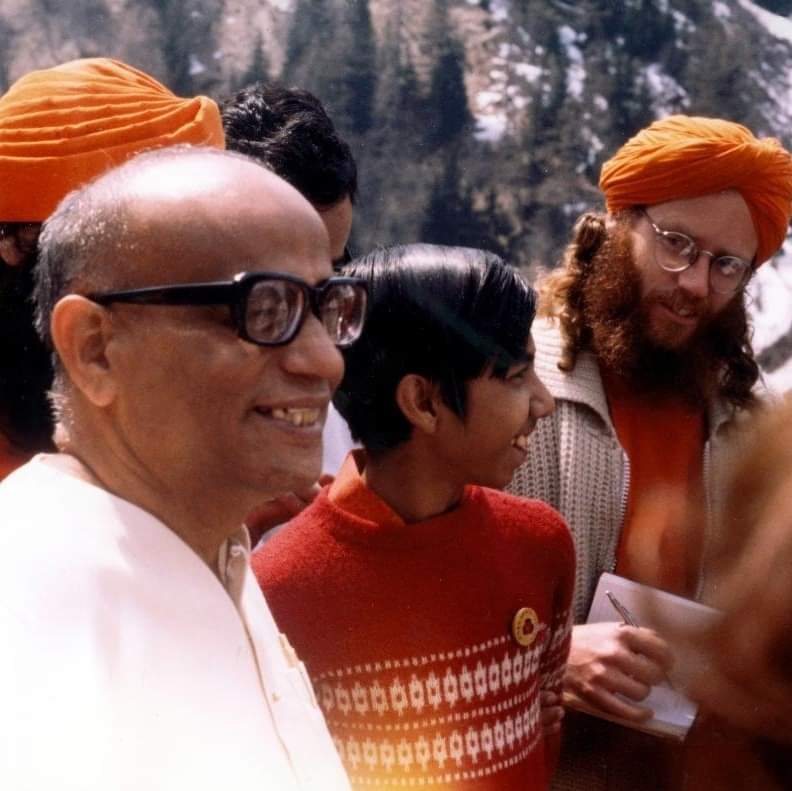
Shrii Shrii Ánandamúrti smiling among disciples, a boy and a bearded man beside him, mountains behind
You are never alone or helpless. The force that guides the stars, guides you too.

His disciples called him Bábá. Here are the things they saw him do and heard him say, each told by someone who was there, and below them his own words.

Stories

  • Early years · Jamalpur

    The mattress in the washing water

    As a boy in Jamalpur, Prabhat Ranjan Sarkar invited a classmate from an 'untouchable' caste into his room and sat him on his bed. After the boy left, his mother Abharani was angry that custom had been broken, and she washed the bedcover and pillowcase. Shrii Shrii Ánandamúrti watched in silence, then put the mattress and pillow in the water as well. If the boy's touch had polluted anything, he told her, it had polluted everything, himself included. Nobody was untouchable to him, he said, because everyone was a child of God. His mother could only answer that nobody in the world could convince him of anything.

    She then removed the bedcover and pillowcase and washed them. Prabhát Ranjan silently watched her without saying a word. Then he took the mattress and the pillow and also immersed them in water. "Bubu! What are you doing?" shouted Abharani. "Since he has polluted everything with his touch, then these are also polluted. So I am cleaning them as well," responded Prabhát Ranjan nonchalantly.

    — Ác. Pranavátmakánanda Avadhúta, Advent of a Mystery

  • Early years · Bamunpara

    His name in ten scripts

    The family spent holidays at its ancestral village of Bamunpara in Burdwan district. On one of these visits his elder sister Hiraprabha teased him for being a daydreamer and a slow learner. She said he could not even write his own name in his mother tongue. He picked up a pencil and wrote his name in ten different scripts, most of which she did not recognize, and told her the name of each one. The memoir says she never spoke to him lightly again.

    While vacationing in Bamunpara, Bábá’s sister Hiiraprabhá commented that Bábá was always roaming in his dream world and was a slow learner. She teased him that he could not even write his name in his own mother tongue. Bábá took a pencil and wrote his name in ten scripts, most of which she did not even recognize. He told her the name of each script.

    — Ácárya Shambhúshivánanda Avadhúta, Towards a Brighter Future

  • Early years · 1931–1939 · Jamalpur

    The schoolboy who taught geography

    From 1931 to 1939 Vimalendu Chatterjee shared a bench with Prabhat Ranjan Sarkar at the railway high school in Jamalpur. Decades later he remembered a friend who was brilliant in every subject and best of all at geography. Shrii Shrii Ánandamúrti knew the world's rivers, mountain ranges, capitals and seaports, and mastered a 500-page English geography textbook in three months. When the teacher was absent, the headmaster asked him to take the class. Chatterjee once asked how he knew so much. Shrii Shrii Ánandamúrti answered that his friend just did not read properly.

    He knew all the capitals of various countries in the different continents and their seaports. His knowledge about rivers was wide-ranging. Put in another way, he had such a thorough command of geography that if the teacher was absent, the headmaster would ask Prabhat Ranjan to teach the geography class.

    — Ácárya Vijayánanda Avadhúta, The Life and Teachings of Shrii Shrii Ánandamúrti

  • Early years · 1941 · Jamalpur

    Look among the first ten

    Prabhat Ranjan Sarkar studied science at Vidyasagar College in Calcutta. When the family's affairs grew difficult, he left his studies, came home and took a job in the accounts department of the Jamalpur railway workshop, where his father had worked. When the examination results came out in a Calcutta newspaper, people at home searched the lists and could not find his roll number. One of them came to tell him, full of regret. He did not ask to see the paper. He told them to look in the list of the top ten candidates on the front page, and his name was there.

    One of them took courage and said very regretfully that he could not find his roll number in the list of successful candidates. Prabhata Ranjan did not ask for having a look at the paper as if he had already seen it. He only asked them to look for His name in the list of top most first ten successful candidates published on the front page of the newspaper.

    — Ananda Marga, Bábá's Family

  • Early years · Jamalpur

    A phone call before the audit

    In the railway accounts department, Shrii Shrii Ánandamúrti audited the stores and accounts sections of the workshop. Before one inspection he telephoned ahead to let the storekeeper know. A junior official answered, cried out that Prabhat Ranjan Sarkar was coming to inspect, left the receiver on the table and ran to fetch his superior. When the officer in charge came to the phone, Shrii Shrii Ánandamúrti asked him why his assistant was so frightened. Was he a tiger? The memoir adds that he never accepted even a cup of tea from the people he audited.

    This worked like a bolt from the blue for the person on the telephone. He cried out, "Bábu, Prabhat Ranjan Sarkar is coming for inspection!" Bábá could easily understand the fear in the mind of the person. Keeping the receiver on the table, the gentleman went to call the in-charge.

    — Ácárya Krpánanda Avadhúta, About Bábá and Ananda Marga

  • Early years · Jamalpur

    Not on office time

    Years after his death, disciples visiting the Jamalpur accounts office met Niranjan Shah, a former section officer who had worked with Prabhat Ranjan Sarkar. No file was ever left pending on his desk, Shah said, and he told them this story. A high-ranking military officer visited the workshop and asked to meet Shrii Shrii Ánandamúrti, who was called to a senior officer's cabin. Shrii Shrii Ánandamúrti politely asked whether the visit was official or private. It was private, so he declined to spend office time on it and asked the officer to see him at home.

    Without showing any uncivilized manner, Prabhát Da (as Bábá was called then) enquired from the gentleman whether he had come for any official work or any private work. It was learnt that he had been there for his private work. At this Bábá said that he did not want to spoil his official time. The gentleman was told that he should meet him at his residence.

    — A collection, Jamálpur, the Birthplace of Bábá

  • Early years · 1954 · Jamalpur

    The first gathering of disciples

    By 1954 Prabhat Ranjan Sarkar had been initiating disciples quietly, one at a time, and most of them did not know about the others. He invited all of them to a gathering on Sunday, 7 November, in railway quarters in Rampur Colony. Once everyone had arrived, he introduced them to one another. Many found friends and office colleagues they had known for years without knowing they had the same guru. He then spoke about the goal of spiritual practice.

    When they arrived, Bábá introduced everybody to one another. Many, especially those from Jamálpur, were surprised to see friends, colleagues, and acquaintances gathered there, often people they had known for years without having any idea that they were disciples of the same guru.

    — Devashish (Donald Acosta), Ánandamúrti: The Jamálpur Years

Showing 7 of 7

Quotes

  • What is then the most precious thing in human life? It is devotion. If one has gotten devotion, one has gotten everything, and nothing remains unrealized.

  • Life is a spiritual sádhaná and the result of this sádhaná is to be offered at the altar of the Supreme.

  • Since the Supreme Father is with me, why should I be afraid of anyone? Why should I fear at all? There is no reason to be fearful. I have to move forward. Fearfulness is not my duty. Let the fear fear me, I will not fear.

  • You have no right to hate even a single living creature. The best you can do is only to serve.

  • Human society is one and indivisible, don’t try to divide it. Each and every individual should be looked upon as the manifestation of the Cosmic Entity.

  • Struggle is the essence of life. Yours should be a pauseless struggle against corruption, hypocrisy and animality.

  • Don’t compare life to a pool of muddy, stagnant water. Life resembles an ever-flowing spring.

  • Knowing oneself is the real knowledge; serving all with the ideation of Náráyańa, the real action, and the vow to please Parama Puruśa the real devotion.

  • You all know that Parama Puruśa is very close to you. He is so near that nothing can be nearer.

  • Morality is the foundation of Sádhaná (spiritual practice). It must, however, be remembered that morality or good conduct is not the culminating point of the spiritual march.

  • Do all your works unitedly. No work is hard for you, no work is difficult. Move forward easily and smilingly, solving all the problems of the world. Your victory is assured.

  • Remember that your service does not oblige the Supreme, rather you are obliged because you have such a chance to serve the Supreme in the form of living beings.

  • All the beings of this universe are the kith and kin of one another. No one is despicable. All are equally respectable and entitled to equal love and affection.

  • We must not forget, even for a single moment, that the entire animate world is a vast joint family. Nature has not assigned any portion of this property to any particular individual.

  • The most valuable treasures on the path of human progress are honesty, simplicity and spiritedness.

  • Book knowledge that cannot be utilized in life has no value.

  • The devotional sentiment is the highest and most valuable treasure of humanity.

  • The goal of sádhaná [spiritual practice] is the all-round elevation of human beings. Spiritual practices do not teach renunciation of the world, they teach only the proper utilization of the subtle and crude potentialities.

  • Everywhere you are with Parama Puruśa, and never in this universe, nowhere in this universe, are you alone. So you are never helpless.

  • If you want to please a mother, simply serve her children and the mother will be pleased.

  • Why should the love and affection of developed human minds be restricted to human beings only? Why should it not include all living beings, including plant life?

  • Social life must take morality as its starting point – it must take inspiration from morality.

  • As long as people sleep, their fortune also sleeps. When they awake and think to rise up, their fortune also begins to awaken. The moment they sit up, their fortune also rises; and as soon as they start moving, their fortune also advances.

  • In my opinion, real education means proper, adequate knowledge and the power of understanding. In other words, education should impart an awareness of who I am and what I ought to do.

  • Your only qualification is that you are the affectionate progeny of the Supreme Progenitor. You are His object of affection. Even if you forget Him He won’t forget you.

  • Persistent endeavour and practical cult are essential to reach the goal. Hence, in sádhaná one should remember two essential factors: constant awareness of one’s goal, and persistent endeavour to attain that goal.

  • Every jiiva, every living being, is the child of Immortality. You have been born in eternity and you are moving towards immortality. Therefore there is no need to be afraid, despondent, or sorry in any condition.

  • Forget whatever you were in the past, or whatever you did in the past, and from this auspicious moment on dedicate yourself to the service of humanity.

  • This love should include all plants, birds, animals etc., because everything has life, everything has feeling. We should think that others feel as I feel, and this feeling should include plants, animals and inanimate objects.

  • If one person rolls in affluence, in most cases others will be deprived of even their minimum requirements. The failure to recognize the needs of others is itself a disease.

  • You should live such a benevolent life and do such glorious deeds that when you leave this world, smiles will blossom on your face while the people mourn your departure with copious tears.

  • Educated are those who have learnt much, remembered much and made use of their learning in practical life.

  • To love Parama Puruśa and the creation is the only Dharma of spiritual aspirants.

  • The mind has infinite potentialities and controlling these infinite potentialities is sádhaná.

  • The Father’s love is for all, so nobody is helpless. Nobody is shelterless. And nobody’s future is sealed forever.

  • The entire human society is anxiously waiting for you, for your service. You will have to shoulder a great responsibility for the suffering humanity.

Showing 36 of 45

Show more