
Ananda Marga

Stories and Quotes

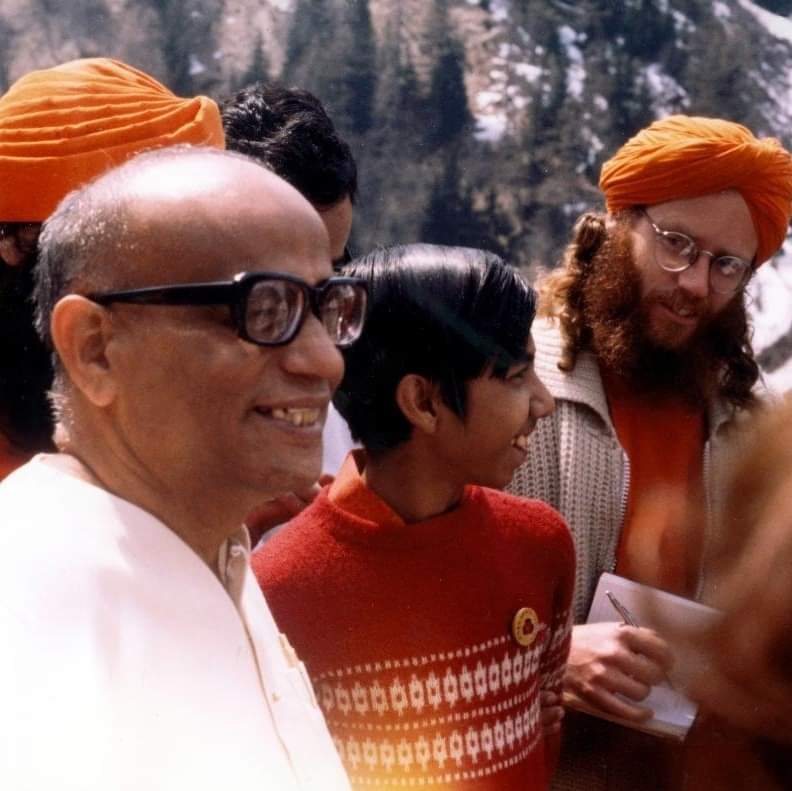
Shrii Shrii Ánandamúrti smiling among disciples, a boy and a bearded man beside him, mountains behind
You are never alone or helpless. The force that guides the stars, guides you too.

His disciples called him Bábá. Here are the things they saw him do and heard him say, each told by someone who was there, and below them his own words.

Stories

  • How people came · 1939 · Calcutta

    The robber called by name

    In 1939 Prabhat Ranjan Sarkar was a student in Calcutta. One full-moon evening he sat alone at Kashi Mitra Ghat on the Ganges, where robbers gathered after dark. Kalicharan Banerjee, a notorious robber, crept up behind him with a knife. Without turning round, Shrii Shrii Ánandamúrti called him by name and said he had been waiting for him. Kalicharan lowered the knife and sat down, and Shrii Shrii Ánandamúrti told him the story of his life. The robber bathed in the river and was initiated that night, and became the sádhaka Kalikánanda.

    But what was that? Someone called him by name. So distinctly, and so mild the voice. Kalicharan was stunned. He could not believe His own ears. He was puzzled; his steel nerves trembled. Who could it be?

    — Ác. Sarveshvaránanda Avadhúta, My Days With Bábá

  • How people came · 1949 · Jamalpur

    The atheist who threw away the mantra

    P. K. Chatterjee, a young clerk at the Jamalpur railway workshop, did not believe in palmistry. He asked 'Prabhat Da' to read his palm anyway. Shrii Shrii Ánandamúrti asked about his aim in life and warned him of danger on the path he wanted. Then he gave him a mantra on a slip of paper. Chatterjee was an atheist and said he had no respect for it, so he was told to throw it into the river. He kept coming back anyway. On 8 August 1949 Prabhat Ranjan Sarkar initiated him at the Tiger's Grave, his first disciple in Jamalpur.

    The next night, Chatarji arrived on time at the Tiger's Grave. Prabhát Dá gave him a piece of paper with a mantra written on it and told him to recite it when he had a bath and after eating breakfast. When Chatarji read the mantra at home, he found that it was Shiva's Dhyána Mantra. He was an atheist and he did not believe in any god or goddess.

    — Ácárya Maháviiránanda Avadhúta, The Tantric Guru

  • How people came · 1953 · Jamalpur

    A decision on the stairs

    Nagina met Prabhat Ranjan Sarkar in Jamalpur on 3 November 1953. After his initiation he asked whether he had to give up meat, because he could not live without it. Shrii Shrii Ánandamúrti smiled. Nagina had only ever thought about how to eat meat in the best way, he said, never about whether it could be given up; he should try thinking about that. Going down the stairs, Nagina decided to start thinking it at once. His family laughed at him, but he stayed vegetarian for life.

    As I was descending the stairs the thought came to my mind, "Bábá has told me just to think whether I can give up non-vegetarian food. If it can be given up just by thinking then I'll start thinking right now that I will no longer take any non-vegetarian food." And it is Bábá's grace that from that day onwards I have been a vegetarian.

    — Ácárya Nagina, Ananda Katha

  • How people came · 1965 · Nagpur

    Ninety years old at the airport

    After the gathering in Nagpur on 22 November 1965, disciples came to the airport to see Shrii Shrii Ánandamúrti off. A ninety-year-old disciple from the village of Itgaon asked him why he had been brought to the path only in old age, and not when he was young. Prabhat Ranjan Sarkar smiled and told him that he had come, even at that age; he should do as much spiritual practice as he could, and all would be well. For the rest of his life the old man went from village to village spreading the teaching, and he gave five acres of his land for a master unit.

    In the meantime, a ninety-year-old Márgii from a village called Itgaon said, "Bábá, why did You bring me to Your lotus feet at this old age? Why didn't You give me an opportunity to come to You at a younger age?" ... After that the Márgii's condition was something to see. He was overwhelmed by devotion and felt revitalized.

    — Ácárya Keshavánanda Avadhúta, Reminiscences of Bábá

  • How people came · 1979 · Kolkata

    A first glimpse at Lake Gardens

    Niiti Gannon had taught meditation for years in the Philippines. In March 1979 colleagues paid her fare to India, and she arrived in Kolkata too late for that morning's gathering. She waited instead on the path to his car. When he came out, she saw his face and feet clearly, but his body looked like a flowing cloud of white light. He stopped in front of her and asked whether the talk had been translated into English, saying it should be. Over the years she came to read this as a charge to write her experiences down.

    When Bábá came out of the entrance, I saw that He wore all white. He positioned His hands in the Namaskar pose, so I did likewise. I became transported and saw Bábá’s head and face very clearly. He wore black, slipper-like shoes and His feet looked very distinct. But His torso looked like a swirling mass of radiant light.

    — Nancy “Niiti” Gannon, Meetings with My Master: A Woman’s Experience

  • How people came · 1978 · Patna

    A question about white sugar

    In 1978 Didi Ananda Uśá was working for Ananda Marga in Rio de Janeiro. In October she traveled alone to Patna to meet him. Disciples in Rio had asked her to find out whether one should eat white sugar. After a week without a meeting she broke down in tears at his gate. When her question reached him, Shrii Shrii Ánandamúrti answered that a substitute should be used where possible, because white sugar makes a 24-year-old look 44. She was 24 and had been living on milk sweets. She went on to become an ácárya.

    His words touched me directly and made me laugh. I was 24 years old. That first week in India I found it a little difficult to adjust with the different food. So three times a day I had eaten a box of milk sweets and almost nothing else!

    — Didi Ananda Uśá (ed. Ácárya Prasiidánanda Avadhúta), Bábá's Love for South America

  • How people came · 1988 · Kolkata

    From Yaoundé: “I am waiting”

    Ácárya Nirvedananda grew up in Cameroon. In 1979, as an economics student in Yaoundé, he went to a yoga lecture. He did not believe in God and wanted only to learn the postures, but the monk initiated him anyway, and the weekly group meditation changed his health, his studies and his outlook. In March 1988 he had a few minutes alone with Shrii Shrii Ánandamúrti in Kolkata, just as he had once dreamed. When he said he wanted to meet him again, Shrii Shrii Ánandamúrti closed his eyes and told him, "I am waiting for you."

    It was exactly how I had dreamed it would be one night eight years before. However, it lasted just a few minutes. I felt disappointed and wanted to stay longer. So, when He told me to go, I said, “Bábá, I want to meet You again!” Bábá closed His eyes and said very seriously, “I am waiting for you.”

    — Istadeva, Shrii Shrii Ánandamúrti: Journey of a Mystery through African Experience

Showing 7 of 7

Quotes

  • What is then the most precious thing in human life? It is devotion. If one has gotten devotion, one has gotten everything, and nothing remains unrealized.

  • Life is a spiritual sádhaná and the result of this sádhaná is to be offered at the altar of the Supreme.

  • Since the Supreme Father is with me, why should I be afraid of anyone? Why should I fear at all? There is no reason to be fearful. I have to move forward. Fearfulness is not my duty. Let the fear fear me, I will not fear.

  • You have no right to hate even a single living creature. The best you can do is only to serve.

  • Human society is one and indivisible, don’t try to divide it. Each and every individual should be looked upon as the manifestation of the Cosmic Entity.

  • Struggle is the essence of life. Yours should be a pauseless struggle against corruption, hypocrisy and animality.

  • Don’t compare life to a pool of muddy, stagnant water. Life resembles an ever-flowing spring.

  • Knowing oneself is the real knowledge; serving all with the ideation of Náráyańa, the real action, and the vow to please Parama Puruśa the real devotion.

  • You all know that Parama Puruśa is very close to you. He is so near that nothing can be nearer.

  • Morality is the foundation of Sádhaná (spiritual practice). It must, however, be remembered that morality or good conduct is not the culminating point of the spiritual march.

  • Do all your works unitedly. No work is hard for you, no work is difficult. Move forward easily and smilingly, solving all the problems of the world. Your victory is assured.

  • Remember that your service does not oblige the Supreme, rather you are obliged because you have such a chance to serve the Supreme in the form of living beings.

  • All the beings of this universe are the kith and kin of one another. No one is despicable. All are equally respectable and entitled to equal love and affection.

  • We must not forget, even for a single moment, that the entire animate world is a vast joint family. Nature has not assigned any portion of this property to any particular individual.

  • The most valuable treasures on the path of human progress are honesty, simplicity and spiritedness.

  • Book knowledge that cannot be utilized in life has no value.

  • The devotional sentiment is the highest and most valuable treasure of humanity.

  • The goal of sádhaná [spiritual practice] is the all-round elevation of human beings. Spiritual practices do not teach renunciation of the world, they teach only the proper utilization of the subtle and crude potentialities.

  • Everywhere you are with Parama Puruśa, and never in this universe, nowhere in this universe, are you alone. So you are never helpless.

  • If you want to please a mother, simply serve her children and the mother will be pleased.

  • Why should the love and affection of developed human minds be restricted to human beings only? Why should it not include all living beings, including plant life?

  • Social life must take morality as its starting point – it must take inspiration from morality.

  • As long as people sleep, their fortune also sleeps. When they awake and think to rise up, their fortune also begins to awaken. The moment they sit up, their fortune also rises; and as soon as they start moving, their fortune also advances.

  • In my opinion, real education means proper, adequate knowledge and the power of understanding. In other words, education should impart an awareness of who I am and what I ought to do.

  • Your only qualification is that you are the affectionate progeny of the Supreme Progenitor. You are His object of affection. Even if you forget Him He won’t forget you.

  • Persistent endeavour and practical cult are essential to reach the goal. Hence, in sádhaná one should remember two essential factors: constant awareness of one’s goal, and persistent endeavour to attain that goal.

  • Every jiiva, every living being, is the child of Immortality. You have been born in eternity and you are moving towards immortality. Therefore there is no need to be afraid, despondent, or sorry in any condition.

  • Forget whatever you were in the past, or whatever you did in the past, and from this auspicious moment on dedicate yourself to the service of humanity.

  • This love should include all plants, birds, animals etc., because everything has life, everything has feeling. We should think that others feel as I feel, and this feeling should include plants, animals and inanimate objects.

  • If one person rolls in affluence, in most cases others will be deprived of even their minimum requirements. The failure to recognize the needs of others is itself a disease.

  • You should live such a benevolent life and do such glorious deeds that when you leave this world, smiles will blossom on your face while the people mourn your departure with copious tears.

  • Educated are those who have learnt much, remembered much and made use of their learning in practical life.

  • To love Parama Puruśa and the creation is the only Dharma of spiritual aspirants.

  • The mind has infinite potentialities and controlling these infinite potentialities is sádhaná.

  • The Father’s love is for all, so nobody is helpless. Nobody is shelterless. And nobody’s future is sealed forever.

  • The entire human society is anxiously waiting for you, for your service. You will have to shoulder a great responsibility for the suffering humanity.

  • The universe does not consist only of humans; other animals, other creatures, other plants, also have the right to live.

  • With the very extinction of honesty, civilization too will not survive; the long sádhaná of the human race will go in vain, and all intellectual achievements will become meaningless.

  • It is the youth, and the youth only, who have the vigour to bring about the necessary change.

  • Modern, educated people must be liberated from all sources of dogma and petty isms. They should reject the worn out shackles of the past and welcome the new, crimson dawn with an open mind.

  • If you think that He is near, then He is not only near, He is more near. He is much closer than you can ever imagine.

  • Remember that victory does not come by itself. Victory has to be invited and welcomed with sweat, the warmth of the blood and the fiery flames of hard labour.

  • You have achieved the human frame. You must make it meaningful by your sádhaná, service and sacrifice.

  • Where animality ends, humanity begins, where humanity ends, divinity begins.

  • Where there is no logic, where there is no support of intellectuality, where there is no debate and free discussion, but there is only a severe imposition forcing people to accept something, there is dogma.

Showing 45 of 45