
Ananda Marga

Personal practices · On your own · Each time you use the toilet

Daily hygiene

“After urination, wash the urinary organ with water.”Caryácarya 2, “Sixteen Points”

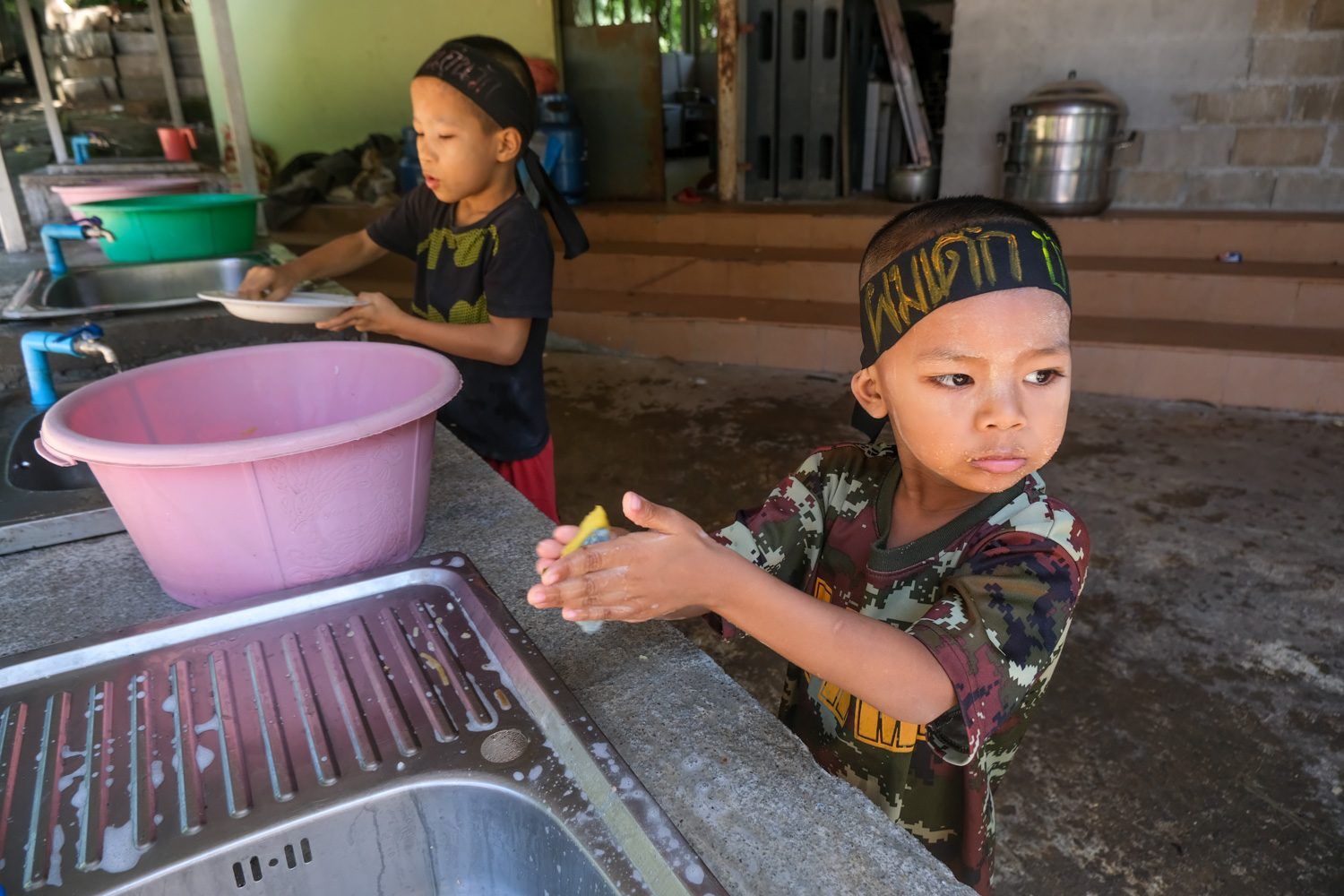
A boy washing his hands at an outdoor sink, another child behind him

Why we do it

The aim of yoga is Supreme Consciousness

  1. 1

    The aim is Supreme Consciousness. The goal of yoga is far off, like a distant star system.

  2. 2

    The instrument to reach that goal is the mind. It is the subtlest part of us, so it is the only part fine enough to reach the aim.

  3. 3

    The method is meditation. Seeing a star takes a telescope pointed at it; reaching Supreme Consciousness takes the mind pointed at it. That is meditation.

  4. 4

    The preparation and care. A telescope has to be looked after, cleaned and set right to see the stars. The mind is the same. Every practice does this for the mind, directly or through the body, because the mind is connected with the body.

    See how it leads to the goal ↓

Reaching the goal through Daily hygiene

Daily hygiene brings us to the goal through shaoca, cleanliness, which has an outer side and an inner one. Water, soap and clean hands keep the body clean, healthy and fit for sádhaná; that is a part of holiness, not the whole of it. The mind gets dirty faster than the body, and it is cleaned by selflessness. A mind made clean this way breaks the fetters of the small “I” and settles in the infinite. That is the goal of yoga.

  1. 01

    Two kinds of cleanliness

    Shaoca, cleanliness, has two sides: the outer, of the body, clothes and surroundings, and the inner, of the mind.

    “It can be subdivided into two parts, one relating to the external sphere, i.e., external cleanliness, and the other to mental sphere, i.e. internal cleanliness.”
    A Guide to Human Conduct, “Shaoca”
  2. 02

    Clean and fit for use

    Outer cleanliness makes clean and fit for use whatever we are in direct contact with, the body first of all.

    “The proper use of soap, water or other cleansers to keep the body, clothes or surroundings clean is external cleanliness. By this cleanliness the physical objects with which people are directly associated are cleaned and made fit for use.”
    A Guide to Human Conduct, “Shaoca”
  3. 03

    Against disease

    Where contaminated matter is left to collect, disease comes. That is why water is used after urinating, by men and women alike.

    “Leucorrhoea occurs if contaminated matter gets a chance to accumulate inside the genital organ. So both males and females should use water after urinating.”
    Yogic Treatments and Natural Remedies, “Female Diseases”
  4. 04

    Cool water, calm cakras

    Cold water on these parts also cools the cakras of the lower body, and a cooler body leaves the mind calmer.

  5. 05

    A part of holiness

    A clean body is part of holiness, but only a part: clean clothes and a bath do not by themselves make one holy.

    “Bathing or wearing clean clothes does not make one holy, although it is a part of holiness.”
    Ánanda Vacanámrtam 4, “The Ten Characteristics of a Dhármika”
  6. 06

    The mind gets dirty faster

    Jealousy, selfishness and passion soil the mind, and they soil it faster than dust soils a house.

    “Just as oneʼs clothes and houses get dirty very quickly in a dust storm, so also the mind becomes much more polluted by the storm of even insignificant passion in much less time.”
    A Guide to Human Conduct, “Shaoca”
  7. 07

    Selflessness cleans the mind

    The mind is cleaned by the opposite of what soiled it: by selfless service and a universal outlook.

    “The feeling of selflessness, the feeling of universalism is the only remedy to remove mental impurities.”
    A Guide to Human Conduct, “Shaoca”
  8. 08

    The realm of infinity

    A mind cleaned this way breaks the fetters of the small “I” and settles in the infinite. This is the goal.

    “You will have to establish yourselves in the realm of infinity by smashing the fetters of unit ego.”
    A Guide to Human Conduct, “Shaoca”

What it is

This page is about outer cleanliness in daily life: water after urination and after passing stool (the first of the Sixteen Points); washing the hands with soap after passing stool; washing the hands and feet before a meal.

In the sources

“The first aspect of Niyama Sádhaná is Shaoca. It means purity or cleanliness. It can be subdivided into two parts, one relating to external sphere, i.e., external cleanliness, and the other to mental sphere, i.e. internal cleanliness.”A Guide to Human Conduct, “Shaoca”

“One more difference between external and internal cleanliness is that to remove external dirt – while cleansing the body, clothes or houses – one has to come in contact with impurities for some time. But in the mental sphere the cleansing process does not require your coming in contact with any filth.”A Guide to Human Conduct, “Shaoca”

How to do it

  1. 1

    General Health Rules (2)Caryácarya 3, “General Health Rules”

    “After urinating use water or cleanse yourself by some other means.”

  2. 2

    Social Norms, 9Caryácarya 2, “Social Norms”

    “After passing stool and using water, wash your hands with soap, rubbing the soap in the right hand first, and then cleaning the left hand with the right.”

  3. 3

    Social Norms, 34Caryácarya 2, “Social Norms”

    “Do not pass urine or stool from a standing position.”

  4. 4

    Social Norms, 28Caryácarya 2, “Social Norms”

    “Before you take a meal, you should wash your hands and feet.”

  5. 5

    Social Norms, 8Caryácarya 2, “Social Norms”

    “After cleaning the nasal duct, wash your hands. When distributing food, if you sneeze or cough, using your hand, wash your hands immediately.”

Why water

First, it keeps one clean.

Second, drops of urine that are not washed away breed microbes and bacteria. They irritate the genital organ, and as they accumulate they can lead to disease.

Why sitting

Sitting, one can empty oneself fully, after passing stool and after urination. A bladder that is not fully emptied leads to disease.

Those who urinate standing soil themselves as well: drops fall on their clothes, and they soil the space around them. Sitting keeps one's body, one's clothes and one's surroundings clean.

Hands and feet before a meal

The feet are washed because in some countries people eat sitting cross-legged on the floor: dirty feet should not be where one sits to eat. Where people eat at a table, the feet need not be washed for the meal.

A small bottle of water

Not every public toilet has a way to wash with water after urination or passing stool. So it is good to carry a small bottle of water.

What studies found

Clean hands, and emptying fully

Stories

  • An empty bottle

    After the DMC, one dádá made arrangements for some people to have Personal Contact with Bábá, and I was on the list. That day happened to be a fasting day. One of the requirements to have PC with Bábá was that one should be following the Sixteen Points and one of the Sixteen Points was that one should carry a small water bottle to use after going to the bathroom. We didn't have one, so on the way to Yangmingshan we stopped at a grocery store and each of us bought a bottle of Yakult. Since it was a fasting day, we gave the drink to the children and kept the empty bottle. When I entered Bábá's room, He was lying on His side on the bed, facing the door. The first thing I saw was His smile, like a full moon. …Read the story

    — A new practitioner going to meet Bábá, Taiwan, 1979, Avadhutika Ánanda Lalita Ác., “A Garland of Lights: Bábá’s Love for Taiwan”, “5.8. Tapeshvar”
  • Water on the road

    … That day, after completing His scrutiny of the daily reports, Bábá started reviewing some of the workers sincerity in adhering to the Sixteen Points. On Bábá's instructions, I called a new worker forward. I asked, "You follow the Sixteen Points and maintain all sorts of cleanliness, I think?" Before the young worker could say anything, Bábá, who had been silent so far, suddenly interrupted, "Tell me, do you really follow the principles of cleanliness? Try to remember a day two months ago, you were travelling from Tatanagar to a village two miles away around noontime. On the way, you had to urinate, but you did not use water to wash yourself clean. What made you think that there was no one who could see if you did not use water after urinating? Is this your adherence to the principles of cleanliness? Don't you know that what you were thinking at the time and what you did are clearly imprinted in my mind." "Yes, Bábá," he confessed, "I violated that rule and entertained those thoughts." …Read the story

    — The general secretary at a reporting session, Lake Gardens, Calcutta, early 1980s, Ác. Sarveshvaránanda Avadhúta, “My Days With Bábá”, “17. Those Two Eyes”

  • Water should be poured like this

    Normally whatever Bábá told had an inner message and usually a practical lesson. Once Bábá went to a small place in North Bihar for Dharma Maha Cakra. He stayed with a devoted Márgii. There was no table and chair in that house and people used to squat on the floor to eat, then wash their hands at a fixed place with water from a pot. In the case of Bábá, the host would pour water for Bábá to wash His hands. For two days it went on like that. The host had a small boy. He watched this procedure very carefully and developed a desire to pour water for Bábá to wash His hands. His father told him to give the water but he said, "No. Today I'll pour water for Bábá." He started pouring water on Bábá's hands from a certain height or distance whereas some water was falling on Bábá's dhoti (clothes). His father saw that and became angry. He snatched the water jug from the boy. Bábá objected and asked the father to return the water jug to the boy. Then Bábá caught the boy's hands and told him lovingly, "See, my boy, water should be poured like this." He held the boy's hands and showed him how to pour the water. He took the father of that boy to task. …Read the story

    — Ac. Cidananda Avadhúta, telling of Bábá’s stay with a devoted Márgii in North Bihar, Ac. Cidananda Avadhúta, “Unforgettable Memories”, “7. Bábá’s Training”

  • A bathroom without water

    … Then there was the water. It stopped in Bábá’s bathroom. Since He did not complain, it was only discovered when a Márgii cleaned His room. For a man who bathed three or four times daily, this was a great inconvenience. Yet He politely tolerated it. After the water was repaired, He commented, “This is the first time in my life that I had to use a bathroom without water.” His silent patience with the clumsiness of our arrangements deeply affected me.Read the story

    — Dada Dharmavedananda, Rotterdam, Dada Dharmavedananda, “Travels with the Mystic Master”, “Heaven in hell”

What Shrii Shrii Ánandamúrti said

  • “Keep the body neat and clean like a temple.”
    Caryácarya 2, “The Body”
  • “Unless their hunger is more powerful than the faculty of reasoning, they will wash their hands before eating. This is a part of culture.”
    A Few Problems Solved 6, “The Spirit of Society”

Videos

  • The Forgotten Practice That Unlocks Your Energy | #1 of 16 PointsOpen on YouTube ↗

    The Forgotten Practice That Unlocks Your Energy | #1 of 16 Points

  • Sixteen points 1. Practices strengthening the mindOpen on YouTube ↗

    Sixteen points 1. Practices strengthening the mind

  • Self Purification Practice Sadhana of ShaocaOpen on YouTube ↗

    Self Purification Practice Sadhana of Shaoca

  • How to remove suffering? Sadhana of ShaocaOpen on YouTube ↗

    How to remove suffering? Sadhana of Shaoca

  • How Purity Creates Perfect HealthOpen on YouTube ↗

    How Purity Creates Perfect Health

Questions

Ask a question →