为什么冥想有时让人感到不满足,以及怎样让梵咒(mantra)的观念成为心智的中心:两种方法——把所有念头都放在一边的专注,和带着爱重复梵咒。
If you follow the meditation technique properly and hold good concentration, the process of meditation never becomes tiresome, because it brings freedom into life, not limitation. A person can enjoy finite things only for a limited time. But we all want infinite happiness.
What keeps us in a state of imperfection
During meditation our mind comes closer to infinite happiness, and from this we get a joy we will never tire of. But sometimes we feel dissatisfied with meditation. This happens because while we are meditating we are not really meditating but thinking our own thoughts. And the mind, instead of concentrating on the 一个声音或一组声音;心里想着它的含义反复念诵,就会把心智带向无限。, spends most of the time pondering something of its own.
The mind jumps from one thought to another and gets no joy from it, because a thought is a form, and a form is a limited thing. We need to set our thoughts aside, telling ourselves, "I'll think about it later." Then we can sink into the very center of our being, and for that, concentration is needed.
What to concentrate on?
In meditation it is important to concentrate on the mantra. The mantra is the center to which we direct all our attention, setting aside all other subtle and crude thoughts. Our thoughts correspond to the active 身体里的一个心灵能量中心;七个主要的脉轮沿脊柱分布。. Whichever cakra is active and whatever vibrations it radiates, so the thought will be. Sometimes subtle thoughts come to us and we want to save the world, and sometimes crude ones and we want to fulfill our selfish desires. Our attachment to our own thoughts is so strong that the mind cannot give them up. When the idea of the mantra becomes central for the mind, a person begins to feel inspired and enjoys that state. Otherwise they may get bored.
Why do we think?
We think about something because we want to think about it. The mind gets a certain kind of pleasure from this process, even when the thoughts are unpleasant. Thinking is the process by which the mind sustains itself. We are attached to something and want to think about it, and we keep wanting to return to it. We are programmed for happiness, and happiness for the mind consists in thinking. That is why we recommend telling the mind, "I'll think about it later," rather than "Renounce it!" Then the mind understands that after meditation it will return to its thoughts, but for now it needs to focus on something more important.
What is concentration?
Imagine a point, the center of your being, your unit consciousness. This center can be called a self-sufficient point, and a whole world is contained in it. From this point are born all the pains and pleasures we experience. All our experiences of objects (someone, for example, loves cheese, while someone else hates it) depend on our awareness, from which pain or pleasure flows. Clinging to some object, concentrating on it, we never get the full picture, because an object is only one of the manifestations of that which possesses all fullness — consciousness. The more deeply we realize the idea of the mantra that we have made our central idea, our center, the fuller our own being becomes.
How long will it take us to renounce our thoughts and come closer to the central idea by concentrating on the mantra? The mantra “只有至上意识的名号”,或“只有至上意识存在”:在基尔坦中唱诵的梵咒,对所有人开放。 contains concentration on the highest name, on the highest essence ("Bábá" is the Supreme Consciousness, "Nám" is name, "Kevalam" is only). Concentrating on the words "Bábá Nám," we concentrate on the highest essence, on the highest name. Focusing on the word "Kevalam," we set aside all other thoughts, reach the very center, and arrive at the very essence. This is called concentration. And the closer we come to the center, the more strongly we feel inner joy.
How to awaken the desire to meditate?
But sometimes we cannot make the supreme idea of the mantra our center. Because of attachments our mind is in a frenzy, and we feel that our desire to think about something else is stronger than our desire to think about the essence. But if we at least make attempts to think about the idea of the mantra, the desire to meditate can awaken, so lengthen the time you give to meditation. Try not to come out of meditation until you have touched the Divine at least a little. If you set yourself this goal and make regular efforts with this intention, the desire to meditate will awaken in the mind.
How to concentrate?
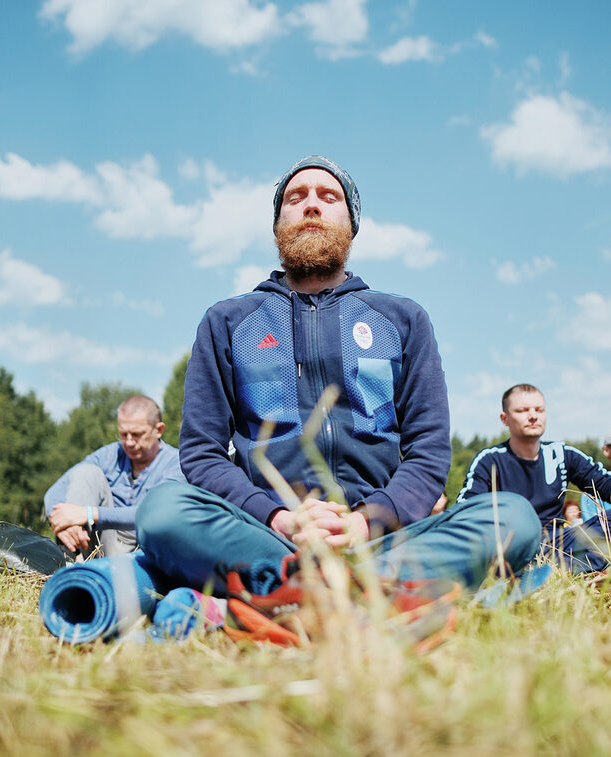
To understand what it means to concentrate and reach high states, let us draw an analogy between meditation and shooting an arrow from a bow: the arrow is our mind, and the target is 至上者,由意识(Shiva)和它的创造能量(Shakti)构成;一切从它而来,又回到它那里。, the Absolute. We take aim — we set aside all thoughts; we draw the bowstring until it hurts — we put effort into our spiritual practice, concentrate hard, and release the arrow. It flies straight to the target! Our longing and intention to reach the center help us. We tell ourselves, "Yes, I want to know this!" And we hit the target exactly!
Sometimes a pile of thoughts won't let us make the mind an arrow, and then another way works. You can simply repeat the mantra with love. And through love the supreme grace works. This is the approach of devotion. In this case we simply make our mind so beautiful that the Supreme Consciousness is drawn to it by itself. We fill our heart with love and think, "Each mantra is an offering to the Supreme, it is my gift to Him." And since giving gifts is a pleasure, we feel a flow of love.
So we know two ways:
The first is to concentrate, setting aside all thoughts. The second is simply to repeat the mantra with a feeling of love. Both ways work. And since the mind has different moods, it is important to learn to combine these two ways.
So we sit in meditation longer, concentrate better, dig in, chip away at the granite. We renounce all subtle and crude thoughts and go to the center. And if this way doesn't work, we sit and simply repeat the mantra with a feeling of love. Each mantra is an offering. Every second of our time is a gift to the Supreme Being.