아난다 마르가가 말하는 명상이 무엇인지, 사하자 요가의 여섯 가지 교습이 어떻게 서로 이어지는지, 자세와 식사와 행동 규범이 왜 같은 수행에 속하는지를 다룹니다.
Ananda Marga teaches a system of meditation known as Sahaja Yoga, "intuitional" or natural yoga, aimed at the all-round development of body, mind, and spirit. At its center is 영적 수행. 마음을 무한을 향해 나아가게 하려는 매일의 노력이며, 그중에서도 명상이 중심입니다.: sustained inner practice through which the limited self gradually expands toward the Infinite. The deepest goal is the union of the individual mind with Cosmic Consciousness. Everything else in the system, the postures, the chanting, the diet, the ethical code, exists to make that practice possible and to keep it honest.
What meditation is
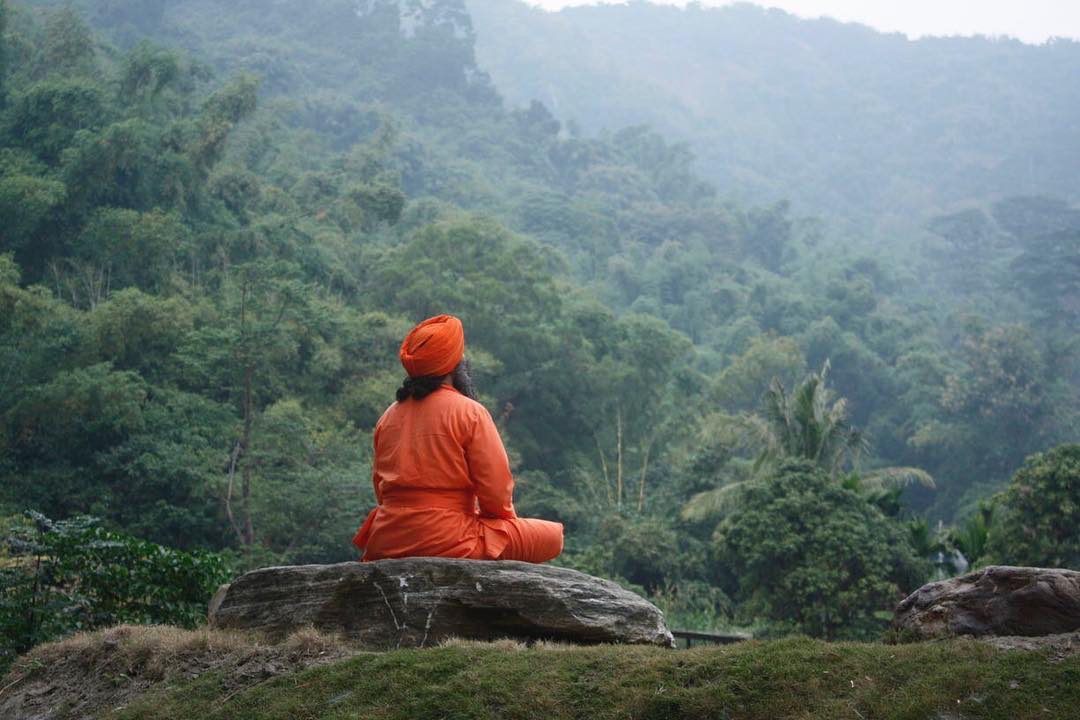
In ordinary use, "meditation" can mean almost anything: relaxing, watching the breath, listening to a recording. In Ananda Marga the word has a precise sense. The mind normally runs outward, toward objects, memories, plans. Meditation reverses that flow. The practitioner withdraws attention from the environment and the body, and then directs it, with the help of a 소리 또는 소리의 짝으로, 그 뜻을 새기며 되풀이하면 마음을 무한으로 이끕니다., toward a single ideal that is vaster than any object: the Cosmic "I" that is the same in every being.
A mantra is not a slogan or a wish. It is a sound with a meaning, chosen for the individual and given personally at initiation. Repeated with its meaning held in mind, it does two things at once: it gives the restless mind a single thread to follow, and it steadily reshapes the practitioner's sense of who they are.
The six lessons
The meditation of Ananda Marga is taught in six lessons. They are given one at a time, in person, by an 개별 지도를 하도록 훈련받은 명상 지도자. 수도자 남녀와 가정을 꾸린 사람도 아차리아가 될 수 있습니다., a trained teacher, and always free of charge. Each lesson is a distinct technique; together they form one practice.
- Iishvara Pranidhana, withdrawal and focus. The foundational lesson. The mind is drawn inward, brought to a specific center of the body, and merged, through the personal mantra, with the Cosmic Consciousness.
- Madhuvidyá, the universal outlook. A short practice used throughout the day before any action, reminding the practitioner that the task, the doer, and the surrounding universe are expressions of one reality. It dissolves the ego of "doership."
- Tattva Dháraná, control of the elements. Concentration on the centers that govern the five fundamental factors: solid, liquid, luminous, aerial, and ethereal.
- Práńáyáma, regulation of the breath. Because breath and mind are linked, a regulated breath calms the mind and deepens concentration.
- 몸 안의 심적 에너지 중심. 일곱 개의 주요 차크라가 척추를 따라 놓여 있습니다. Shodhana, purification of the propensities. The centers of the body that govern emotions and tendencies are vibrated rhythmically with the mantra, bringing them under control.
- Dhyána, absorption. The final stage, in which meditation is no longer an effort but a natural flow of the mind toward its goal, ending in the total absorption of the individual identity in the Cosmic Mind.
Nobody is asked to master all six before beginning. The first lesson alone is a complete practice, and many people keep it for years before asking for the next.
Why yoga postures belong here
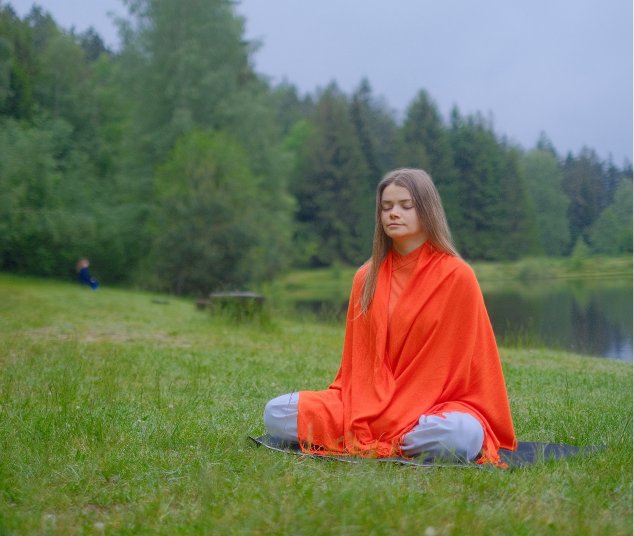
The body is the instrument. 안정되고 편안하게 유지하는 요가 자세. 분비샘의 균형을 잡고, 명상을 앞두고 몸과 마음을 고요하게 합니다., the yoga postures, are practiced not for their own sake but because they balance the glands, steady the nervous system, and give the mind a calm body to sit in. The postures taught in Ananda Marga are gentle and held with the breath; they are chosen for their effect on the endocrine system rather than for flexibility or display. A person who has done twenty minutes of postures will find meditation easier that day. That is the whole reason for them.
The same logic applies to diet. Food affects the mind. A light, mostly plant-based diet, taken with attention, keeps the mind clear enough to go inward. Fasting on certain days of the lunar month gives the digestive system rest and the mind a chance to notice how much of its noise comes from the body.
지고의 존재의 이름을 함께 부르는 노래이며, 흔히 간단한 춤이 곁들여집니다. 아난다 마르가에서는 바바 남 케발람을 부릅니다. and the heart
Meditation trains the mind; kiirtan lifts the heart. Before sitting to meditate, practitioners sing a universal mantra, “오직 지고의식의 이름뿐” 또는 “오직 지고의식만이 있다”는 뜻입니다. 키르탄에서 부르는 만트라이며, 누구에게나 열려 있습니다., together, often with a simple dance. The singing loosens the grip of the day's concerns and brings the mind into a devotional mood, and meditation that follows kiirtan tends to go deeper. Kiirtan has its own article in the library; here it is enough to say that the two practices are inseparable in daily life.
Ethics as a foundation
세상을 대하는 다섯 가지 원칙입니다. 해치지 않기, 진실함, 훔치지 않기, 마음을 지고의 존재에게 두기, 필요 이상으로 살지 않기. and 자신을 빚는 다섯 가지 원칙입니다. 청결, 만족, 어려움 속에서도 하는 봉사, 마음을 고양하는 공부, 지고의 존재를 삶의 목표로 삼기., ten principles of conduct, give the practice a harmonious foundation. They are not commands from outside but tools that bring harmony to one's own being and to one's relations with others: not harming, truthfulness in the service of welfare, not taking what is not one's own, seeing the divine in all, simplicity, cleanliness, contentment, service and sacrifice, study, and surrender to the Supreme.
The reason ethics come first is practical. A mind that lies, harms, or hoards is a divided mind, and a divided mind cannot concentrate. The principles clear the ground so the technique can work.
What to expect
Meditation is taught one to one, at no cost, by a trained teacher, and the invitation is open to anyone, whatever their background or belief. The techniques are simple to describe and take a lifetime to deepen. Most people notice, within weeks, a quieter mind and a longer fuse; the deeper changes come more slowly and are harder to name.
"Meditation is trying to make the 'I' feeling coincide with the subjectivated form. Because it is a coincidence of 'I' feeling, it is concentrated thinking. In other words, the endeavour to make the controlling point of the 'I' feeling coincide with some other subjectivated form is called meditation." — Shrii Shrii Anandamurti